How many HVAC jobs are needed to break even?
Calculate separate service-call and replacement-job contribution, three HVAC break-even boundaries, callback capacity, and parts cash exposure.
Work through the guide →
Start a residential HVAC company by defining a narrow service area, two paid field roles, and separate economics for collected service calls and completed equipment-replacement jobs. Test contribution, productive technician hours, callbacks, parts cash timing, vehicle coverage, and the complete opening commitment before increasing dispatch volume.

The operating record begins with one completed customer job tied to an address, authorization, technician time, work performed, equipment or parts used, invoice, payment status, and warranty outcome. Keep diagnostic or repair service calls separate from replacement jobs. A lead, booking, estimate, customer deposit for undelivered work, cancelled appointment, warranty callback, or unpaid invoice is not another collected revenue unit.
Repeat demand is valuable when the company can deliver it without displacing already promised work or hiding quality failures. Track returning households, maintenance reminders, accepted estimates, emergency requests, first-time fix rate, callbacks, parts delays, arrival windows, invoice collection, and the contribution of each completed job. Agreement revenue requires its own service obligation and deferral schedule before it enters this reference format.
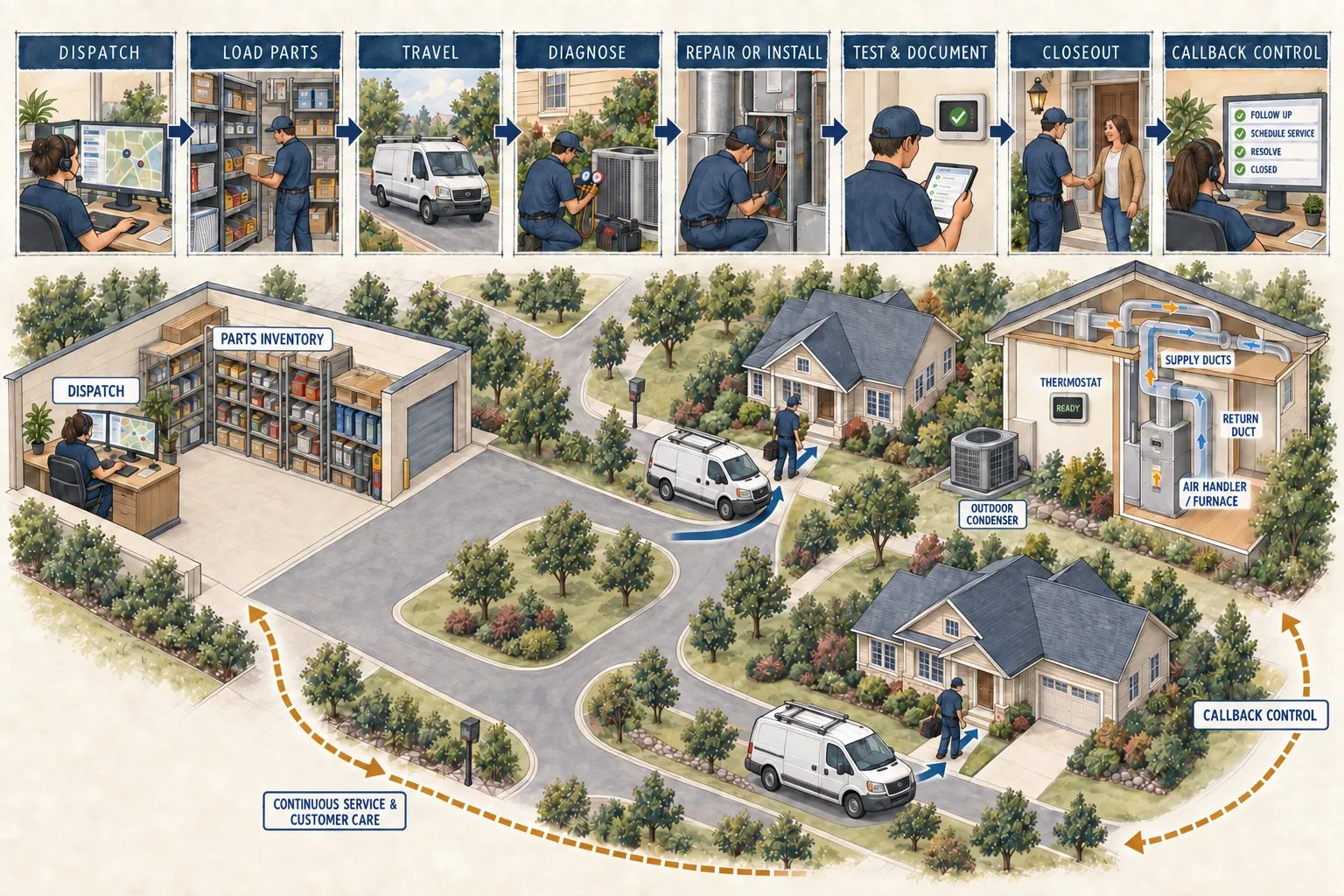
| Format | What changes | How to use it |
|---|---|---|
| Residential service and replacement | Two paid field technicians complete diagnostic, repair, and planned residential equipment-replacement work inside a defined service area | The reference format here; job mix, direct parts and equipment, technician-hours, travel, callback recovery, vehicles, and collection timing constrain the plan. |
| Maintenance-agreement-led operation | Recurring plans create scheduled obligations, renewal behavior, priority rules, and deferred service commitments | Build a separate agreement roll-forward and capacity reserve before treating contract billings as current service revenue. |
| Commercial, refrigeration, or new-construction contractor | Projects, bid packages, jobsite coordination, retainage, equipment scope, staffing, and authorization can differ materially | Use a separate operating and cash model rather than extending the residential service-call mix. |
A founder prepared to manage technical quality, a paid field team, routing, customer authorization, parts procurement, vehicles, documentation, collections, and callback accountability. The format rewards a narrow service promise and disciplined job records because a large ticket cannot repair unavailable technician time or repeated quality failures.
The figures below are a national wage reference scenario. The paid roster uses May 2025 BLS national occupational medians. Prices, customer volume, rent, equipment and other commercial inputs are authored assumptions. This is not a researched average startup cost, owner-income promise or a funding recommendation.
| Input or result | Reference | What to verify |
|---|---|---|
| Completed sales units | 88 weighted-mix collected jobs / month | 88 weighted-mix collected jobs per month; demand requires evidence. |
| Net selling price | $1,069.32 | Build and test a relevant local menu, package or contract scope. |
| Revenue | $94,100 | Calculated volume × price, not observed sales. |
| Paid payroll | $21,190 / month | National wage medians × the stated hours × the 18% employer allowance. |
| Opening payments | $240,591 | Authored equipment and setup allowances, deposit and paid training. |
| Funding including reserve | $359,970 | Opening payments + deepest modeled operating deficit + retained buffer. |
| Mature operating profit (EBIT) | $15,500 / month | After the full paid roster and depreciation; before financing and income taxes. |
| EBIT break-even | 62.6 weighted-mix collected jobs per month | A sales threshold to compare with capacity and tested demand. |
Two paid field technicians supply 346.67 monthly hours. The authored 84-service-call and 4-replacement-job mix uses 176.40 service-cycle hours, 96.00 replacement crew-hours, 9.48 callback hours, and 30.00 hours for training, stocking, and meetings, leaving 34.79 hours. The 98-job engine ceiling preserves the fixed mix; generic HVAC jobs are not interchangeable, and the figures are not observed demand.
Service calls carry $145.00 of parts and consumables per collected call plus 2.5% for payment and financing and 1.5% for warranty parts and credits. Replacement jobs carry $5,500.00 of equipment and parts plus $600.00 for permits, disposal, and specialty work, the same percentage allowances, and a disclosed 42.87% fixed-mix adapter for the shared engine.. Vehicle, general liability, and other business insurance $2,500.00; fuel $1,800.00; recurring local marketing $4,000.00; dispatch, CRM, phones, and software $900.00; utilities and shop supplies $650.00; accounting, legal, licensing, and continuing education $750.00; tolls, parking, and telematics $400.00; recruiting, uniforms, and safety $500.00. Occupancy or storage and the monthly maintenance allowance are modeled separately.
The research handoff's occupational wage rows are broad occupation anchors for the stated period and geography. They do not establish company-specific hiring quotes, qualifications, lawful scheduling, employer obligations, technician eligibility, contractor authority, refrigerant authorization, or compensation terms. The reference pays the disclosed field and support hours rather than using unpaid owner work to create capacity.
BLS May 2025 national wage workbook · Calculation definitions · How owner income differs from EBIT
| Workstream | What the brief needs | Decision before spending |
|---|---|---|
| Service vehicles and field access | Two roadworthy vehicles, secure tool and refrigerant storage, loading, parking, mileage, fuel, maintenance, downtime, replacement, and safe access at customer sites | Price the full vehicle system and one ordinary downtime event; a technician without a usable vehicle does not create dispatch capacity. |
| Diagnostic, recovery, and installation equipment | Meters, gauges, recovery and evacuation equipment, leak detection, ladders, lifting and handling equipment, personal protective equipment, calibration, inspection, maintenance, and replacement | Tie each tool and safety control to the defined service and installation scope and to the qualifications required for the task. |
| Dispatch, estimate, inventory, and job records | Customer authorization, scheduling, route sequence, equipment history, estimates, deposits, parts, serial information, technician notes, invoices, collections, warranties, and callbacks | Test the complete record from first contact through payment and callback closure; a full calendar cannot substitute for a closed job record. |
Compare installed scope, exclusions and payment dates. Do not treat an unquoted item as zero or count a bundled installation twice. How to compare equipment quotes and build the opening budget explains a reusable quote ledger.
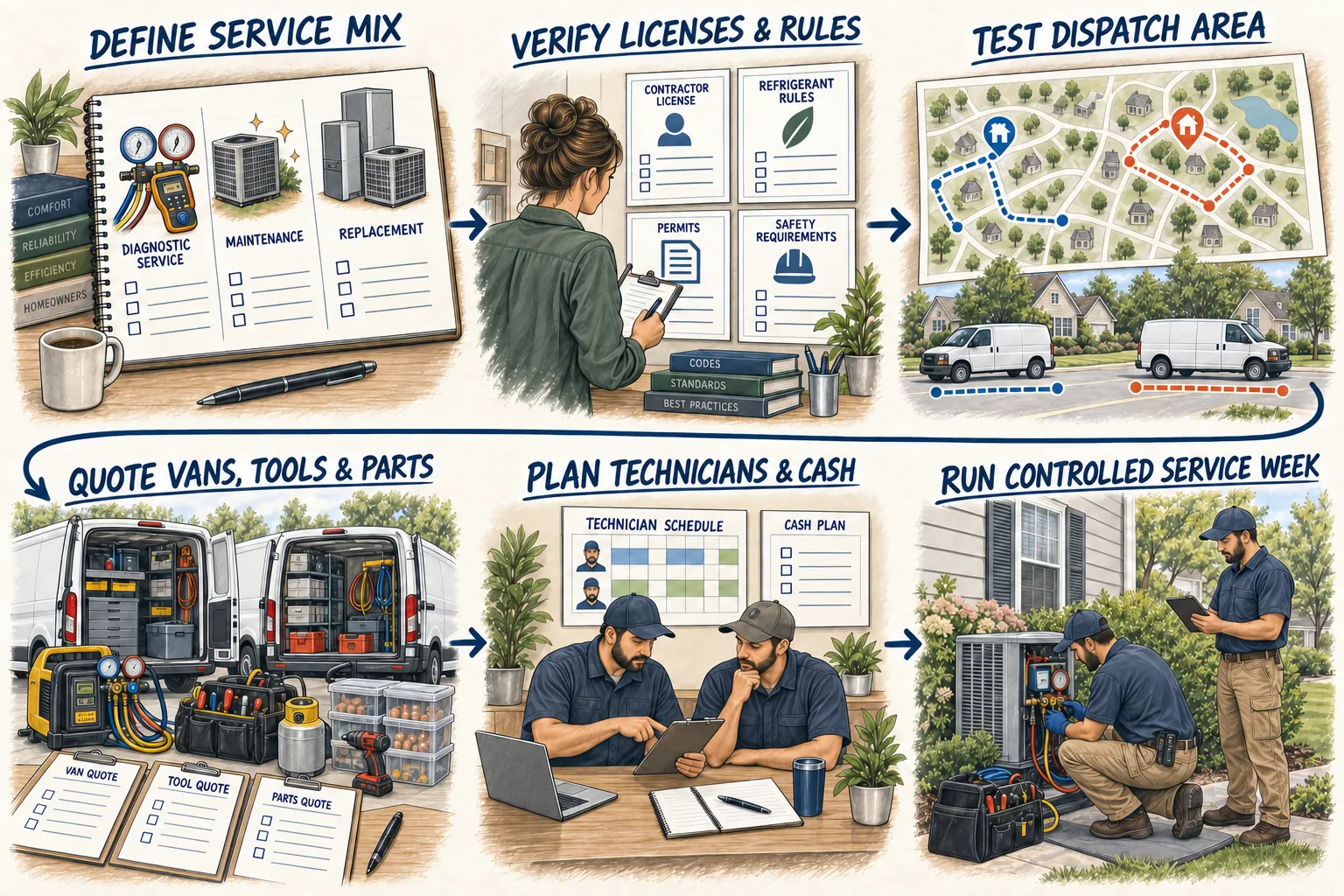
Write the included diagnostic and repair scope, replacement scope, service area, ordinary hours, emergency policy, exclusions, authorization, pricing, deposit, invoice, collection, and warranty terms. Keep each stream in its own job and contribution ledger.
Schedule whole work blocks for preparation, travel, diagnosis, approved work, parts collection, documentation, installation, cleanup, customer handoff, emergency reserve, and callbacks. Do not assign one technician or vehicle to overlapping work.
Take the exact legal entity, ownership, tasks, equipment, refrigerants, employees, subcontractors, service area, vehicles, storage, and customer terms to the responsible federal, state, and local offices, insurer, and counsel where needed.
Run authorized field tests or a controlled opening. Record calls received, qualified bookings, completed and collected jobs, accepted estimates, direct materials, paid hours, travel, first-time fix, callbacks, deposits, supplier payments, collections, and vehicle availability.
| Measure | Why it changes a decision |
|---|---|
| Completed and collected service calls by type | Separates closed diagnostic or repair work from leads, cancelled visits, open estimates, and unpaid invoices. |
| Replacement jobs, realized revenue, and direct equipment cash | Shows whether large invoices create contribution and whether equipment must be funded before the customer balance arrives. |
| Paid technician hours by productive and support category | Connects dispatch capacity to travel, loading, diagnosis, installation, documentation, emergency reserve, and callbacks. |
| Callbacks tied to the original job | Makes quality leakage, warranty parts, recoverable supplier claims, lost capacity, and customer outcome visible. |
Review actuals against the scope you priced. If an extra service, new trading hour or more distant client changes the work, update the roster and contribution calculation before expanding.
Describe the exact entity, ownership, residential service and replacement tasks, equipment types, refrigerants, employee roles, subcontractors, service area, ordinary and emergency hours, vehicles, storage, disposal, customer contracts, deposits, warranties, and advertising. Ask the responsible federal, state, and local offices, insurer, and counsel which contractor, business, trade, refrigerant, building, mechanical, electrical, environmental, employer, tax, consumer, vehicle, storage, and disposal requirements apply.
Each state profile links to official registration, tax and employer routes, together with the questions still requiring an address-specific answer. How to find the permits and approvals your business actually needs provides the record to keep.
Stop when break-even requires more productive technician-hours than two paid technicians and two usable vehicles can deliver, when replacement work creates an unfunded equipment-and-parts cash gap, when callbacks consume the dispatch reserve, or when the planned tasks depend on an unresolved contractor, technician, refrigerant, permit, insurance, or storage requirement.
Write a response that changes the actual cause: narrower scope, a different site, revised paid staffing, a tested price or a delayed opening. A larger cash buffer only addresses a temporary timing gap.
Calculate separate service-call and replacement-job contribution, three HVAC break-even boundaries, callback capacity, and parts cash exposure.
Work through the guide →Build a two-technician HVAC dispatch plan from productive hours, routes, job scope, parts readiness, emergency reserve, and callback control.
Work through the guide →Calculate contribution, the price required at realistic sales volume and the number of completed services needed to cover fixed costs.
Work through the guide →Account for service, setup, cleaning, travel and owner work, then turn a complete paid week into a monthly staffing budget.
Work through the guide →A Restaurant earns many guest transactions through one fitted food-service site. An HVAC Company earns from scheduled field work across customer addresses, with service-call and equipment-replacement economics kept separate. Both coordinate paid labor and costly equipment, but the restaurant carries daily premises trade while HVAC carries vehicles, travel, parts cash, technical authorization, and callback responsibility.
Compare the operating choices →A Coffee Shop depends on many short transactions during a few buying windows. An HVAC Company schedules longer technical jobs whose scope can change after diagnosis and whose equipment or parts may be paid before collection. The choice is between counter throughput at one location and field capacity across a route.
Compare the operating choices →Both businesses deliver work at customer sites, so route density, paid travel, access, and quality control matter. A Cleaning Business earns from repeated scoped visits; an HVAC Company handles technical diagnosis, repairs, equipment replacement, task authorization, parts cash, and callbacks. Recurring account scope and mixed technical jobs need separate unit economics.
Compare the operating choices →A Hair Salon sells skilled appointment time at a fitted customer destination. An HVAC Company sends skilled technicians to customer properties and separates service calls from equipment replacements. Both depend on scheduling and repeat trust, but HVAC adds route time, service vehicles, parts procurement, jobsite conditions, and callback responsibility.
Compare the operating choices →An Auto Detailing Business completes scoped vehicle packages through technician and bay capacity. An HVAC Company completes diagnostic, repair, and replacement work through technician, vehicle, route, parts, and authorization capacity. Both require strong intake and quality control, but HVAC jobs occur on customer systems and can create larger supplier and callback exposure.
Compare the operating choices →A Laundromat earns from customer-operated washer turns supported by installed machines, utilities, and a fixed site. An HVAC Company earns from paid technical field work supported by technicians, vehicles, tools, parts, and supplier access. One format concentrates capital in self-service equipment; the other ties capacity to qualified paid hours and route execution.
Compare the operating choices →A Daycare Center earns recurring child-weeks while maintaining daily room, staffing, and supervision coverage. An HVAC Company earns from discrete field jobs through two paid technicians and vehicles. Both have consequential safety and authorization duties, but one carries continuous care obligations while the other carries task-specific technical and callback obligations.
Compare the operating choices →A Pet Grooming Salon sells scheduled, hands-on appointments at a fitted animal-care premises. An HVAC Company sells technical service and replacement work at customer properties. Both rely on skilled paid time and careful handoff, but HVAC capacity also includes route travel, vehicles, parts, task authorization, and warranty callbacks.
Compare the operating choices →Both formats dispatch paid field workers and equipment across a service area. A Landscaping Company earns from completed property-service visits; an HVAC Company separates diagnostic or repair calls from equipment-replacement jobs. Route density matters to both, while HVAC adds technical authorization, refrigerant handling, equipment procurement, and callback records.
Compare the operating choices →A Food Truck earns many completed orders from a mobile food operation positioned for specific selling windows. An HVAC Company earns from technical jobs reached through a service route. Both depend on vehicle uptime and daily preparation, but the truck brings production to demand while HVAC technicians enter customer properties with changing job scope and parts needs.
Compare the operating choices →A Bakery converts scheduled production into many retail orders, with freshness, waste, and staffed selling hours shaping contribution. An HVAC Company converts paid technician capacity into service and replacement jobs, with travel, parts, equipment cash, and callbacks shaping contribution. One is production-and-retail led; the other is field-service led.
Compare the operating choices →A Fitness Studio earns recurring member-months while delivering usable scheduled class access. An HVAC Company earns from completed service calls and replacement jobs through a two-technician field schedule. Both must reconcile demand with paid capacity, but membership retention differs from job dispatch, parts procurement, and callback recovery.
Compare the operating choices →No. Keep the booking in the dispatch record and recognize the job only under the stated policy after authorized work is completed. Track the invoice and collection separately so booked, earned, and collected amounts are not confused.
Only after the underlying mix, contribution, technician time, and cash timing remain visible. A replacement job can carry a larger invoice while consuming equipment cash and crew-hours that a diagnostic call does not.
Tie each callback to the original job, record paid hours and parts, identify any supplier or manufacturer recovery, and remove the time from future dispatch capacity. Do not count the callback as a new sale.
No. State scope is only one layer. Confirm the exact work, entity, individual qualifications, refrigerant task, address or storage, permits, local trade requirements, insurance, vehicles, and customer terms with the responsible authorities.
The reference company uses two paid field technicians, paid dispatch and paid owner-manager coverage, two vehicles and a defined residential service area. Service calls and replacement jobs have different prices, direct parts and equipment, crew-hours, callback exposure and collection timing. The numbers below are authored planning inputs; the cited May 2025 occupation wages are the only geographic cost observations in this reference scenario.
| Revenue stream | Collected jobs | Revenue per job | Monthly revenue | Monthly direct costs | Monthly contribution |
|---|---|---|---|---|---|
| Service calls | 84 | $525 | $44,100 | $13,944 | $30,156 |
| Replacement jobs | 4 | $12,500 | $50,000 | $26,400 | $23,600 |
| Combined | 88 | Fixed mix only | $94,100 | $40,344 | $53,756 |
The shared reference calculator accepts one volume, price and direct-cost share, so this exact 84:4 mix is represented there as 88 weighted collected job-equivalents at about $1,069.32 each and 42.87% direct costs. This is a disclosed calculation adapter, not an observed generic HVAC ticket. Change the mix in the two-stream calculator, then recompute contribution and technician capacity.
At the fixed mix at national wage medians, the model requires 62.63 weighted job-equivalents for depreciation-inclusive EBIT break-even, about 59.78 service calls and 2.85 replacement jobs together. Operating EBITDA is $17,866, cash after the monthly maintenance allowance is $15,666, and EBIT after depreciation is $15,500 at the stated mature volume. These boundaries differ because maintenance cash and depreciation are separate costs.
The fixed mix plans 311.88 of 346.67 paid field hours, including 9.48 callback hours and 30 support hours. The 98-job ceiling applies only to this mix. The shared model calculates receivables; customer deposits, $24,400 of monthly replacement equipment and variable-job outlay, supplier credit and inventory aging need a separate cash schedule.
Opening funding at national wage medians: $359,970 under the authored vehicle, tool, stock, premises, roster, ramp and buffer inputs. For a selected territory, replace those inputs with current qualified-person, permit, vehicle, insurance, supplier, staffing, collected-price, job-mix and demand evidence. Build the dispatch and callback plan before promising more jobs.
No states match these filters.
Sorting compares one defined format. It does not rank states for attractiveness or prove demand. Funding includes a 60-month cash reserve under each scenario.
| State | Funding scenario | Loaded payroll / month | EBIT break-even weighted-mix collected jobs per month |
|---|---|---|---|
| Alabama | $343,021 | $17,866 | 57.2 |
| Alaska | $386,215 | $25,796 | 70.2 |
| Arizona | $357,048 | $20,677 | 61.8 |
| Arkansas | $341,409 | $17,523 | 56.6 |
| California | $380,720 | $24,831 | 68.6 |
| Colorado | $367,274 | $22,472 | 64.7 |
| Connecticut | $384,811 | $25,549 | 69.8 |
| Delaware | $364,306 | $21,951 | 63.9 |
| Florida | $351,743 | $19,723 | 60.2 |
| Georgia | $351,601 | $19,692 | 60.2 |
| Hawaii | $368,559 | $22,697 | 65.1 |
| Idaho | $351,986 | $19,774 | 60.3 |
| Illinois | $380,304 | $24,758 | 68.5 |
| Indiana | $358,540 | $20,939 | 62.2 |
| Iowa | $359,519 | $21,110 | 62.5 |
| Kansas | $356,882 | $20,648 | 61.7 |
| Kentucky | $353,444 | $20,044 | 60.8 |
| Louisiana | $352,398 | $19,861 | 60.5 |
| Maine | $363,146 | $21,747 | 63.5 |
| Maryland | $370,304 | $23,003 | 65.6 |
| Massachusetts | $385,248 | $25,626 | 69.9 |
| Michigan | $358,601 | $20,949 | 62.2 |
| Minnesota | $381,926 | $25,043 | 68.9 |
| Mississippi | $341,248 | $17,489 | 56.6 |
| Missouri | $357,532 | $20,762 | 61.9 |
| Montana | $360,681 | $21,314 | 62.8 |
| Nebraska | $357,476 | $20,752 | 61.9 |
| Nevada | $357,637 | $20,780 | 62 |
| New Hampshire | $378,675 | $24,472 | 68 |
| New Jersey | $381,661 | $24,997 | 68.9 |
| New Mexico | $345,930 | $18,485 | 58.2 |
| New York | $381,105 | $24,899 | 68.7 |
| North Carolina | $352,585 | $19,893 | 60.5 |
| North Dakota | $379,549 | $24,626 | 68.3 |
| Ohio | $361,549 | $21,467 | 63.1 |
| Oklahoma | $352,346 | $19,851 | 60.4 |
| Oregon | $366,246 | $22,291 | 64.4 |
| Pennsylvania | $361,279 | $21,419 | 63 |
| Rhode Island | $367,846 | $22,572 | 64.9 |
| South Carolina | $350,898 | $19,543 | 59.9 |
| South Dakota | $359,053 | $21,029 | 62.4 |
| Tennessee | $351,474 | $19,665 | 60.1 |
| Texas | $353,205 | $20,002 | 60.7 |
| Utah | $356,355 | $20,555 | 61.6 |
| Vermont | $363,743 | $21,852 | 63.7 |
| Virginia | $358,068 | $20,856 | 62.1 |
| Washington | $384,854 | $25,557 | 69.8 |
| West Virginia | $342,274 | $17,707 | 56.9 |
| Wisconsin | $362,826 | $21,691 | 63.4 |
| Wyoming | $355,076 | $20,331 | 61.2 |
Published research and calculations support business planning and education. They are not personalized financial, investment, tax or legal advice, and they do not guarantee costs, revenue, profit or financing. Estimates depend on the stated format, location, source periods and assumptions. Check the requirements and commitments that apply to your circumstances.