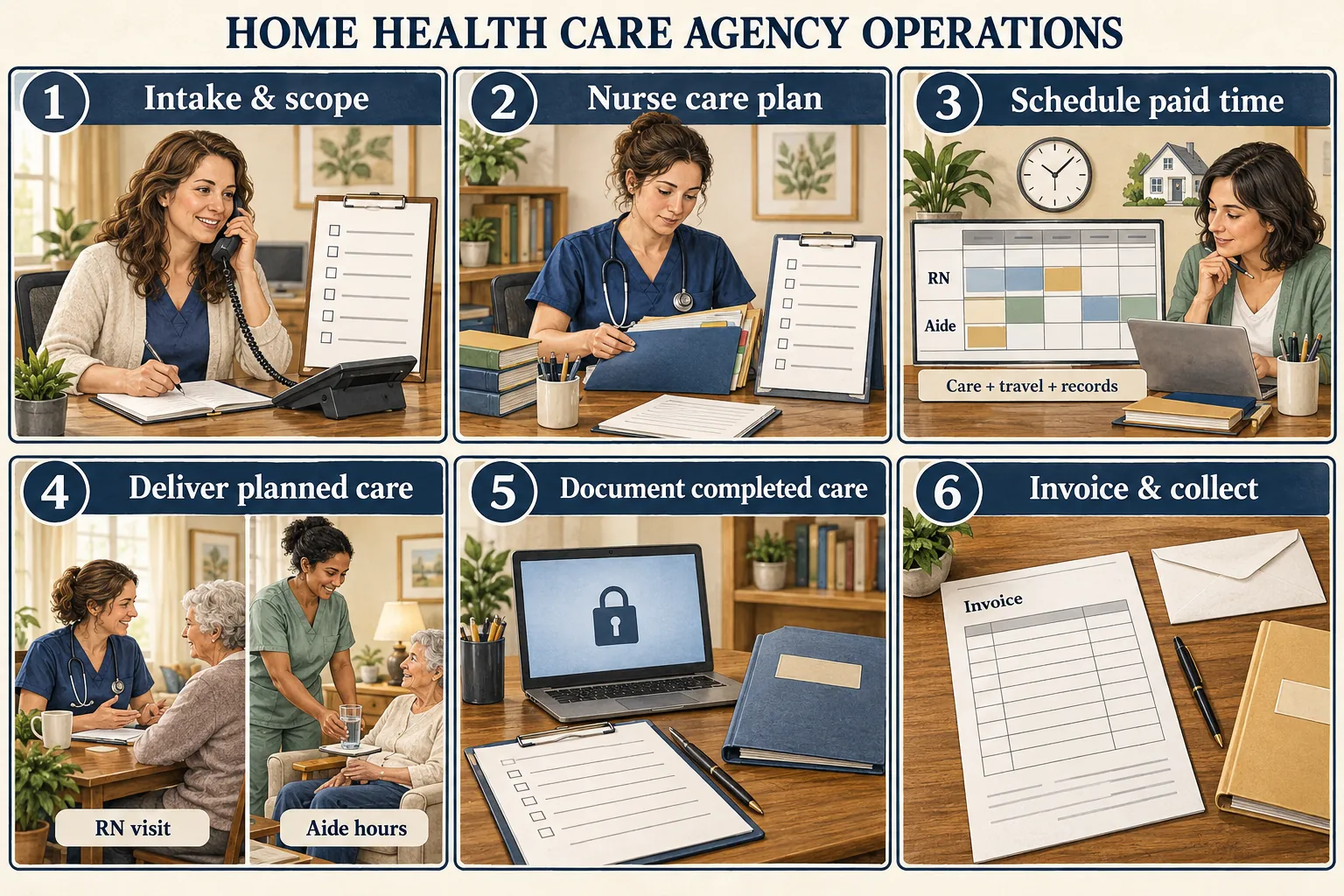
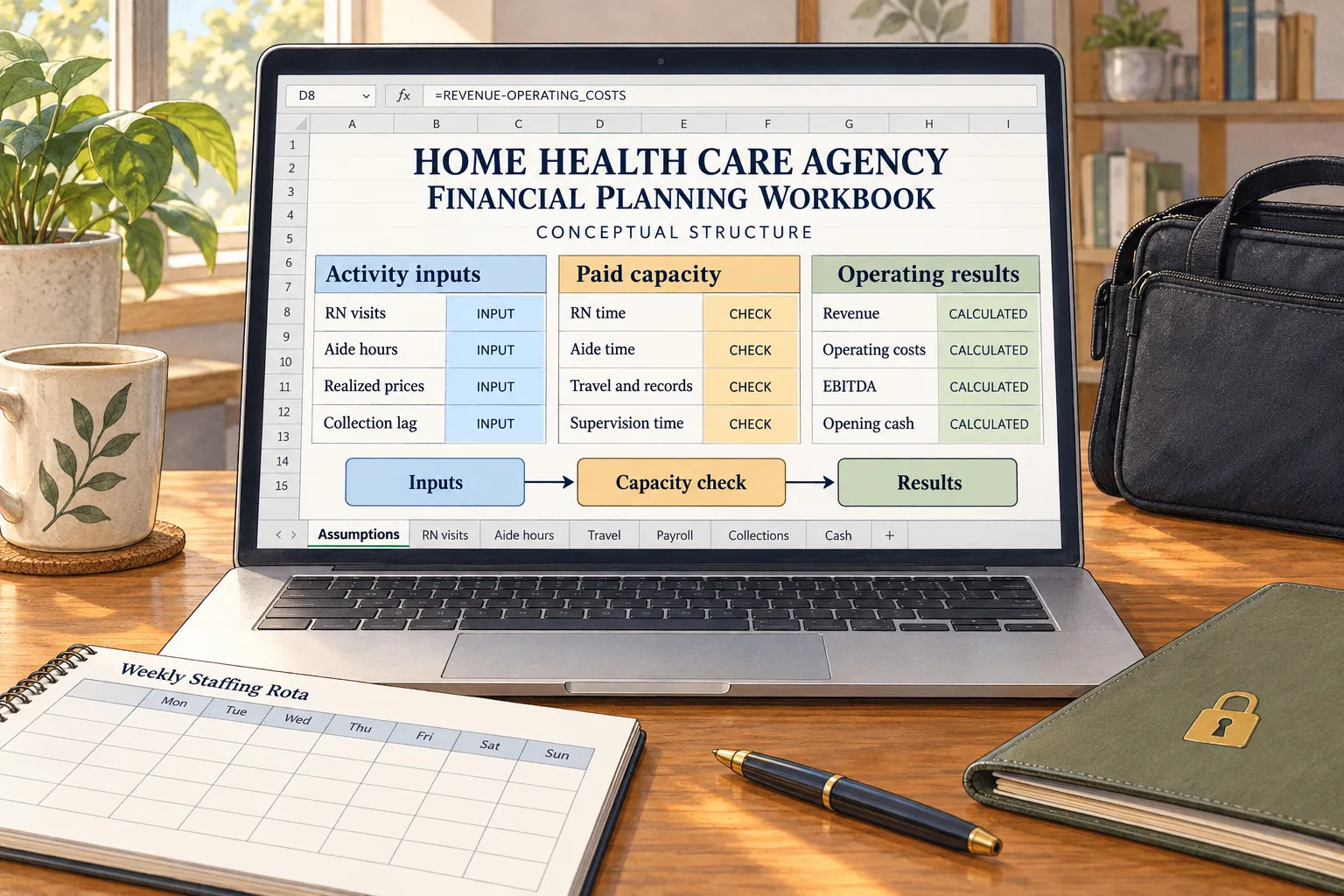
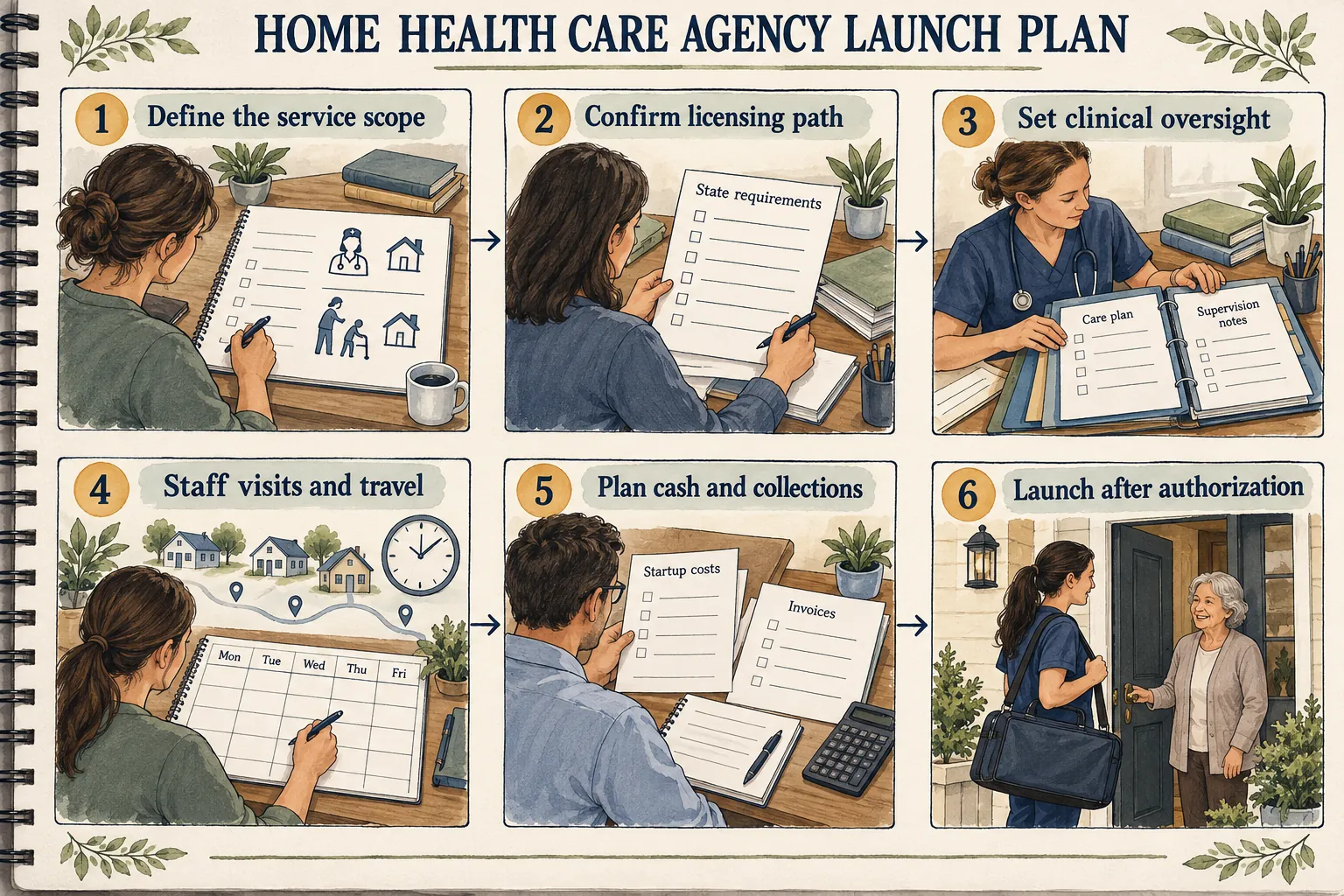
Confirm the exact nursing and aide authority, qualified clinical direction and paid availability before committing to an agency. The reference assumes 80 completed RN visits at $200 plus 800 aide care hours at $45, earning $52,000 fees before a separate expected credit loss. With all field, director, alternate, aide and administrative coverage paid, mature EBIT is -$7,737 and cash after maintenance is -$7,570. At the 85-visit/850-hour paid-resource ceiling, EBIT remains -$4,917. The same-mix threshold exceeds capacity, so more clients alone do not repair the case. These commercial, workload and contract values are assumptions to replace with applicable evidence.
Can completed care pay for complete qualified coverage?
The consequential result is an operating loss with the complete paid roster, not a claim that the market can supply more clients. Billable care is only part of paid field work. Clinical direction, qualified alternate response and 24/7 on-call availability have their own costs.
Completed RN visits and aide care hours earn different fees. Deduct expected credit loss once, apply payment cost to collectible earned fees, and add the actual supplies and whole-visit mileage allowances before the full paid roster and standing costs.
Mature private-pay month: one exact input snapshot
Measure
Monthly amount
Definition
Earned RN fees
$16,000
80 completed visits × $200
Earned aide fees
$36,000
800 completed care hours × $45
Total earned fees
$52,000
After concessions/refunds, before the separate expected credit loss
Expected credit loss
$1,040
2% of earned fees; permanently reduces collectible earning once
Collectible earned fees
$50,960
Earned fees less the expected credit loss
Payment-cost estimate
$1,529
3% of collectible earned fees; assumed paid in the earned month
Use-driven care supplies
$1,440
$8 per RN visit plus $1 per aide care hour
Travel reimbursement
$2,800
20 RN miles/visit + 12 aide miles/whole block, at an assumed $0.70/mile
Contribution before paid roster
$45,191
Collectible fees less payment costs, care supplies and mileage
Loaded paid roster
$44,962
Five distinct paid pools; 18% employer addition assumed
Contribution less all paid roster and standing commitments
Depreciation
$467
$28,000 selected assets / 60 months
Depreciation-inclusive EBIT
-$7,737
EBITDA less depreciation
Capital-maintenance cash
$300
Capital cash allowance, distinct from depreciation
Cash after maintenance before receivable movement
-$7,570
EBITDA less capital maintenance; debt, tax and distributions excluded
The paid-resource ceiling at the held one-RN-visit/ten-aide-hour mix is 85 whole planning equivalents. The approximate financial thresholds are 92.8822 for EBITDA, 93.4086 for cash after maintenance and 93.7074 for EBIT. The first permitted financial cash condition is 94 equivalents; it exceeds the paid-resource ceiling. The first permitted financial EBIT condition is 94; it exceeds the paid-resource ceiling. A financial condition is not a clinical prescription or an actual client/staff timetable. At the ceiling, EBIT is -$4,917 and cash after maintenance is -$4,750.
Full paid workload at the held-mix ceiling
Paid resource
Available hours / month
Workload at ceiling
Workload at next equivalent
Paid field RN care, travel, documentation and recovery
173.3333
164.875
166.65
Paid aide care, whole-visit travel, documentation, handoff and recovery
1,040
1,035.88
1,047.4
Paid qualified clinical direction and agency administration
173.3333
71.8775
72.25
Paid qualified alternate RN response
43.3333
16.51
16.6
Paid medical administration, scheduling and collection
86.6667
64.29
64.805
At the ceiling, aide care needs 213 whole visit blocks. The next planning equivalent needs 215 blocks and 1,047.4 aide person-hours, exceeding the paid 1,040. Field RN, director, alternate response and administration are independent constraints. These assumed aggregate clocks do not prove qualifications, client compatibility, travel timing, actual staffing availability or legal adequacy.
Earning, collections and operating cash are different
Measure
First twelve planning months
Mature month before receivable movement
Earned fees
$536,880
$52,000
Expected credit loss
$10,738
$1,040
Collectible fees actually received in the first-year schedule
$475,182
Mature collection timing depends on receivable movement
EBITDA
-$162,949
-$7,270
Depreciation-inclusive EBIT
-$168,549
-$7,737
Operating cash after maintenance and receivable movement
-$217,509
-$7,570
The default holds 30 average days of collectible earned fees in month-end receivables. Expected credit losses are excluded from that receivable rather than deducted a second time. The payment-cost estimate, supplies, mileage, paid roster and standing costs are assumed paid in the earned month; this is a conservative timing convention, not an observed processor settlement term. At a stable mature volume, the receivable stops growing, but it still ties up $50,960. A dated payroll, invoice and bank schedule can show a larger daily need.
Opening payments are approximately $72,557. The cumulative operating deficit reaches approximately $580,885 in month 60; the retained buffer is approximately $104,923. Their approximately $758,366 total would finance the modeled continuing losses over 60 months. More starting cash does not repair that operating gap. This is not a financing recommendation. Opening payments are not sustainably recovered within that horizon. Validate supported fees, service mix, territory and every qualified paid commitment before proceeding.
Separate held-constant sensitivities of the national reference
64 RN visits + 640 aide care hours; same paid roster
-$16,775
-$16,609
10% higher wage anchors
Same paid hours, 1.10 × wage anchors; employer share fixed at 18%
-$12,233
-$12,066
20% higher office allowance
$2,400 office allowance; other inputs fixed
-$8,137
-$7,970
10% lower fees
$180/RN visit + $40.50/aide hour; same care and paid costs
-$12,680
-$12,513
10% higher fees, hypothetical only
$220/RN visit + $49.50/aide hour; no achieved-yield claim
-$2,794
-$2,627
Of the declared activity, wage and premises tests, 20% fewer completed care services has the largest EBIT effect. The test sizes have no assigned probabilities. Even the hypothetical 10% fee increase leaves mature EBIT at -$2,794. Fees and volume must be supported by actual accepted, completed and collected private-pay care rather than altered solely to make the model positive.
Moving collectible receivables from 30 to 45 average days leaves mature EBIT unchanged at -$7,737 while raising the 60-month funding arithmetic to approximately $783,846. Credit losses change what can be collected; settlement lag changes when collectible fees become cash. The default assumes the estimated payment costs are paid in the earned month. Collection timing uses earned-fee cohorts, uniform earning within each 30-day planning month and no preopening earning; a fractional lag splits receipts between the applicable monthly cohorts.
The private-pay scope excludes public-payer billing, therapy, hospice, infusion, equipment sales and continuous bedside care. Licenses, clinical plans, eligible administrators/directors, accreditation, records, insurance and actual qualified availability must be resolved for the chosen jurisdiction and clients. Aggregate hours do not certify safe or lawful care.
Observed sources and commercial choices
What do actual home-care prices and rules support?
The operating unit is a private-pay licensed agency providing intermittent RN home visits and aide care under the applicable care plan and supervision. The scenario excludes public-payer reimbursement, a companion-only business, therapy, hospice, continuous bedside care, infusion and equipment sales. Confirm the state service category, eligible tasks and approved territory for the actual agency before using a roster or price.
The reference assumes 80 completed RN visits at $200 each and 800 completed aide care hours at $45/hour, delivered in up-to-four-hour aide visit blocks. These fees are after concessions and refunds, before a separate 2% expected credit loss. They produce $52,000.00 earned monthly fees. Price, patient volume, service mix, care duration, collection losses and thirty-day settlement delay are authored choices.
CareScout’s July–November 2025 survey reports national medians of $35 per nonmedical caregiver hour, $90 per private-duty nursing hour and $160 per private-duty nursing visit. Nursing combines roles and service scopes; an hourly contract cannot be converted into the model’s RN visit without matched terms. These observations give pricing context and establish no achieved agency yield or demand. CareScout: 2025 Cost of Care Survey: Home Care Median Costs.
Direct provider statements checked October 16, 2026
Nights/weekends included; major holidays extra. Includes employment costs, screening, RN oversight, scheduling and fill-in coverage.
FAQ range differs at $35-$40/hour. Extended private-duty nurse shifts are separate, with no RN-visit quote.
What does the paid operating plan cost?
May 2025 national cross-industry medians are $46.90/hour for Registered Nurses (29-1141), $17.21 for Home Health and Personal Care Aides (31-1120) and $22.08 for Medical Secretaries and Administrative Assistants (43-6013). The aide occupation covers a broader range of duties than a selected care plan. Source freshness was checked October 16, 2026. These are employee wage observations, not qualified local hiring offers. U.S. Bureau of Labor Statistics: May 2025 occupation wages.
The authored roster pays 40 weekly field-RN hours, 40 clinical-director hours, ten alternate RN response hours, 240 aide hours and twenty medical-administration hours, using 52 weeks divided by twelve months. With an assumed 18% employer addition, loaded payroll is $44,961.54/month. A separate $2,500 monthly qualified-availability retainer sits within the $5,500 other-cost allowance. The qualified director is assumed also to perform agency governance and administration within that same paid clock only where a combined role is permitted and accepted. The medical secretary supplies clerical work. A jurisdiction requiring separate qualified management needs an additional paid pool. Neither the retainer nor the employer percentage is a provider quote or proof that credentials, individual shifts, leave, overtime and uninterrupted qualified cover have been secured.
At the entered fees and care activity, mature EBITDA is -$7,270.34, depreciation-inclusive EBIT is -$7,737.01, and cash after capital maintenance is -$7,570.34, before receivable movement, financing, income tax and distributions. The same-mix paid-resource ceiling is 85 completed RN visits with 850 aide care hours; EBIT there remains -$4,916.76. More volume at that mix cannot repair the default roster within its capacity.
One independent lower-fee sensitivity, $175 per RN visit and $40 per aide hour with activity and costs fixed, calculates -$13,440.61 EBIT and -$13,273.94 cash after maintenance. Those are alternative assumptions, not a reinterpretation of the provider offers. The $65,000 opening allowance, office rent, supplies, mileage, ramp and availability budget also require matched quotations or a documented operating plan.
Planning information only. The sources do not quote a complete agency opening, establish clinical suitability or guarantee a license, patients, prices or business outcomes.
What the customer buys and what makes the business repeatable.
The client purchases authorized intermittent nursing visits and supervised aide care under the applicable plan, order, agreement and state rules. One completed RN visit and one aide client-care hour are different earning units. Scheduled time, approved care, a referral, an advance payment or an unused authorized hour is not another completed sale.
Clients may require continuing care, but accepted care can change with clinical need, discharge, hospitalization, caregiver availability and the applicable plan. Record completed visits/hours, missed care, changes, concessions, refunds and actual collection. Recurring authorization or an older population does not establish a retained private-pay client cohort.
The format on this site: Private-pay agency providing state-authorized intermittent RN visits and supervised home-health aide care, with paid clinical direction and qualified on-call coverage. Medicare or Medicaid billing, payer certification, therapy, hospice, infusion, medical-equipment sales, continuous bedside or live-in care, pure companionship-only service, staffing contracts, franchises, multiple branches, property purchase and unpaid owner work are excluded. Qualified 24/7 on-call availability is included as an assumed contracted commitment, distinct from continuous bedside care. Actual service authority, required care plans, credentials, director and administrator eligibility, accreditation and availability obligations depend on the jurisdiction and exact services.
Choose the format before choosing a budget.
Different formats need different operating plans
Format
What changes
How to use it
Private-pay intermittent nursing plus supervised aides
Completed RN visits and aide care hours, qualified clinical direction, distinct field pools and paid 24/7 on-call availability
Reference only; actual license/category and service requirements differ by jurisdiction.
Medicare/Medicaid certified home health
Different certification, covered services, eligibility, documentation, reimbursement and collection mechanisms
Excluded; do not carry private-pay fees into a public-payer model.
Nonmedical companionship or personal-care-only agency
Different accepted services, legal categories, clinical responsibilities and price/workload scope
Excluded from this skilled reference; an aide occupation or provider survey does not make the formats interchangeable.
Therapy, hospice, infusion or continuous bedside care
Different clinician mix, visit/shift pattern, authority, coverage, equipment and payment scope
Requires a separate scoped clinical and financial case.
A founder prepared to fund qualified clinical governance, reliable field and alternate coverage, careful client acceptance and records, travel, recruiting, service quality and slow collections. This is an accountable care operation rather than a schedule of billable hours alone.
Understand the reference operating plan.
The figures below are a national wage reference scenario. The paid roster uses May 2025 BLS national occupational medians. Prices, customer volume, rent, equipment and other commercial inputs are authored assumptions. This is not a researched average startup cost, owner-income promise or a funding recommendation.
One defined format · monthly amounts before financing and income taxes
Input or result
Reference
What to verify
Completed sales units
80 planning mix equivalents / month
80 planning mix equivalents per month; demand requires evidence.
Combined fees per planning mix equivalent (one RN visit plus ten aide care hours)
$650.00
Build and test a relevant local menu, package or contract scope.
Revenue
$52,000
Calculated volume × price, not observed sales.
Paid payroll
$44,962 / month
National wage medians × the stated hours × the 18% employer allowance.
Opening payments
$72,557
Authored equipment and setup allowances, deposit and paid training.
After the full paid roster and depreciation; before financing and income taxes.
Approximate EBIT threshold
Approximately 93.7 planning mix equivalents per month
A rounded estimate. Test whole permitted activity against the full roster and resource constraints.
Two care services and one analytical comparison mix
Earning or work unit
Authored default
What it establishes
Completed intermittent RN visits
80 visits × one direct care hour × $200 per visit
$16,000 earned RN fees; travel, records and recovery are paid separately
Completed supervised aide care
800 care hours × $45 per hour
$36,000 earned aide fees; care hours are not total paid caregiver hours
Whole aide visit blocks
ceil(800 ÷ 4 maximum care hours) = 200 visits
Every visit consumes travel, documentation, handoff and expected recovery, including a partly used last block
Planning mix equivalents
80 × (one RN visit + ten aide care hours)
A held-mix analysis unit only; not a sold package, patient count or clinical plan
The $200 visit and $45 care-hour fees are authored assumptions after concessions and refunds but before the separate 2% credit loss. They do not come from a scope-matched realized-price quote. Required care, actual visit duration, cancellation treatment and clinical authority must be established for each accepted client.
The qualified director pool includes standing governance and agency administration only where an eligible combined appointment is permitted; the clerical pool is not the qualified administrator. The default delivers 80 one-hour RN visits and 800 aide care hours in 200 four-hour visit blocks. Field RN work is 14 standing hours plus 80 direct-care, 40 travel, 20 documentation and two expected recovery hours: 156 of 173.3333 paid hours. Aide work is 24 standing hours plus 800 care, 100 travel, 30 documentation, 20 handoff and two expected recovery hours: 976 of 1,040 paid hours. Clinical direction uses 70 of 173.3333 hours; the qualified alternate RN response pool uses 16 of 43.3333; medical administration uses 61.4 of 86.6667. These pools are distinct and cannot be counted as simultaneous field care. At the held ratio of one RN visit to ten aide care hours, 85 whole planning equivalents fit all clocks, including 850 aide care hours across 213 visit blocks. Aides use 1,035.88 hours at that ceiling; the next equivalent needs 1,047.4 and fails. Every expected recovery rate grows with proposed activity. These are authored work and scheduling assumptions, not patient demand, legal staffing standards or proof of a deliverable address-level schedule.
Earned fees are after concessions and refunds but before the separate assumed 2% credit loss. Payment costs are 3% of collectible earned fees. Care supplies cost an assumed $8 per RN visit and $1 per aide care hour. Reimbursed travel assumes 20 miles per RN visit and 12 per aide visit at an authored $0.70 per mile; that rate is not presented as a tax or statutory reimbursement rate. Every paid field, documentation, supervisory and response hour remains in payroll. The $5,500 monthly standing allowance comprises $1,200 insurance, $500 secure scheduling/records, $500 marketing, $500 professional/compliance support, $200 utilities, $100 standing communications and a separate $2,500 qualified 24/7 on-call availability retainer. The retainer purchases assumed availability; actual response work has its own paid RN pool. Neither amount is a provider quote or proof of legally adequate coverage. The $2,000 office allowance and $300 capital-maintenance cash are separate.
The director pool assumes an eligible combined clinical-director and agency-administrator appointment only where permitted. Its 40 monthly standing hours cover governance and agency administration; activity-linked clinical work is added once within the same paid clock. Any combined appointment depends on the regulator’s actual employee-and-contractor count, qualifications, required direct employment, duties and qualified alternate administration. The 8.75 wage-pool FTE excludes availability-provider personnel and does not establish a statutory count. The medical-administration pool supplies clerical work, not the qualified agency administrator. If separate qualified roles are required, add a separately paid pool and recalculate. May 2025 BLS medians anchor Registered Nurses (29-1141), Home Health and Personal Care Aides (31-1120) and Medical Secretaries and Administrative Assistants (43-6013). Paid field RN and clinical director coverage each has 40 weekly hours, and the qualified alternate RN response pool ten, totaling 390 monthly RN person-hours at 52/12 weeks per month. Aides have 240 weekly hours, or 1,040 monthly; administration has 20 weekly hours, or 86.6667 monthly. The cross-industry aide occupation includes personal-care work beyond this licensed scope. Medians do not prove hiring costs, credentials or availability. The 18% employer addition is assumed. Split aggregate pools into enough qualified people, lawful individual shifts, leave/relief, travel, training and overtime; a full-time director cannot be silently reused as a simultaneous field nurse.
The national wage scenario has approximately $72,557 opening payments: $65,000 unquoted allowances, a $4,000 refundable premises deposit and approximately $3,557 paid training. The authority, policy, professional and accreditation line is a $10,000 planning allowance, not an observed license or accreditation fee total. Obtain a matched accreditation, regulatory and insurance scope before treating the allowance as adequate.
Earned fees are separate from collectible amounts and cash. The default writes off an assumed 2% once, then collects the collectible earned fees after 30 days. Uniform earning within each 30-day planning month and no preopening earning determine the monthly collection cohorts and receivables. That delay does not apply a second credit loss. Customer advances and amounts for undelivered care remain separate obligations. The base loses $7,570 mature cash each month; its approximately $758,366 opening-plus-60-month reserve would finance continuing losses. This is a warning from the assumptions, not a funding target or financing recommendation. Month-end balances can miss a larger daily payroll gap; debt, income tax and owner distributions need separate schedules.
The reference needs more sales than its stated capacity to reach EBIT break-even. The format must change; additional opening cash does not remove that mismatch.
Fund qualified coverage before relying on billable care
Interpretation of the national reference format
An agency decision should follow the exact service authority, accepted care and a qualified roster whose full paid work can earn collected contribution. RN visits and aide care hours are different services; field travel, records, protected direction, alternate response and qualified availability cannot be treated as free overhead. A licence or referral pipeline does not establish deliverable paid demand.
The National wage scenario earns $52,000 fees from 80 assumed RN visits at $200 and 800 aide care hours at $45, before separate credit losses. With field nurses, a full clinical director, qualified alternate response, aides, administration and on-call availability paid, mature EBIT is -$7,737 and cash after maintenance is -$7,570. The approximate same-mix EBIT condition is 93.71 planning equivalents versus a paid ceiling of 85; more volume at the same mix cannot repair the shortfall within that capacity. At 20% fewer completed services, EBIT is -$16,775. State wages are observations. Fees, demand, clinical work rates, travel, all commercial costs and coverage contracts are assumptions; actual license/category, plans, credentials, accreditation and qualified availability remain prerequisites.
At the national occupation medians, the complete reference loses mature EBIT and cash even at its held-mix paid-resource ceiling. Expected credit loss and receivable delay affect different boundaries. Every commercial, workload and coverage input remains an assumption, and a conditional combined director/administrator appointment does not prove that jurisdiction-specific leadership duties have been satisfied.
Quote the actual authority, accreditation, insurance, qualified appointments and availability arrangement. Reconcile a named client and staff week to completed care, every paid clock and dated collections. Change supported fees, service mix, territory or complete paid costs when the financial condition lies beyond capacity; a larger loss reserve is not an operating remedy.
Confirm what nursing and aide services can be offered, required plans/orders, client acceptance limits, state categories, qualified leadership, accreditation and insurance.
Contract qualified availability and staff the work
Protect the full director, field, alternate-response, aide and medical-administration pools. Verify who is available after hours and how actual response, relief and overtime are paid.
Rehearse completed care and the route
Schedule named clients and staff, visit windows, travel, documentation, handoffs, supervision, incident recovery and safe escalation under the clinical plan.
Test separate fees and dated collections
Keep RN visits, aide hours, whole visit blocks, concessions/refunds, expected losses, receivables, cash and unearned advances separate. Replace material allowances with applicable complete quotes.
Your first evidence task: Reconcile one authorized client-care week to completed RN visits, aide care hours and whole aide blocks, named staff and clinical direction, every travel/documentation/handoff/recovery hour, qualified on-call availability, net fees, losses and collected cash. With the full national paid roster, the reference remains EBIT-negative even at 85 RN visits plus 850 aide care hours.
What to measure in the first operating weeks.
A small operating dashboard
Measure
Why it changes a decision
Completed care by authorized service
Separates RN visits, direct RN time, aide care hours, whole aide blocks, canceled/missed visits and changes in accepted scope.
Every paid role and qualified availability
Reconciles field travel/documentation, protected direction, alternate response, aide work, administration, relief and on-call commitments.
Earned fees, credit loss and collections
Distinguishes fees after concessions, expected uncollectibility, settlement delay, advances/refunds and actual unrestricted cash.
Care scope and exceptions
Links the approved plan, credentials, supervision, handoffs, incident/escalation records, additional paid work and closure.
Opening scope and continuing commitments
Tracks authority/accreditation, insurance, secure systems, staffing and availability quotes, payment dates and losses before further commitments.
Review actuals against the scope you priced. If an extra service, new trading hour or more distant client changes the work, update the roster and contribution calculation before expanding.
Prepare the right approval brief.
Take the exact state and service area, ownership, nursing/aide categories, administrator and clinical-director credentials, client acceptance and care-plan process, operating hours, qualified on-call/alternate arrangements, field roster, insurance, records/privacy, emergency and continuity policies, office and accreditation scope to the responsible licensing authority and qualified advisers. Confirm the actual category rather than assuming every state uses the phrase home health agency for a private-pay operation.
Pause the agency commitment when service authority or qualified leadership is unresolved, availability depends on unpaid or uncontracted nursing, director hours are counted twice, planned visits overbook a paid clock, or the same-mix financial threshold lies beyond capacity. A larger cash reserve cannot establish clinical adequacy or cure an ongoing operating loss.
Write a response that changes the actual cause: narrower scope, a different site, revised paid staffing, a tested price or a delayed opening. A larger cash buffer only addresses a temporary timing gap.
Connect private-pay RN visits and aide care hours to whole field visits, qualified paid coverage, credit losses, receivables, operating thresholds and one 60-month cash schedule.
Build a client-to-care-to-cash record connecting state authority, accepted nursing and aide scope, qualified direction, field scheduling, availability, completed care and collection obligations.
Restaurant earns from completed paid meal covers at realized net check and is constrained by kitchen stations, seats, service windows, preparation and paid kitchen/service coverage. Home Health Care Agency earns separate completed RN-visit and aide-care-hour fees while funding field travel, records, qualified clinical direction, alternate response and availability. Compare accepted scope, complete paid work and dated collected contribution using each format’s own earning unit.
Coffee Shop earns from completed coffee and food orders at realized basket value and is constrained by espresso/food stations, queue flow, opening/closing and paid peak coverage. Home Health Care Agency earns separate completed RN-visit and aide-care-hour fees while funding field travel, records, qualified clinical direction, alternate response and availability. Compare accepted scope, complete paid work and dated collected contribution using each format’s own earning unit.
Cleaning Business earns from earned recurring cleaning account-months with specified visit frequency, property scope and net contract yield and is constrained by paid cleaning crews, access, travel, setup, supplies and corrective work. Home Health Care Agency earns separate completed RN-visit and aide-care-hour fees while funding field travel, records, qualified clinical direction, alternate response and availability. Compare accepted scope, complete paid work and dated collected contribution using each format’s own earning unit.
Hair Salon earns from completed hair appointments at a realized service mix and is constrained by qualified stylists, chair/station time, preparation, sanitation and appointment recovery. Home Health Care Agency earns separate completed RN-visit and aide-care-hour fees while funding field travel, records, qualified clinical direction, alternate response and availability. Compare accepted scope, complete paid work and dated collected contribution using each format’s own earning unit.
Auto Detailing Business earns from completed detailing jobs at realized job value and is constrained by crew time, vehicle/bay availability, preparation, travel where applicable and rework. Home Health Care Agency earns separate completed RN-visit and aide-care-hour fees while funding field travel, records, qualified clinical direction, alternate response and availability. Compare accepted scope, complete paid work and dated collected contribution using each format’s own earning unit.
Laundromat earns from paid wash-and-dry cycles in the stated machine mix and is constrained by machine cycles, opening hours, utility capacity, customer flow and paid maintenance. Home Health Care Agency earns separate completed RN-visit and aide-care-hour fees while funding field travel, records, qualified clinical direction, alternate response and availability. Compare accepted scope, complete paid work and dated collected contribution using each format’s own earning unit.
Daycare Center earns from earned enrolled child-weeks by accepted age group and is constrained by licensed rooms, age-group ratios, paid classroom coverage, relief and enrollment mix. Home Health Care Agency earns separate completed RN-visit and aide-care-hour fees while funding field travel, records, qualified clinical direction, alternate response and availability. Compare accepted scope, complete paid work and dated collected contribution using each format’s own earning unit.
Pet Grooming Salon earns from completed grooming appointments at a realized service mix and is constrained by groomer time, stations, washing/drying, handling, sanitation and recovery. Home Health Care Agency earns separate completed RN-visit and aide-care-hour fees while funding field travel, records, qualified clinical direction, alternate response and availability. Compare accepted scope, complete paid work and dated collected contribution using each format’s own earning unit.
Landscaping Company earns from completed recurring property visits in the accepted service mix and is constrained by crew-and-equipment time, route travel, weather, property scope and callbacks. Home Health Care Agency earns separate completed RN-visit and aide-care-hour fees while funding field travel, records, qualified clinical direction, alternate response and availability. Compare accepted scope, complete paid work and dated collected contribution using each format’s own earning unit.
Food Truck earns from completed paid orders at realized net ticket and is constrained by menu production, preparation, commissary/travel, service windows and paid crew. Home Health Care Agency earns separate completed RN-visit and aide-care-hour fees while funding field travel, records, qualified clinical direction, alternate response and availability. Compare accepted scope, complete paid work and dated collected contribution using each format’s own earning unit.
Bakery earns from paid retail baskets supported by product mix and sell-through and is constrained by batch production, ovens, paid production coverage, shelf life, waste and retail flow. Home Health Care Agency earns separate completed RN-visit and aide-care-hour fees while funding field travel, records, qualified clinical direction, alternate response and availability. Compare accepted scope, complete paid work and dated collected contribution using each format’s own earning unit.
Fitness Studio earns from retained billable member-months at realized net yield and is constrained by class timetable, instructor hours, usable places, promised access, churn and collections. Home Health Care Agency earns separate completed RN-visit and aide-care-hour fees while funding field travel, records, qualified clinical direction, alternate response and availability. Compare accepted scope, complete paid work and dated collected contribution using each format’s own earning unit.
HVAC Company earns from completed service calls and replacement jobs in a stated mix and is constrained by qualified technician time, travel, diagnosis, installations, parts and callbacks. Home Health Care Agency earns separate completed RN-visit and aide-care-hour fees while funding field travel, records, qualified clinical direction, alternate response and availability. Compare accepted scope, complete paid work and dated collected contribution using each format’s own earning unit.
Moving Company earns from completed local household moves and is constrained by whole crew-and-truck blocks, origin/destination access, travel, handling, reset and claims. Home Health Care Agency earns separate completed RN-visit and aide-care-hour fees while funding field travel, records, qualified clinical direction, alternate response and availability. Compare accepted scope, complete paid work and dated collected contribution using each format’s own earning unit.
Auto Repair Shop earns from completed authorized repair orders with realized labor and parts yield and is constrained by technician clocks, bay dwell, lifts, parts readiness, authorizations and warranty work. Home Health Care Agency earns separate completed RN-visit and aide-care-hour fees while funding field travel, records, qualified clinical direction, alternate response and availability. Compare accepted scope, complete paid work and dated collected contribution using each format’s own earning unit.
Plumbing Company earns from completed and collected residential plumbing jobs and is constrained by qualified plumber time, vehicle routes, diagnosis, materials, permits and callbacks. Home Health Care Agency earns separate completed RN-visit and aide-care-hour fees while funding field travel, records, qualified clinical direction, alternate response and availability. Compare accepted scope, complete paid work and dated collected contribution using each format’s own earning unit.
Electrical Contractor earns from completed and collected electrical service and alteration jobs and is constrained by qualified electrician time, sold-hour realization, vehicles, materials, inspections and rework. Home Health Care Agency earns separate completed RN-visit and aide-care-hour fees while funding field travel, records, qualified clinical direction, alternate response and availability. Compare accepted scope, complete paid work and dated collected contribution using each format’s own earning unit.
Pest Control Company earns from retained paid residential service-plan months and is constrained by qualified technicians, initial and recurring visits, travel, records and callbacks. Home Health Care Agency earns separate completed RN-visit and aide-care-hour fees while funding field travel, records, qualified clinical direction, alternate response and availability. Compare accepted scope, complete paid work and dated collected contribution using each format’s own earning unit.
Residential Remodeling Company earns from accepted delivered interior scope in earned-project equivalents and is constrained by paid carpenter/management hours, selections, authorized trades, inspection timing and rework. Home Health Care Agency earns separate completed RN-visit and aide-care-hour fees while funding field travel, records, qualified clinical direction, alternate response and availability. Compare accepted scope, complete paid work and dated collected contribution using each format’s own earning unit.
Self-Storage Facility earns from occupied unit-months by size at realized net rent and is constrained by rentable units, unit condition, access, paid leasing/management/maintenance and account duties. Home Health Care Agency earns separate completed RN-visit and aide-care-hour fees while funding field travel, records, qualified clinical direction, alternate response and availability. Compare accepted scope, complete paid work and dated collected contribution using each format’s own earning unit.
Dog Daycare and Boarding earns from paid day-only dog visits and boarding dog-nights without double-counting residents and is constrained by simultaneous dog places, suites, distinct handlers, rest/isolation, sanitation and night coverage. Home Health Care Agency earns separate completed RN-visit and aide-care-hour fees while funding field travel, records, qualified clinical direction, alternate response and availability. Compare accepted scope, complete paid work and dated collected contribution using each format’s own earning unit.
Tutoring Center earns from completed student sessions and whole instructional group blocks and is constrained by competent tutors, rooms, compatible groups, preparation, enrollment and family coordination. Home Health Care Agency earns separate completed RN-visit and aide-care-hour fees while funding field travel, records, qualified clinical direction, alternate response and availability. Compare accepted scope, complete paid work and dated collected contribution using each format’s own earning unit.
No. It is a private-pay intermittent nursing and supervised aide scenario. Public-payer certification, eligibility, reimbursement and documentation require a separate model. State authority and accreditation can still apply.
Are the RN visit and aide hour sold as one package?
No. They are separate services. A planning mix equivalent of one RN visit plus ten aide care hours is used only to compare the held reference mix and test capacity. It is neither a clinical prescription nor a patient count.
Does the on-call retainer include continuous bedside care?
No. It is an assumed availability contract for qualified nursing response, with separately paid response work. The actual contract, qualified alternate, restrictions and costs must be verified. Continuous bedside and live-in care are excluded.
Can a director also cover the field RN visits?
Only where the actual lawful assignment and simultaneous responsibilities permit it. This reference funds distinct pools and never adds protected director or alternate hours to field capacity.
Do the fees come from a provider quote?
No. The $200 RN visit and $45 aide hour are authored assumptions. Provider offers and broad care-cost surveys retain their own worker mix, duration, requirements, location and date.
Does the displayed funding make the reference viable?
No. The base loses mature cash, and the 60-month reserve would finance continued losses. The reference has no sustained opening-cash recovery. Revise supported economics and the complete qualified coverage plan before a commitment.
Sorting compares one defined format. It does not rank states for attractiveness or prove demand. Funding includes opening payments, the deepest cumulative operating cash deficit in the 60-month model and the retained cash buffer.
Home Health Care Agency · same commercial assumptions, state occupational wage medians
State
Funding scenario
Loaded payroll / month
Approximate EBIT threshold planning mix equivalents per month
Published research and calculations support business planning and education. They are not personalized financial, investment, tax or legal advice, and they do not guarantee costs, revenue, profit or financing. Estimates depend on the stated format, location, source periods and assumptions. Check the requirements and commitments that apply to your circumstances.