How many fitness studio members are needed to break even?
Calculate paid active member-months, realized recurring revenue, member losses, acquisition needs and three Fitness Studio break-even boundaries.
Work through the guide →
Start a boutique group fitness studio by defining one recurring membership offer, one paid active member-month and one class timetable that the paid roster and room can actually deliver. Test retention, realized member revenue and usable class access together before committing to the lease, fit-out or a larger schedule.

The reference revenue unit is one paid active member-month: one month of access earned under the membership terms, net of discounts, credits, refunds and failed collections. A lead, trial registration, future contract, paused account, failed payment, cancelled membership, class reservation or attended visit is not another active member-month. Recognize prepaid access across the months in which service is owed.
Recurring billing becomes durable only when members continue paying and can use the classes they value. Track each start-month cohort through paid renewals, cancellations, freezes, failed collections and returns, while measuring reservations, attendance, late cancellations, waitlist refill and peak-time availability. A gross signup count can rise while the active base or service experience weakens.
| Format | What changes | How to use it |
|---|---|---|
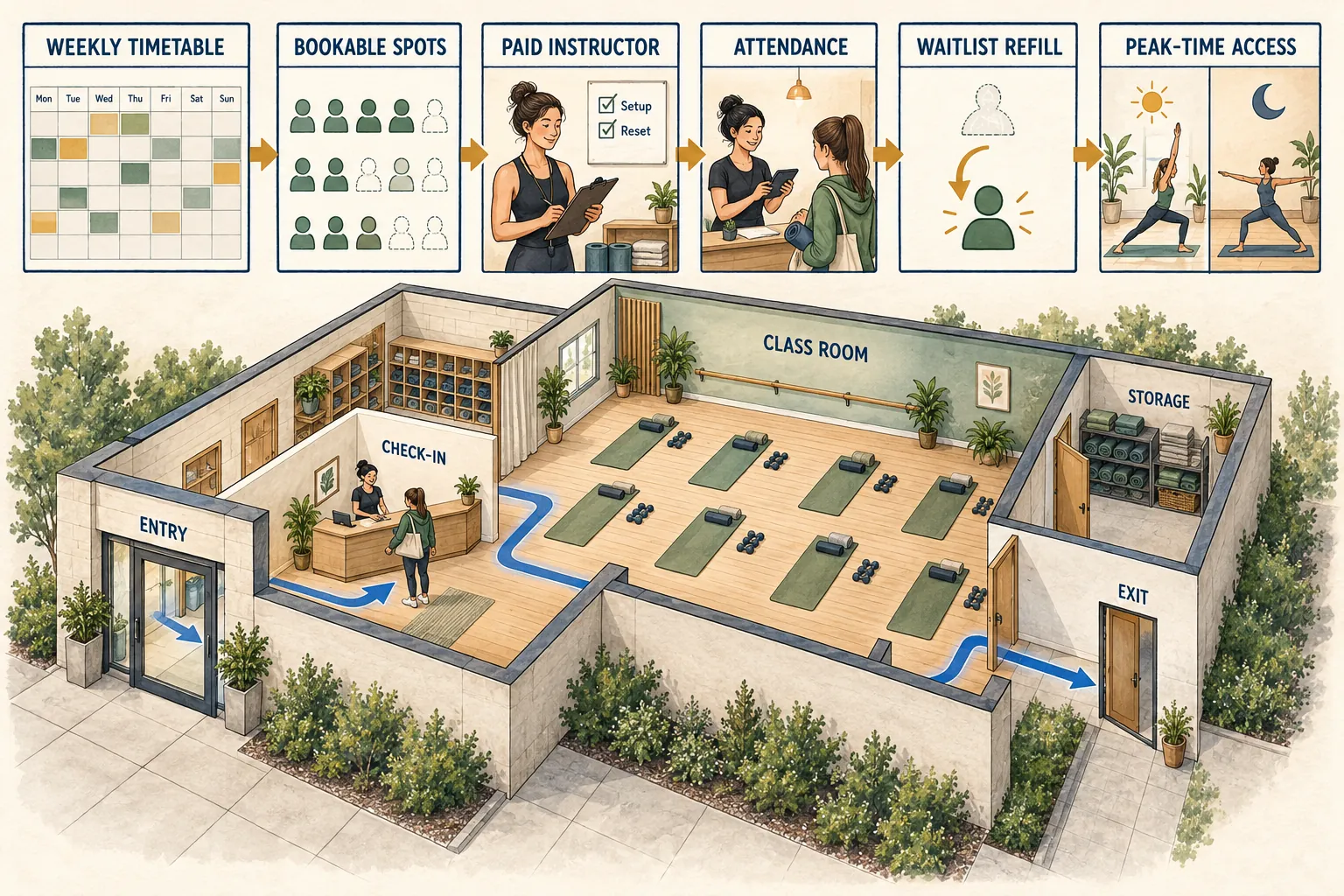
| Boutique group fitness studio | One primary class room, a defined timetable, paid instructors and a recurring monthly membership | The reference format here; member retention, usable whole-class spots, paid coverage and the premises jointly constrain the plan. |
| Open-gym membership | Members use equipment across longer access hours with different supervision, equipment, cleaning and peak-demand patterns | Build a separate capacity and staffing plan rather than treating open-floor visits as scheduled class spots. |
| Personal training or expanded hybrid services | Individual appointments, digital access, retail and additional service lines have different units and cash timing | Keep each added offer in a separate sales and delivery ledger until its realized contribution and capacity are measured. |
A founder prepared to manage a recurring member relationship, paid instructor quality, a disciplined timetable and a fixed customer-facing premises. The format rewards careful cohort and class-level measurement because signups cannot repair poor retention or a schedule that members cannot use.
The figures below are a national wage reference scenario. The paid roster uses May 2025 BLS national occupational medians. Prices, customer volume, rent, equipment and other commercial inputs are authored assumptions. This is not a researched average startup cost, owner-income promise or a funding recommendation.
| Input or result | Reference | What to verify |
|---|---|---|
| Completed sales units | 280 paid active member-months / month | 280 paid active member-months per month; demand requires evidence. |
| Net selling price | $149.00 | Build and test a relevant local menu, package or contract scope. |
| Revenue | $41,720 | Calculated volume × price, not observed sales. |
| Paid payroll | $17,904 / month | National wage medians × the stated hours × the 18% employer allowance. |
| Opening payments | $232,115 | Authored equipment and setup allowances, deposit and paid training. |
| Funding including reserve | $331,703 | Opening payments + deepest modeled operating deficit + retained buffer. |
| Mature operating profit (EBIT) | $4,113 / month | After the full paid roster and depreciation; before financing and income taxes. |
| EBIT break-even | 250.3 paid active member-months per month | A sales threshold to compare with capacity and tested demand. |
The authored timetable provides 3,120 bookable class spots per month from 45 whole weekly classes and 16 spots per class. At 8.5 reservations per member-month, the arithmetic supports 367 whole member-months before time-slot preference; the shared model uses a lower 350-member ceiling. Both are planning assumptions rather than observed demand or approved occupancy. Peak-time access, safe layout, equipment, instructor coverage, opening and closing work, cleaning, cancellations and the actual member visit pattern can reduce usable capacity.
3.0% payment processing and transaction leakage, 1.50% member-use consumables and amenities, 1.0% refunds, credits and chargebacks, 0.75% sales and affiliate incentives, 0.75% variable program-supply replacement; all instructor, operations and member-services compensation remains in payroll. Utilities $2,000.00; Cleaning and laundry $1,500.00; Recurring local marketing $1,250.00; Insurance $750.00; Booking, point of sale, music and software $600.00; Accounting, administration and professional services $400.00. Occupancy is modeled separately at $7,500.00 and maintenance investment at $1,000.00 per month.
Exercise Trainers and Group Fitness Instructors, First-Line Supervisors of Personal Service Workers and Customer Service Representatives are broad May 2025 occupational wage benchmarks. They do not establish studio-specific hiring quotes, qualifications, lawful scheduling, employer obligations or compensation terms. The model pays all class instruction, operations and member-services hours; it does not use unpaid owner work to create capacity.
BLS May 2025 national wage workbook · Calculation definitions · How owner income differs from EBIT
| Workstream | What the brief needs | Decision before spending |
|---|---|---|
| Premises and class room | Permitted use, occupancy, egress, accessibility, floor loading, ventilation, temperature, acoustics, restrooms, storage, cleaning, deliveries and neighbor impacts | Trace the exact class format and maximum operating schedule through the proposed address before signing or starting fit-out. |
| Exercise and safety system | Portable training equipment, clear zones, secure storage, inspection, cleaning, replacement, first-aid response and instructor sightlines | Price an installed and maintainable scope for the defined class plan; equipment count alone does not establish safe participant capacity. |
| Membership, booking and access system | Billing, authorization, renewals, cancellations, freezes, credits, reservations, waitlists, attendance, failed payments, refunds and record access | Test the complete member journey and make the financial model use earned collections and delivered access rather than gross contracts. |
Compare installed scope, exclusions and payment dates. Do not treat an unquoted item as zero or count a bundled installation twice. How to compare equipment quotes and build the opening budget explains a reusable quote ledger.
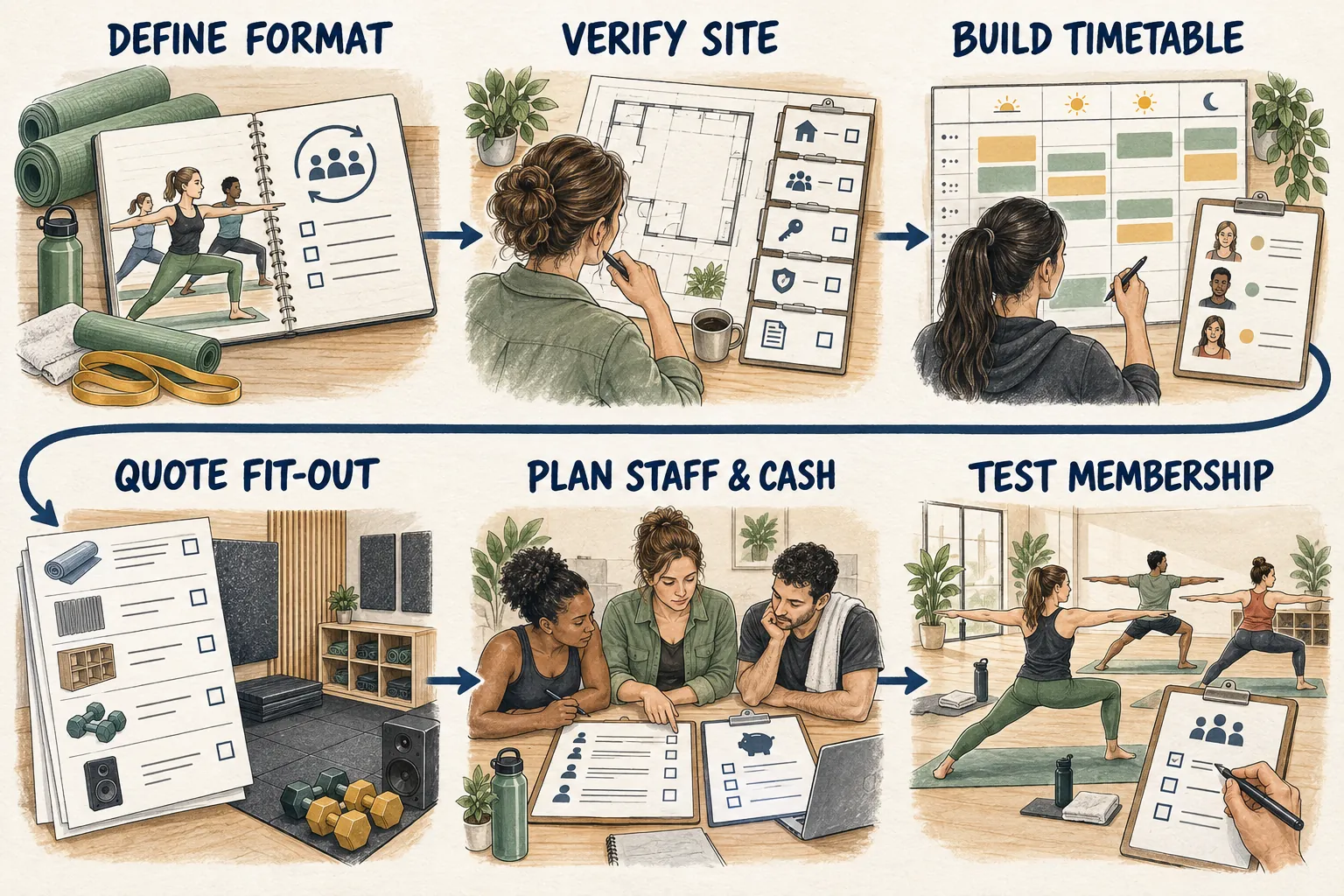
Write the access promise, billing date, term, cancellation and freeze rules, credits, refunds, failed-payment treatment and exclusions. Record the limited class-pack and drop-in mix inside the realized member-month value as modeled; keep personal training, retail and digital subscriptions outside the reference.
Set whole classes, bookable spots, instructor preparation and reset, opening and closing, cleaning, administration, substitution and peak-time choice. Do not add fractional classes or simultaneous duties that the roster cannot perform.
Take the actual use, layout, occupancy, class activities, equipment, sound, ventilation, hours, signage, employees and any added services to the landlord, insurer and responsible authorities.
Run an authorized presale or controlled opening test. Record paid starts, active member-months, cancellations, freezes, failed collections, reservations, attendance, no-shows, waitlists, class-level utilization and every paid hour.
| Measure | Why it changes a decision |
|---|---|
| Paid active member-months and realized revenue per member | Separates earned recurring revenue from leads, contracts, future prepaid service, taxes and failed collections. |
| New members, paid renewals, cancellations, freezes and failed payments by cohort | Shows whether the active base is being retained or repeatedly replaced. |
| Reservations, attendance, late cancellations, waitlist refill and turnaways by class | Makes usable capacity and peak-time access visible instead of relying on an all-day average. |
| Paid instructor and operating hours by timetable block | Connects each delivered class to preparation, reset, opening, closing, cleaning, administration and substitution coverage. |
Review actuals against the scope you priced. If an extra service, new trading hour or more distant client changes the work, update the roster and contribution calculation before expanding.
Describe the exact address, proposed use, room layout, occupancy, activities, equipment, sound, ventilation, restrooms, accessibility, hours, signage, employees, membership terms, cleaning and any child care, food, retail, massage, clinical or personal-training activity. Ask the landlord, insurer and responsible state and local offices which business, land-use, building, fire, accessibility, employer, tax, consumer-contract and activity-specific requirements apply.
Each state profile links to official registration, tax and employer routes, together with the questions still requiring an address-specific answer. How to find the permits and approvals your business actually needs provides the record to keep.
Stop when break-even requires more paid active member-months than the tested class schedule can serve with usable peak-time access, when growth depends on replacing avoidable cancellations every month, when the roster omits opening, cleaning or coordination work, or when the lease and fit-out depend on an unverified use, occupancy, ventilation, acoustic or insurance assumption.
Write a response that changes the actual cause: narrower scope, a different site, revised paid staffing, a tested price or a delayed opening. A larger cash buffer only addresses a temporary timing gap.
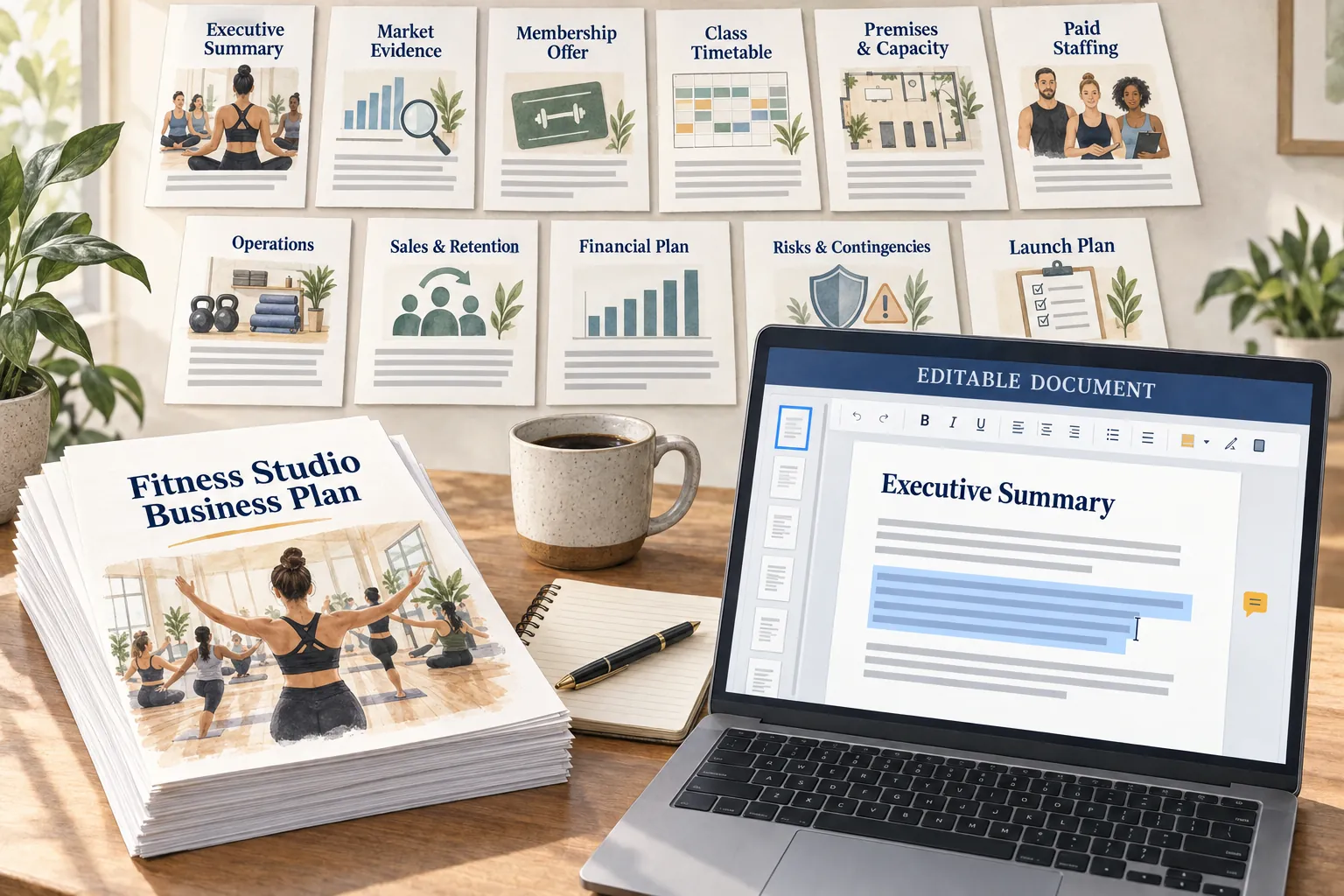
Calculate paid active member-months, realized recurring revenue, member losses, acquisition needs and three Fitness Studio break-even boundaries.
Work through the guide →Build a Fitness Studio timetable from whole classes, usable spots, member reservations, attendance, waitlist refill and complete paid coverage.
Work through the guide →Account for service, setup, cleaning, travel and owner work, then turn a complete paid week into a monthly staffing budget.
Work through the guide →Compare total occupancy cash, upfront commitments and site dependencies using a worked premises budget and a practical review record.
Work through the guide →A Restaurant earns from completed guest transactions during food-service periods. A Fitness Studio earns recurring member-months while delivering scheduled instructor-led access. Both coordinate a paid team and fixed premises, but meals are consumed per visit while studio value depends on retention and repeat access across the month.
Compare the operating choices →A Coffee Shop depends on many short transactions at one frontage. A Fitness Studio depends on recurring member-months and fewer, longer scheduled classes. Both need repeat local use, but buying-window throughput and membership retention create different capacity and acquisition problems.
Compare the operating choices →A Cleaning Business earns recurring account-months by routing paid work through client sites. A Fitness Studio earns recurring member-months at one leased premises through a scheduled class service. Both depend on retention, but the cleaning promise travels while studio capacity is concentrated in whole classes and time slots.
Compare the operating choices →A Hair Salon sells individually booked services tied to stylist and chair time. A Fitness Studio sells recurring access delivered through shared instructor-led classes. Both depend on skilled personal service and repeat clients, but one appointment uses a dedicated service slot while one class serves several members at once.
Compare the operating choices →An Auto Detailing Business earns from condition-sensitive vehicle jobs in fixed bays. A Fitness Studio earns recurring member-months through a shared room and scheduled instructors. Both use a fitted premises, but vehicle dwell time and repeated member access require different capacity records.
Compare the operating choices →A Laundromat sells customer use of a machine bank across long opening hours. A Fitness Studio sells recurring access through a much narrower instructor-led timetable. Both require a reliable premises and repeat local use, but customer-operated cycles and paid classes produce different labor and peak-capacity economics.
Compare the operating choices →A Daycare Center earns enrolled child-weeks while maintaining continuous qualified room coverage. A Fitness Studio earns member-months while delivering discrete scheduled classes. Both use rooms and paid staff, but care obligations, age groups and regulatory ratios cannot be transferred to short adult fitness sessions.
Compare the operating choices →A Pet Grooming Salon earns from individual dog appointments that move through bathing, drying and table work. A Fitness Studio earns recurring member-months through shared classes. Both depend on skilled service and safe circulation, but animal handling and group participant access create different schedules and responsibilities.
Compare the operating choices →A Landscaping Company earns completed property-service visits through mobile paid crews. A Fitness Studio earns recurring member-months through a fixed class timetable. Both schedule labor ahead of demand, but routes, weather and equipment travel differ from room capacity, member access and instructor substitution.
Compare the operating choices →A Food Truck earns many short customer orders in mobile service windows. A Fitness Studio earns recurring member-months through fixed scheduled classes. Both can concentrate demand into peaks, but prepared food, location access and vehicle reliability differ from retention, room access and instructor coverage.
Compare the operating choices →A Bakery commits ingredients and paid production to whole batches before final retail sell-through is known. A Fitness Studio commits room time and paid instructors before final class attendance and membership retention are known. Both schedule capacity ahead of use, but perishable inventory and recurring service access create different loss paths.
Compare the operating choices →No. Count the month only when access is owed and the earned charge is collected or recognized under the stated terms. Track prepaid service, failed payments, refunds, freezes and cancellations separately.
No. Averages can hide full evening classes and empty off-peak classes. Measure reservations, attendance, waitlists, refill and turnaways by timetable block.
The reference includes a limited realized mix inside monthly revenue per active member. Keep their visits as service-use measures, and build a separate unit and schedule before adding personal training, retail or digital services.
No. Deposits, permitted use, fit-out, ventilation, acoustics, accessibility, utilities, insurance, cleaning, maintenance and opening cash can create separate commitments.
No states match these filters.
Sorting compares one defined format. It does not rank states for attractiveness or prove demand. Funding includes a 60-month cash reserve under each scenario.
| State | Funding scenario | Loaded payroll / month | EBIT break-even paid active member-months per month |
|---|---|---|---|
| Alabama | $316,241 | $15,095 | 230.1 |
| Alaska | $331,724 | $17,907 | 250.3 |
| Arizona | $332,695 | $18,066 | 251.5 |
| Arkansas | $317,206 | $15,284 | 231.4 |
| California | $350,647 | $20,848 | 271.6 |
| Colorado | $340,101 | $19,276 | 260.2 |
| Connecticut | $350,251 | $20,793 | 271.2 |
| Delaware | $332,618 | $18,053 | 251.4 |
| Florida | $320,787 | $15,984 | 236.5 |
| Georgia | $325,552 | $16,898 | 243.1 |
| Hawaii | $337,288 | $18,817 | 256.9 |
| Idaho | $331,473 | $17,866 | 250.1 |
| Illinois | $332,962 | $18,110 | 251.8 |
| Indiana | $320,748 | $15,976 | 236.4 |
| Iowa | $318,890 | $15,613 | 233.8 |
| Kansas | $318,673 | $15,570 | 233.5 |
| Kentucky | $321,135 | $16,052 | 237 |
| Louisiana | $318,057 | $15,450 | 232.6 |
| Maine | $336,288 | $18,653 | 255.7 |
| Maryland | $331,932 | $17,941 | 250.6 |
| Massachusetts | $355,038 | $21,465 | 276 |
| Michigan | $326,046 | $16,979 | 243.6 |
| Minnesota | $333,886 | $18,261 | 252.9 |
| Mississippi | $307,139 | $13,317 | 217.2 |
| Missouri | $320,129 | $15,855 | 235.5 |
| Montana | $329,281 | $17,508 | 247.5 |
| Nebraska | $317,560 | $15,353 | 231.9 |
| Nevada | $334,453 | $18,353 | 253.6 |
| New Hampshire | $337,041 | $18,776 | 256.6 |
| New Jersey | $349,336 | $20,664 | 270.2 |
| New Mexico | $324,791 | $16,766 | 242.1 |
| New York | $340,766 | $19,385 | 261 |
| North Carolina | $325,098 | $16,824 | 242.5 |
| North Dakota | $324,793 | $16,766 | 242.1 |
| Ohio | $319,127 | $15,659 | 234.1 |
| Oklahoma | $318,481 | $15,533 | 233.2 |
| Oregon | $350,416 | $20,816 | 271.3 |
| Pennsylvania | $329,590 | $17,558 | 247.8 |
| Rhode Island | $340,198 | $19,292 | 260.3 |
| South Carolina | $321,406 | $16,105 | 237.3 |
| South Dakota | $323,109 | $16,437 | 239.7 |
| Tennessee | $328,881 | $17,442 | 247 |
| Texas | $321,369 | $16,097 | 237.3 |
| Utah | $325,479 | $16,886 | 243 |
| Vermont | $349,469 | $20,683 | 270.4 |
| Virginia | $324,784 | $16,765 | 242.1 |
| Washington | $347,120 | $20,353 | 268 |
| West Virginia | $314,171 | $14,691 | 227.1 |
| Wisconsin | $329,824 | $17,597 | 248.1 |
| Wyoming | $330,321 | $17,678 | 248.7 |
Published research and calculations support business planning and education. They are not personalized financial, investment, tax or legal advice, and they do not guarantee costs, revenue, profit or financing. Estimates depend on the stated format, location, source periods and assumptions. Check the requirements and commitments that apply to your circumstances.