
Business opening checklist: the decisions to resolve before launch
A useful opening checklist tells you which commitments are ready, which depend on another decision and which still lack evidence. Work from the customer offer through premises, delivery, permissions and cash, then rehearse a complete operating day before confirming the launch plan.
What you will produce: A launch decision record with unresolved dependencies and a named next action.
Updated September 6, 2026 · Worked examples and editable worksheets
What to have ready
Describe the proposed service or product, customer, location, opening hours, paid team and expected launch date. Use this same scope when asking suppliers, authorities and potential customers for information.
Work through the calculation and decision
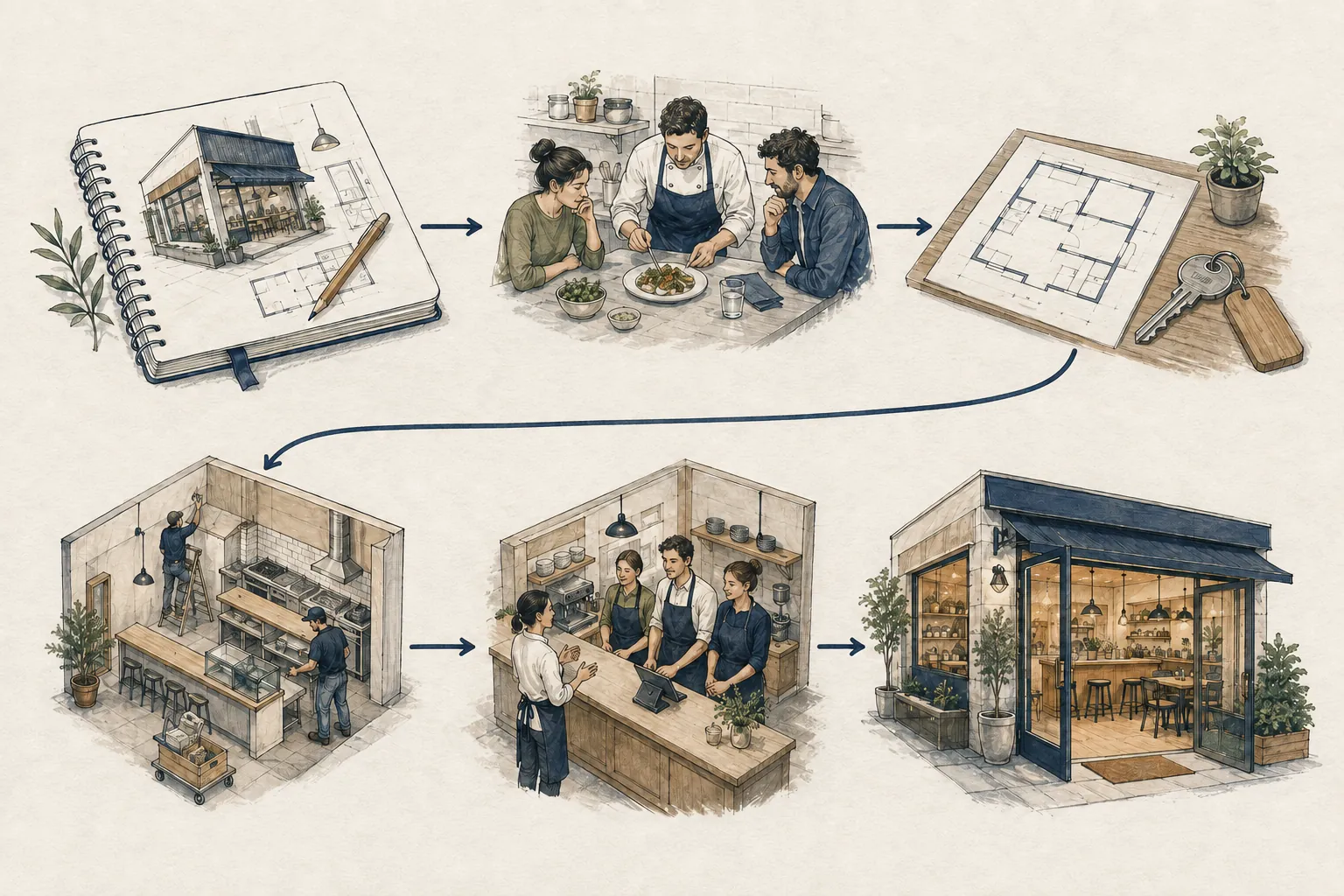
What should you decide before spending on the opening?
Define the customer unit and the exact operating format. A staffed salon, a chair-rental business and a mobile service have different responsibilities and revenue units. Test whether the offer solves a customer problem at a price that can support delivery.
Identify the premises and equipment conditions the format requires. Record what must be confirmed before deposits or orders become difficult to reverse. A selected piece of equipment is not a resolved opening step if installation, utility capacity or the premises arrangement is still unknown.
How should you order the launch tasks?
For each decision, name its dependency, the evidence needed, the person responsible and the next cash commitment. For example, a utility specification may precede equipment selection; the installed equipment layout may affect the premises review; financing may need a defined scope before funds are committed.
Set dates backward from the intended opening, using actual supplier and authority information where available. Treat an unconfirmed lead time as unresolved. Keep alternative paths visible so a delay can trigger a smaller launch, another site or a revised date rather than an unsupported promise.
What should a final rehearsal test?
Run a representative sequence from customer enquiry or ordering through delivery, payment, handover and cleanup. Check who does each task, which resource is occupied and what happens when a job takes longer or a worker is absent. Include opening preparation and closing work in the paid schedule.
Reconcile the launch cash plan with the latest dates and scopes. Review all unresolved items before making the next commitment. The worksheet below records your assessment; it does not issue a permit, verify a supplier or approve the business for opening.
An equipment order depends on a premises answer
This authored example concerns a small food business considering equipment with an unconfirmed electrical requirement. Dates and requirements must come from the actual parties.
| Decision | Dependency | Evidence to obtain | Next action |
|---|---|---|---|
| Choose the equipment | Usable power and installation scope | Written technical scope for the exact unit and premises | Ask the installer and premises contact to reconcile requirements |
| Commit the deposit | Scope, suitability and cash availability | Supplier terms plus resolved technical questions | Set the order date after the prerequisite is resolved |
| Confirm opening date | Delivery, installation and required approvals | Dated responses from the relevant parties | Update the dependency schedule |
What this changes: The useful outcome is a specific next action and a postponed dependent commitment. Marking the equipment as selected would not resolve the technical or cash dependency.
Illustrative amounts are rounded for display. Use the full inputs and stated units when recalculating; an approximate threshold is not itself a sufficient activity prescription.
Complete your decision record
A launch decision record with unresolved dependencies and a named next action. Enter the finding or number, the source and the next action for each row. “Supported” records your assessment of that item; it does not approve the business or certify completed research.
| Item and what to record | Your finding and evidence | Status and next action |
|---|---|---|
| Customer offerExact scope, customer unit, price test and demand evidence | ||
| Premises and equipmentSuitability, installation dependencies, quotes and terms | ||
| Paid deliveryRoster, capacity, handovers and operating rehearsal | ||
| PermissionsRelevant activity and address questions, offices and responses | ||
| Opening cashPayment dates, usable funds, operating deficit and reserve | ||
| Launch decisionRemaining dependency, next action, responsible person and date |
6 items have no evidence recorded yet.
Entries are temporary and are not sent to us or saved automatically. Download your completed work before leaving or refreshing this page.
Choose your next action
| If your finding is… | Your next action |
|---|---|
| A commitment depends on an unresolved condition | Resolve that condition or revise the commitment and launch sequence. |
| A task is marked complete without its stated evidence | Reopen it and attach the missing result. |
| The rehearsal exposes an uncovered task | Revise the roster or service promise and repeat the affected part. |
Errors that can change the result
- Treating a calendar date as evidence that opening conditions are satisfied.
- Using a checklist completion percentage as permission to trade.
- Leaving responsibilities at the level of “the team.”
Apply this to your business
Choose the matching format and check its customer unit, paid team and evidence limits.
Restaurant
48-seat counter-service restaurant
Open the operating guide and state profiles →Coffee Shop
Independent coffee shop without a drive-through
Open the operating guide and state profiles →Cleaning Business
Two-person commercial cleaning team with recurring accounts
Open the operating guide and state profiles →Hair Salon
Three-stylist employee salon with booked appointments
Open the operating guide and state profiles →Auto Detailing Business
Two-technician fixed-site detailing studio
Open the operating guide and state profiles →Match the launch decisions to the responsibilities and customer unit of your chosen format. Values entered here are not automatically transferred to another calculator.
Continue with the next part of your plan
- How to turn a state business profile into a local opening plan
A local evidence register showing which decisions are supported and what must be resolved next.
- How to find the permits and approvals your business actually needs
An approval register with official responses and the next unresolved question.
- How to build a 13-week cash plan for your first 90 days
A weekly cash schedule, the lowest balance and the extra funding needed to retain your chosen minimum.
Sources and limits
The sources below provide the stated background. The worked examples, calculator defaults and decision exercises are authored teaching material. They do not establish market prices, local demand, legal applicability or completed state research.
- SBA: launching a business
Location and approval routing background.
Source background and its scope are stated above. The guide update date does not change a source observation period. Research and review standards · Report an issue
When you need a longer financial plan
Use a financial model to organize a broader forecast after defining your own operating assumptions. The site’s research, your worksheet entries and any purchased workbook are separate; entries are not transferred automatically.
Financial models