How to price a recurring cleaning contract from its actual scope
Turn measured tasks, paid travel, visit frequency and periodic work into a monthly contract price and a cash-collection plan.
Work through the guide →
Price a measured commercial-cleaning account and a compact route before adding recurring contracts to a two-person team's plan. The stated national wage scenario uses 10 active accounts per month at $1,690.00 per active account-month, producing $3,291 mature monthly EBIT and $71,130 modeled opening funding. Sales, capacity and nonwage costs remain planning assumptions.

The account fee must cover every promised visit and periodic task. Scope creep, access delays and isolated sites can consume the time left between accounts even when recurring invoices look predictable.
An active account-month earns the defined monthly service scope. The model can express an average account count; the actual calendar still needs whole visits at the agreed frequency.
At the assumed activity, the mature month produces $3,675 EBITDA, $3,291 EBIT and $3,525 cash after maintenance. The first twelve modeled months generate $7,882 of operating cash; they do not represent a full year at the mature run rate.
The EBIT threshold is approximately 7.88 active accounts per month; it uses the same price, variable-cost basis and complete paid roster. The listed ceiling is 13.33 active accounts per month, with the operating qualifications in the capacity explanation below. Reserve paid travel, access, loading, breaks, inspection and callback time before allocating service hours. The published theoretical account ceiling has no allowance for those route losses and must be reduced to a deliverable schedule.
| Test | Entered activity or cost | Monthly EBIT |
|---|---|---|
| Published reference | 10 active accounts per month | $3,291 |
| 20% less earned activity | 8 active accounts per month | $182 |
| 10% higher wage benchmarks | 1.10 × the same occupational wage anchors | $2,344 |
| 20% higher occupancy cost | $720.00 monthly occupancy | $3,171 |
Of the three separate tests shown, 20% less earned activity makes the largest change to monthly EBIT: -$3,110. This is a result of the stated test sizes, not a probability or a universal risk ranking.
Two cleaners deliver the work, with supervision paid separately. Two people on site for one hour use two labor-hours; supervisor time does not automatically add another cleaning shift.
Opening payments of $30,766, the deepest cumulative operating cash deficit of $16,618 in month 4, and the retained buffer of $23,746 add to $71,130 modeled funding. Refundable deposits are included in opening cash uses; they are not operating expenses. Funding is a scenario total, not a quote or a financing recommendation.
The receivables assumption moves part of earned invoices beyond the service month. Payroll remains due while invoices are outstanding, so stable contract contribution does not establish cash on the invoice date.
EBITDA pays the full modeled roster and operating costs. EBIT also deducts depreciation. Mature cash deducts maintenance investment from EBITDA, after receivables stop growing. All three exclude financing, income taxes and additional owner distributions.
If the full route cannot deliver the required recurring scope or collections cannot fund payroll, reprice, narrow the scope or change the client cluster before adding accounts. Walk and time one authorized account, record every promised monthly task, map access and travel, and verify the customer's payment terms before taking the next geographically separate account.
The wage observation is the BLS May 2025 national occupational median for each stated role. Hours, employer allowance, sales, prices, capacity and all nonwage costs are authored assumptions. Read the calculation definitions.
Calculations retain the exact input values. USD totals are displayed to whole dollars and blended prices to cents; activity and threshold estimates are displayed to up to two decimals. Rounded thresholds are estimates, not prescriptions for a sufficient whole job, visit or member count.
This reference uses recurring commercial accounts, not one-off residential visits. Each account has an agreed service frequency and monthly price. A new contract adds obligations as well as revenue.
Retention depends on consistent completion, documented quality and communication with the client. A signed renewal is different from assuming a contract repeats indefinitely without a service review.
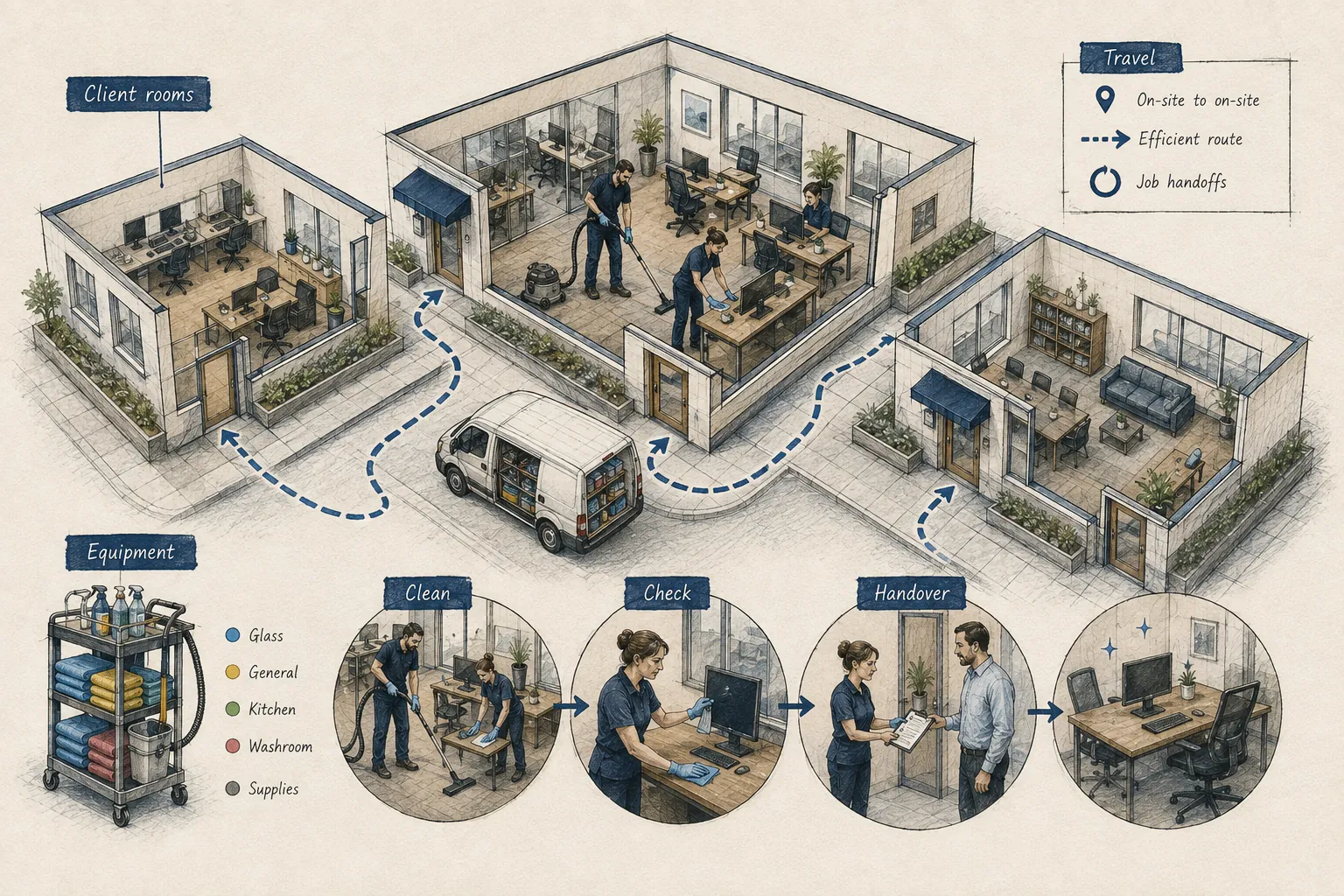
| Format | What changes | How to use it |
|---|---|---|
| Recurring commercial cleaning | A defined monthly scope and repeated service visits | The reference format here; account workload and density limit capacity. |
| Residential cleaning | Visits to homes with different scopes and booking patterns | Requires its own cancellation, travel, ticket and collection assumptions. |
| Specialist or post-construction cleaning | Project scopes, equipment and risk that differ from routine work | Do not use recurring-office hours or supplies as a default estimate. |
A founder who can sell a clear service agreement, schedule people reliably and inspect quality. It suits an interest in repeatable delivery and account management, including evenings where client access requires them.
The figures below are a national wage reference scenario. The paid roster uses May 2025 BLS national occupational medians. Prices, customer volume, rent, equipment and other commercial inputs are authored assumptions. This is not a researched average startup cost, owner-income promise or a funding recommendation.
| Input or result | Reference | What to verify |
|---|---|---|
| Completed sales units | 10 active account-months / month | 10 active accounts per month; demand requires evidence. |
| Net selling price | $1,690.00 | Build and test a relevant local menu, package or contract scope. |
| Revenue | $16,900 | Calculated volume × price, not observed sales. |
| Paid payroll | $9,473 / month | National wage medians × the stated hours × the 18% employer allowance. |
| Opening payments | $30,766 | Authored equipment and setup allowances, deposit and paid training. |
| Funding including reserve | $71,130 | Opening payments + deepest modeled operating deficit + retained buffer. |
| Mature operating profit (EBIT) | $3,291 / month | After the full paid roster and depreciation; before financing and income taxes. |
| Approximate EBIT threshold | Approximately 7.9 active accounts per month | A rounded estimate. Test whole permitted activity against the full roster and resource constraints. |
10 average active accounts × $1,690 monthly fee = $16,900 monthly revenue. Each account includes 26 labor hours per month, an assumed $65 of revenue per labor hour. Two cleaners provide 346.66 paid labor hours; 260 sold hours use about 75% of that time. The theoretical ceiling is 13.33 average accounts before allowing for travel and gaps. Two people on site for one hour consume two labor hours.
8% supplies, consumables and variable job costs; all employee labor remains in fixed payroll. Vehicle running costs $650; insurance $450; marketing $400; software and administration $300 per month. Storage allowance is separate.
Janitors and Cleaners, Except Maids and Housekeeping Cleaners matches the commercial format more closely than a residential housekeeping occupation. Supervision is paid separately and does not add billable cleaning capacity.
BLS May 2025 national wage workbook · Calculation definitions · How owner income differs from EBIT
| Workstream | What the brief needs | Decision before spending |
|---|---|---|
| Routine service kits | Task-specific equipment, consumables, PPE and secure storage | Match the kit to surfaces and client restrictions rather than buying every machine. |
| Transport and access | Route time, parking, keys, badges and out-of-hours access | Record paid travel and what happens when a team cannot enter. |
| Operations and quality | Scheduling, time records, inspection checklist and incident handling | Build supervision and rework into the operating plan. |
Compare installed scope, exclusions and payment dates. Do not treat an unquoted item as zero or count a bundled installation twice. How to compare equipment quotes and build the opening budget explains a reusable quote ledger.
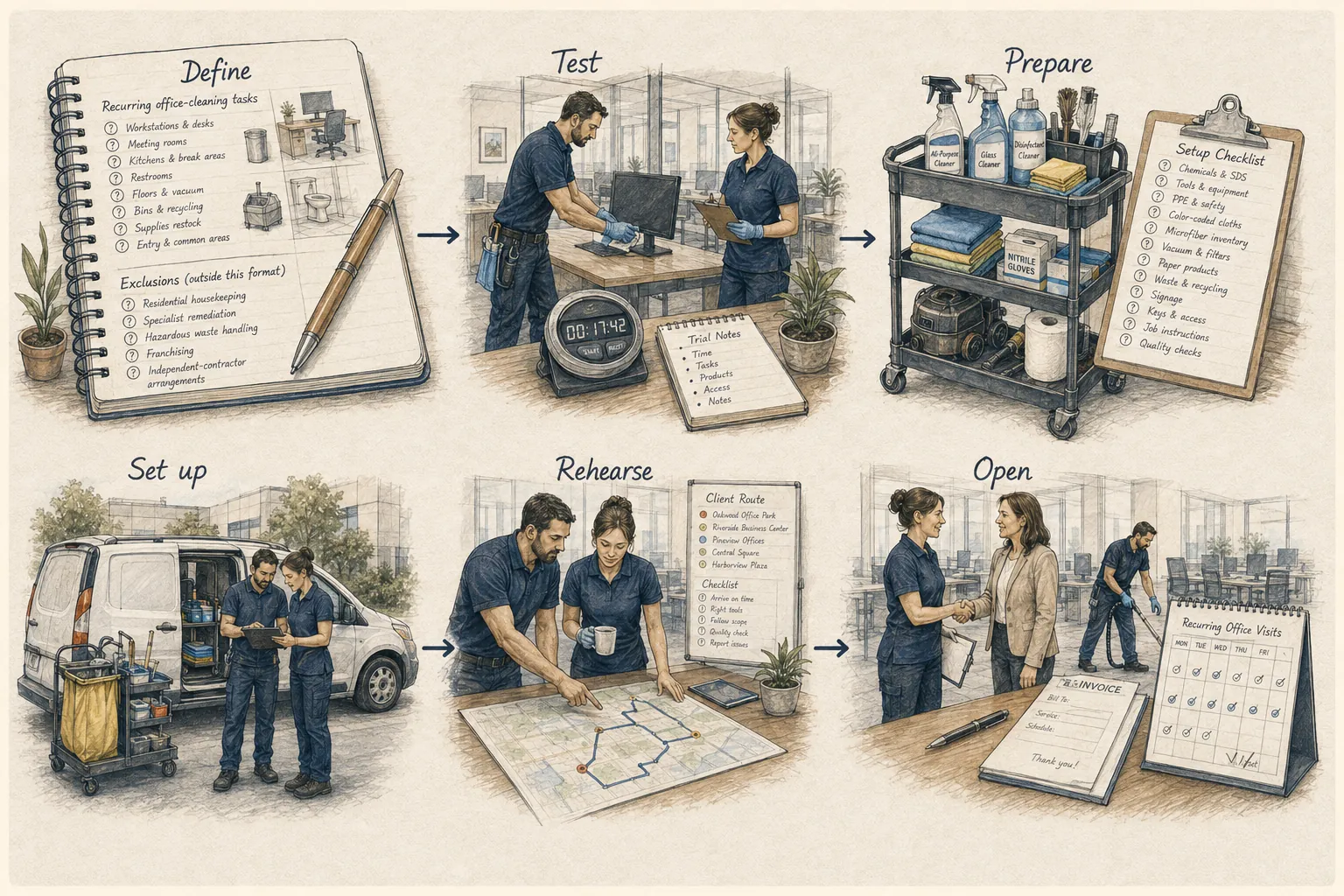
Walk the site with the client, record frequencies and exclusions, and time representative tasks. Identify periodic work separately from the normal visit.
Add on-site hours, travel, loading, supervision and a stated callback allowance. Use current labor quotes and a supply plan to test the monthly contribution.
Record access, consumables responsibility, approval of extra work, quality review, invoicing and cancellation terms. The commercial agreement needs to fit the measured scope.
Check the route and roster before accepting the next contract. A geographically isolated account can consume more of the team than its monthly price suggests.
| Measure | Why it changes a decision |
|---|---|
| Paid hours versus quoted hours | Reveals scope creep and underpriced visits. |
| Travel time by route | Shows how much paid capacity is unavailable for service. |
| Rework and missed tasks | Separates a low quote from an operation that can retain the client. |
| Receivables and overdue invoices | Connects signed contracts with the cash available for payroll. |
Review actuals against the scope you priced. If an extra service, new trading hour or more distant client changes the work, update the roster and contribution calculation before expanding.
Specify routine work, chemicals, waste handling, storage, vehicles and any specialist activities. Ask the state and local offices about registration, service tax treatment, employer obligations and activity-specific requirements; ordinary cleaning and specialist work may have different routes.
Each state profile links to official registration, tax and employer routes, together with the questions still requiring an address-specific answer. How to find the permits and approvals your business actually needs provides the record to keep.
A contract priced from floor area alone, no allowance for access or travel, or payroll due long before the first collection can undermine a seemingly simple recurring business.
Write a response that changes the actual cause: narrower scope, a different site, revised paid staffing, a tested price or a delayed opening. A larger cash buffer only addresses a temporary timing gap.
Turn measured tasks, paid travel, visit frequency and periodic work into a monthly contract price and a cash-collection plan.
Work through the guide →Calculate contribution, the price required at realistic sales volume and the number of completed services needed to cover fixed costs.
Work through the guide →Account for service, setup, cleaning, travel and owner work, then turn a complete paid week into a monthly staffing budget.
Work through the guide →Create a weekly receipts-and-payments forecast, locate the cash low point and test late collections using an editable 13-week schedule.
Work through the guide →This is a choice between serving customers at a fitted destination and delivering a recurring service across client sites. The restaurant depends on its address and meal-period trade; cleaning depends on measured contracts, route density and consistent delivery.
Compare the operating choices →A coffee shop wins short, frequent customer transactions at a location. A recurring cleaning business wins a defined monthly obligation at client sites. Compare buying windows with route capacity, and immediate customer collections with invoice timing.
Compare the operating choices →Cleaning capacity follows account scope and routes; salon capacity follows practitioner hours and appointments. Both depend on reliable people and repeat clients, but a commercial cleaning account creates an ongoing service obligation while each salon visit occupies a specific diary slot.
Compare the operating choices →Both businesses sell a defined cleaning result, but their units and operating constraints differ. Recurring commercial cleaning depends on route density and repeated account scope; a detailing studio depends on vehicle condition, technician-hours and usable bay time.
Compare the operating choices →Both businesses sell access to clean laundry or premises outcomes, but the cleaning business moves a paid team across client sites while the laundromat concentrates customers and equipment at one utility-intensive location.
Compare the operating choices →Both formats can use recurring agreements, but a cleaning business sends a paid team across client sites while a daycare center serves enrolled children inside one licensed premises.
Compare the operating choices →A cleaning business delivers recurring scopes across client sites. A pet grooming salon concentrates booked animal-care work, skilled people and fitted resources at one premises. Both depend on repeat relationships and complete paid time records.
Compare the operating choices →Both businesses send paid teams to recurring client locations, so scope, route density and collection timing matter. The cleaning reference serves commercial accounts indoors; the landscaping reference completes residential outdoor maintenance visits through two equipment-equipped crews.
Compare the operating choices →The Cleaning Business builds recurring commercial account-months across client sites; the Food Truck earns retail orders in scheduled service periods. Both travel, but cleaning manages contracted scope and invoice timing while the truck manages food production, location access and immediate transaction flow.
Compare the operating choices →A Cleaning Business earns recurring account-months through paid work at client sites and may collect later. A Bakery produces perishable goods at one premises for immediate retail orders. One manages route scope and receivables; the other manages whole batches, customer intervals and unsold inventory.
Compare the operating choices →A Cleaning Business earns recurring account-months by routing paid work through client sites. A Fitness Studio earns recurring member-months at one leased premises through a scheduled class service. Both depend on retention, but the cleaning promise travels while studio capacity is concentrated in whole classes and time slots.
Compare the operating choices →Both businesses deliver work at customer sites, so route density, paid travel, access, and quality control matter. A Cleaning Business earns from repeated scoped visits; an HVAC Company handles technical diagnosis, repairs, equipment replacement, task authorization, parts cash, and callbacks. Recurring account scope and mixed technical jobs need separate unit economics.
Compare the operating choices →Both businesses send paid workers to customer properties and lose capacity to travel, access, and quality recovery. A Cleaning Business earns from recurring scoped visits; a Moving Company earns from one-time origin-to-destination projects using one truck. Contract retention differs from job quoting, custody, loading, and claim exposure.
Compare the operating choices →A Cleaning Business earns recurring account-months through route and team coverage at customer premises. An Auto Repair Shop earns completed repair orders at one fitted site through technician and bay capacity. Both sell skilled labor and repeat trust, while vehicle custody, parts, fixed equipment, environmental handling, and warranty work distinguish repair.
Compare the operating choices →A Cleaning Business earns from completed account visits through crew hours, route density, access, and repeat contracts. A Plumbing Company earns from completed and collected residential service jobs through licensed plumbers, two vehicles, dispatch, materials, permits, and callback control. Both must fit paid capacity to realized contribution, while plumbing adds address-to-address travel, trade authority, water and gas system risk, material acquisition, and return-service exposure.
Compare the operating choices →A Cleaning Business earns from completed account visits through crew hours, route density, access, and repeat contracts. An Electrical Contractor earns from completed and collected residential service and small-alteration jobs through licensed electricians, two vehicles, dispatch, sold hours, materials, permits, inspections, testing, and rework control. Both must fit paid capacity to realized contribution, while electrical adds address-to-address travel, trade authority, code and energized-work risk, material compatibility, inspection dependencies, and return-service exposure.
Compare the operating choices →Cleaning Business earns from completed account visits and is constrained by crew hours, route density, access, and repeat contracts. Pest Control Company earns a monthly household-plan yield while delivering a separate calendar of inspections, initial visits and callbacks. Compare realized contribution and paid capacity in their own units; a pest contract base is useful only when retention, legal scope and route obligations remain deliverable.
Compare the operating choices →Cleaning Business earns from an active recurring commercial account-month and is constrained by account scope, visit frequency, paid travel, access and supervision. Residential Remodeling Company earns accepted interior scope, expressed as comparable project equivalents, while controlling a paid carpenter crew and authorized specialty trades. Compare the complete paid operating mechanism and dated cash, using each format’s own unit.
Compare the operating choices →No. The service must be delivered, invoiced and collected under the agreed terms. The reference includes a receivables allowance, but actual client terms may require a different schedule.
Only while the paid roster and route can absorb the measured work. Check travel, supervision and periodic tasks, not just the number of accounts.
No. Residential visits, cancellations and payment patterns need a separately defined operating model.
No states match these filters.
Sorting compares one defined format. It does not rank states for attractiveness or prove demand. Funding includes opening payments, the deepest cumulative operating cash deficit in the 60-month model and the retained cash buffer.
| State | Funding scenario | Loaded payroll / month | Approximate EBIT threshold active accounts per month |
|---|---|---|---|
| Alabama | $63,489 | $8,035 | 7 |
| Alaska | $77,662 | $10,542 | 8.6 |
| Arizona | $70,267 | $9,332 | 7.8 |
| Arkansas | $61,018 | $7,552 | 6.6 |
| California | $79,760 | $10,868 | 8.8 |
| Colorado | $74,918 | $10,093 | 8.3 |
| Connecticut | $74,725 | $10,061 | 8.3 |
| Delaware | $69,761 | $9,249 | 7.7 |
| Florida | $67,707 | $8,860 | 7.5 |
| Georgia | $67,608 | $8,840 | 7.5 |
| Hawaii | $74,939 | $10,096 | 8.3 |
| Idaho | $70,059 | $9,298 | 7.8 |
| Illinois | $72,386 | $9,679 | 8 |
| Indiana | $71,084 | $9,466 | 7.9 |
| Iowa | $68,935 | $9,100 | 7.6 |
| Kansas | $68,634 | $9,041 | 7.6 |
| Kentucky | $65,552 | $8,438 | 7.2 |
| Louisiana | $60,468 | $7,444 | 6.6 |
| Maine | $75,514 | $10,190 | 8.3 |
| Maryland | $71,002 | $9,452 | 7.9 |
| Massachusetts | $85,494 | $11,675 | 9.3 |
| Michigan | $69,528 | $9,211 | 7.7 |
| Minnesota | $75,679 | $10,217 | 8.4 |
| Mississippi | $60,734 | $7,496 | 6.6 |
| Missouri | $69,100 | $9,132 | 7.7 |
| Montana | $71,213 | $9,487 | 7.9 |
| Nebraska | $69,942 | $9,279 | 7.8 |
| Nevada | $73,302 | $9,828 | 8.1 |
| New Hampshire | $75,597 | $10,204 | 8.4 |
| New Jersey | $73,766 | $9,904 | 8.2 |
| New Mexico | $69,038 | $9,120 | 7.7 |
| New York | $80,257 | $10,938 | 8.8 |
| North Carolina | $68,124 | $8,941 | 7.5 |
| North Dakota | $73,644 | $9,884 | 8.1 |
| Ohio | $69,207 | $9,153 | 7.7 |
| Oklahoma | $63,084 | $7,956 | 6.9 |
| Oregon | $76,124 | $10,290 | 8.4 |
| Pennsylvania | $70,150 | $9,313 | 7.8 |
| Rhode Island | $75,704 | $10,221 | 8.4 |
| South Carolina | $64,276 | $8,189 | 7.1 |
| South Dakota | $68,962 | $9,105 | 7.6 |
| Tennessee | $66,898 | $8,702 | 7.4 |
| Texas | $65,267 | $8,383 | 7.2 |
| Utah | $66,946 | $8,711 | 7.4 |
| Vermont | $78,870 | $10,739 | 8.7 |
| Virginia | $69,063 | $9,125 | 7.7 |
| Washington | $86,658 | $11,838 | 9.4 |
| West Virginia | $63,190 | $7,976 | 6.9 |
| Wisconsin | $71,319 | $9,504 | 7.9 |
| Wyoming | $69,828 | $9,260 | 7.7 |
Published research and calculations support business planning and education. They are not personalized financial, investment, tax or legal advice, and they do not guarantee costs, revenue, profit or financing. Estimates depend on the stated format, location, source periods and assumptions. Check the requirements and commitments that apply to your circumstances.