How many clients can your salon or detailing business serve?
Calculate paid service capacity, allow for cancellations, and compare completed appointments with operating cash break-even.
Work through the guide →
Build a timed employee-salon menu and a realistic diary of completed visits before choosing stations or treating rebookings as sales. The stated national wage scenario uses 14 completed visits per trading day at $85.00 per completed visit, producing $6,914 mature monthly EBIT and $101,403 modeled opening funding. Sales, capacity and nonwage costs remain planning assumptions.

The ticket and appointment count must describe the same service mix. A higher-priced color service can use more practitioner time and lower daily completions; a station count does not repair that mismatch.
One completed visit earns the blended service ticket. Bookings, cancellations, rebookings and retail-product receipts remain separate from this employee-service unit.
At the assumed activity, the mature month produces $7,722 EBITDA, $6,914 EBIT and $7,522 cash after maintenance. The first twelve modeled months generate $51,153 of operating cash; they do not represent a full year at the mature run rate.
The EBIT threshold is approximately 9.87 completed visits per trading day; it uses the same price, variable-cost basis and complete paid roster. The listed ceiling is 18 completed visits per trading day, with the operating qualifications in the capacity explanation below. Place the service mix into an appointment day with changeovers, breaks, no-shows and a long-service exception. Test each practitioner's calendar rather than filling every chair on paper.
| Test | Entered activity or cost | Monthly EBIT |
|---|---|---|
| Published reference | 14 completed visits per trading day | $6,914 |
| 20% less earned activity | 11.2 completed visits per trading day | $2,230 |
| 10% higher wage benchmarks | 1.10 × the same occupational wage anchors | $5,744 |
| 20% higher occupancy cost | $3,000.00 monthly occupancy | $6,414 |
Of the three separate tests shown, 20% less earned activity makes the largest change to monthly EBIT: -$4,684. This is a result of the stated test sizes, not a probability or a universal risk ranking.
All three stylists' hours are paid, including lead duties, preparation, cleanup, breaks and scheduling. Concurrent processing creates capacity only when the actual service supervision and practitioner schedule support it.
Opening payments of $60,462, the deepest cumulative operating cash deficit of $9,546 in month 2, and the retained buffer of $31,395 add to $101,403 modeled funding. Refundable deposits are included in opening cash uses; they are not operating expenses. Funding is a scenario total, not a quote or a financing recommendation.
The reference assumes ordinary completed-service receipts arrive within the month. Owner work has a replacement cost in payroll; additional withdrawals need a separate cash plan.
EBITDA pays the full modeled roster and operating costs. EBIT also deducts depreciation. Mature cash deducts maintenance investment from EBITDA, after receivables stop growing. All three exclude financing, income taxes and additional owner distributions.
A menu that cannot earn the required contribution within paid stylist time needs repricing, a different mix or a separately modeled staffing format. Retain a timed menu, kept-appointment log and realized service mix, then verify practitioner arrangements and the exact wash-station and premises scope.
The wage observation is the BLS May 2025 national occupational median for each stated role. Hours, employer allowance, sales, prices, capacity and all nonwage costs are authored assumptions. Read the calculation definitions.
Calculations retain the exact input values. USD totals are displayed to whole dollars and blended prices to cents; activity and threshold estimates are displayed to up to two decimals. Rounded thresholds are estimates, not prescriptions for a sufficient whole job, visit or member count.
The reference uses a blended net ticket per completed visit. A cut and a color service can have different prices, product use and time requirements. The blend is useful only when the service mix also fits the available stylist hours.
Rebooking can support a future diary, but a booking is not a completed sale. Track kept appointments, cancellations, return intervals and client concentration by stylist.
| Format | What changes | How to use it |
|---|---|---|
| Employee appointment salon | The business schedules and pays a stylist team | The reference here has three paid stylists and excludes separate retail revenue. |
| Chair or suite rental | Independent professionals rent working space | Rent receipts, occupancy and contractual obligations require a different model. |
| Solo stylist | One practitioner provides and manages the service | Capacity, administration and owner compensation must be rebuilt for one person. |
A founder who values skilled service delivery, a stable client relationship and careful appointment management. An employee salon also requires recruiting, coaching and retaining a paid team.
The figures below are a national wage reference scenario. The paid roster uses May 2025 BLS national occupational medians. Prices, customer volume, rent, equipment and other commercial inputs are authored assumptions. This is not a researched average startup cost, owner-income promise or a funding recommendation.
| Input or result | Reference | What to verify |
|---|---|---|
| Completed sales units | 336 visits / month | 14 completed visits per trading day; demand requires evidence. |
| Net selling price | $85.00 | Build and test a relevant local menu, package or contract scope. |
| Revenue | $28,560 | Calculated volume × price, not observed sales. |
| Paid payroll | $11,697 / month | National wage medians × the stated hours × the 18% employer allowance. |
| Opening payments | $60,462 | Authored equipment and setup allowances, deposit and paid training. |
| Funding including reserve | $101,403 | Opening payments + deepest modeled operating deficit + retained buffer. |
| Mature operating profit (EBIT) | $6,914 / month | After the full paid roster and depreciation; before financing and income taxes. |
| Approximate EBIT threshold | Approximately 9.9 completed visits per trading day | A rounded estimate. Test whole permitted activity against the full roster and resource constraints. |
Three stylists × 8 paid hours × 75% appointment time ÷ one hour per completed visit = 18 visits per day. Across 24 trading days, 576 paid hours support 432 one-hour visits at the assumed ceiling. The remaining time covers preparation, cleanup, breaks, scheduling and management. Color processing, double booking and actual service durations must be scheduled explicitly.
14% color and treatment products plus 4% payment processing and other variable consumables; employee compensation remains in payroll. Utilities and laundry $500; insurance $250; marketing $400; booking software, communications and administration $350 per month.
Hairdressers, Hairstylists, and Cosmetologists is the selected occupation. BLS wages can include tips and incentive pay; the benchmark is a compensation proxy, not an employment contract or a minimum-wage determination. Do not add the same tips or commission twice. Lead-stylist time includes scheduling and supervision.
BLS May 2025 national wage workbook · Calculation definitions · How owner income differs from EBIT
| Workstream | What the brief needs | Decision before spending |
|---|---|---|
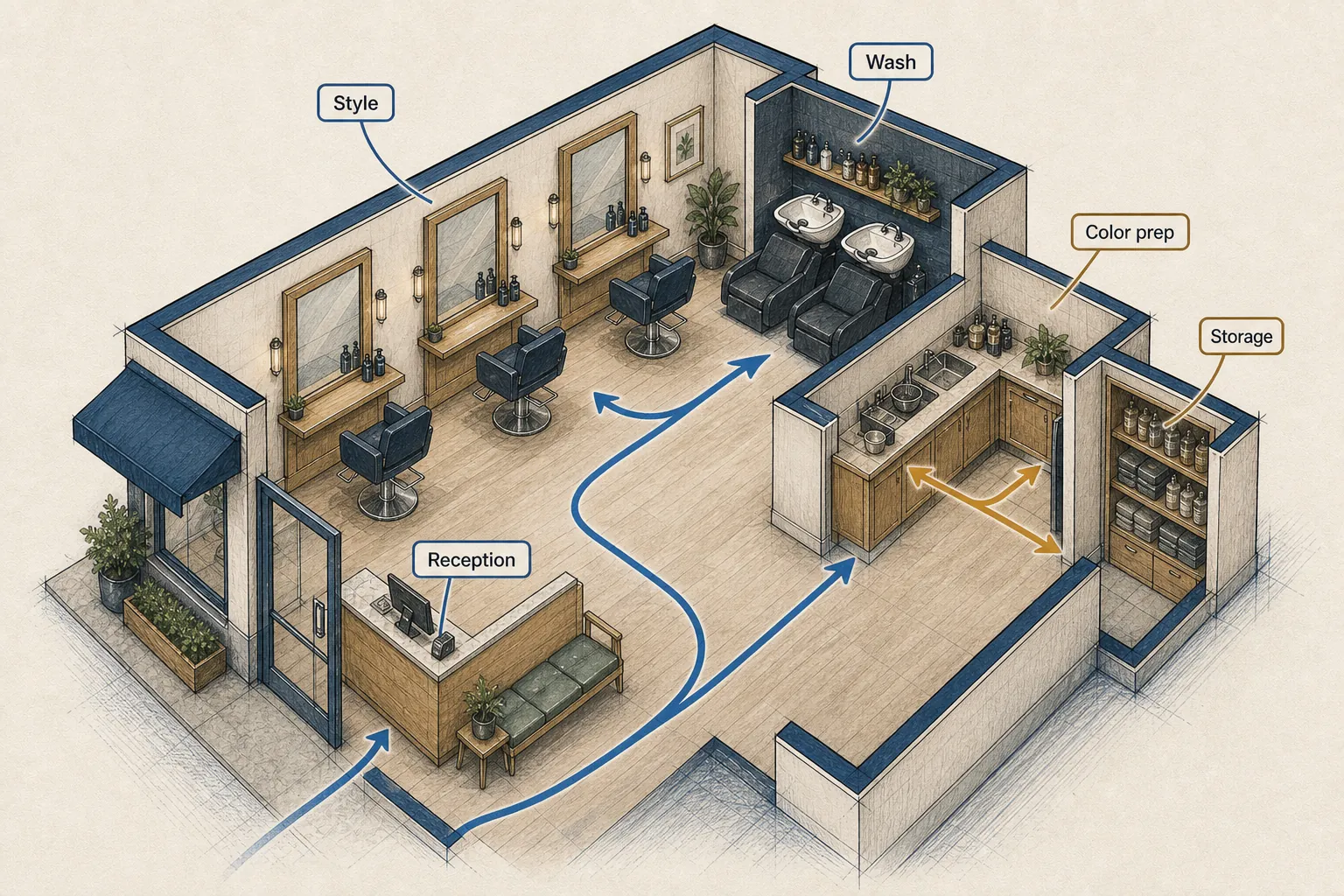
| Fit-out and wash area | Stations, wash basins, plumbing, power, ventilation and installation | Check premises and professional requirements before a non-refundable order. |
| Service equipment | Chairs, dryers, tools, linen and cleaning facilities | Match the equipment and products to the launch menu. |
| Bookings and products | Scheduling, payment process, consumables and inventory controls | Separate appointment revenue from any future retail-stock business. |
Compare installed scope, exclusions and payment dates. Do not treat an unquoted item as zero or count a bundled installation twice. How to compare equipment quotes and build the opening budget explains a reusable quote ledger.
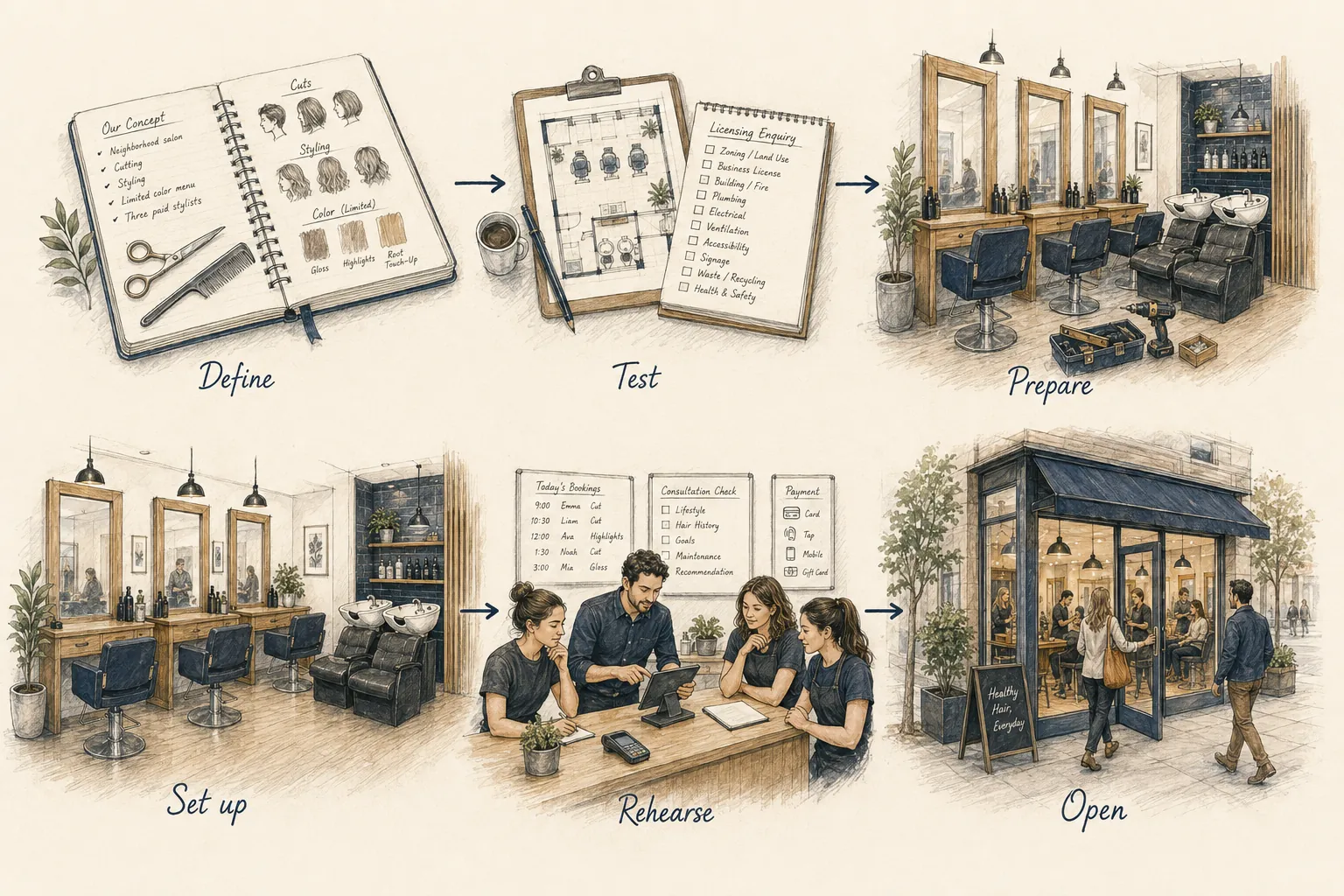
List the price, paid stylist minutes, processing time and products for each service. Distinguish time that truly frees a stylist from time that still requires supervision.
Check the state route for the establishment and each practitioner, then the requirements for the actual address. A business registration alone does not establish permission to offer every treatment.
Build a week with breaks, consultations, cleaning, records and cancellations. Confirm that the claimed daily visit count fits the service mix and paid hours.
Track completed first visits, rebooking, kept return appointments and complaints. Make changes to booking intervals or menu scope using these records rather than a full-looking calendar.
| Measure | Why it changes a decision |
|---|---|
| Completed paid visits | Removes cancellations and unfilled bookings from reported volume. |
| Revenue per occupied stylist hour | Tests the service mix as well as the ticket. |
| Kept rebookings | Measures whether future diary entries turn into retained business. |
| Products, corrections and overtime | Captures costs that a simple appointment count can hide. |
Review actuals against the scope you priced. If an extra service, new trading hour or more distant client changes the work, update the roster and contribution calculation before expanding.
Prepare the exact treatment list, proposed practitioner arrangements, floor plan, wash stations and sanitation plan. Ask the relevant professional licensing office about establishment and practitioner permissions separately, then confirm address-level requirements.
Each state profile links to official registration, tax and employer routes, together with the questions still requiring an address-specific answer. How to find the permits and approvals your business actually needs provides the record to keep.
An appointment forecast that exceeds the available stylist minutes, confusion between employment and chair rental, or an unresolved establishment requirement is a reason to stop and revise the launch plan.
Write a response that changes the actual cause: narrower scope, a different site, revised paid staffing, a tested price or a delayed opening. A larger cash buffer only addresses a temporary timing gap.

Calculate paid service capacity, allow for cancellations, and compare completed appointments with operating cash break-even.
Work through the guide →Calculate contribution, the price required at realistic sales volume and the number of completed services needed to cover fixed costs.
Work through the guide →Build an activity-and-address approval register with the responsible office, exact question, response, dependencies and renewal dates.
Work through the guide →Separate pay for owner work, business profit and distributable cash using a worked reserve calculation and a monthly decision record.
Work through the guide →A restaurant coordinates a team around meal periods; a hair salon schedules skilled service time around appointments. Both use fitted premises, but the salon’s service duration and kept bookings play the role that menu production and paid covers play in a restaurant.
Compare the operating choices →The core difference is a transaction queue versus an appointment diary. Coffee depends on fast fulfillment during buying peaks; a salon depends on skilled hours, service duration and kept appointments. Both need repeat customers, but their scheduling and hiring problems differ.
Compare the operating choices →Cleaning capacity follows account scope and routes; salon capacity follows practitioner hours and appointments. Both depend on reliable people and repeat clients, but a commercial cleaning account creates an ongoing service obligation while each salon visit occupies a specific diary slot.
Compare the operating choices →Both are appointment-led service businesses in these reference formats. A salon sells skilled practitioner time to a person; a detailing studio sells technician work and space use for a vehicle. Service mix, completion rates and exceptions matter more than the headline ticket.
Compare the operating choices →A salon sells scheduled practitioner time; a laundromat sells access to machines and a usable customer environment. Both need repeat customers, but capacity and service quality are created differently.
Compare the operating choices →A salon sells scheduled practitioner visits. A daycare center sells reserved child-weeks and must support each room continuously under its entered age-group rules.
Compare the operating choices →Both formats sell skilled booked time, but the clients, service classification, handling, sanitation, premises and duration uncertainty differ. Each needs a truthful service mix and paid diary.
Compare the operating choices →A hair salon brings scheduled clients to skilled practitioners at one premises. A landscaping company sends two crews and equipment to recurring properties. Both sell paid labor time, but service mix, travel, seasonality and asset use shape capacity differently.
Compare the operating choices →A Hair Salon reserves practitioner and station time for booked visits at one premises. A Food Truck prepares inventory before serving many shorter customer orders in a constrained location window. Both lose capacity to cancellations or weak periods, but recovery and perishability differ.
Compare the operating choices →A Hair Salon sells named practitioner appointments whose service duration and mix shape the diary. A Bakery commits whole batches and paid production before completed retail orders are known. Both depend on repeat demand at one premises, but unused capacity appears differently.
Compare the operating choices →A Hair Salon sells individually booked services tied to stylist and chair time. A Fitness Studio sells recurring access delivered through shared instructor-led classes. Both depend on skilled personal service and repeat clients, but one appointment uses a dedicated service slot while one class serves several members at once.
Compare the operating choices →A Hair Salon sells skilled appointment time at a fitted customer destination. An HVAC Company sends skilled technicians to customer properties and separates service calls from equipment replacements. Both depend on scheduling and repeat trust, but HVAC adds route time, service vehicles, parts procurement, jobsite conditions, and callback responsibility.
Compare the operating choices →A Hair Salon sells skilled appointment time at a fitted destination. A Moving Company sells a crew-and-truck block across customer addresses. Both depend on scheduling and customer readiness, but a move can change with inventory, stairs, elevators, parking, travel, and claims after the job.
Compare the operating choices →A Hair Salon earns from completed appointments through stylist time and chairs. An Auto Repair Shop earns from completed repair orders through technician time, bays, labor operations, and parts. Both manage booked capacity and repeat customers, but vehicle diagnosis, authorization, parts delays, custody, and warranty rework add a different operating chain.
Compare the operating choices →A Hair Salon earns from completed appointments through licensed stylist hours and usable chairs. A Plumbing Company earns from completed and collected residential service jobs through licensed plumbers, two vehicles, dispatch, materials, permits, and callback control. Both must fit paid capacity to realized contribution, while plumbing adds address-to-address travel, trade authority, water and gas system risk, material acquisition, and return-service exposure.
Compare the operating choices →A Hair Salon earns from completed appointments through licensed stylist hours and usable chairs. An Electrical Contractor earns from completed and collected residential service and small-alteration jobs through licensed electricians, two vehicles, dispatch, sold hours, materials, permits, inspections, testing, and rework control. Both must fit paid capacity to realized contribution, while electrical adds address-to-address travel, trade authority, code and energized-work risk, material compatibility, inspection dependencies, and return-service exposure.
Compare the operating choices →Hair Salon earns from completed appointments and is constrained by licensed stylist hours and usable chairs. Pest Control Company earns a monthly household-plan yield while delivering a separate calendar of inspections, initial visits and callbacks. Compare realized contribution and paid capacity in their own units; a pest contract base is useful only when retention, legal scope and route obligations remain deliverable.
Compare the operating choices →Hair Salon earns from completed appointments and a service-mix ticket and is constrained by paid stylist time, service duration, stations and the actual appointment diary. Residential Remodeling Company earns accepted interior scope, expressed as comparable project equivalents, while controlling a paid carpenter crew and authorized specialty trades. Compare the complete paid operating mechanism and dated cash, using each format’s own unit.
Compare the operating choices →No. It is an authored input for the reference scenario. Build a local menu, source its prices and weight it by a plausible completed-service mix.
That ceiling assumes eight paid hours each, 75% client-serving time and one stylist-hour per visit. A longer service mix lowers capacity; overlapping services require a defensible scheduling plan.
BLS suppresses the May 2025 Virginia wage estimates for the selected occupation. The reference explicitly uses the national benchmark. It is not a measured Virginia wage or evidence of a Virginia payroll difference.
No states match these filters.
Sorting compares one defined format. It does not rank states for attractiveness or prove demand. Funding includes opening payments, the deepest cumulative operating cash deficit in the 60-month model and the retained cash buffer.
| State | Funding scenario | Loaded payroll / month | Approximate EBIT threshold completed visits per trading day |
|---|---|---|---|
| Alabama | $92,459 | $9,529 | 8.6 |
| Alaska | $96,497 | $10,508 | 9.2 |
| Arizona | $102,777 | $12,030 | 10.1 |
| Arkansas | $92,011 | $9,420 | 8.5 |
| California | $105,714 | $12,635 | 10.4 |
| Colorado | $104,077 | $12,316 | 10.2 |
| Connecticut | $115,676 | $14,579 | 11.6 |
| Delaware | $99,441 | $11,222 | 9.6 |
| Florida | $92,964 | $9,651 | 8.6 |
| Georgia | $99,749 | $11,296 | 9.6 |
| Hawaii | $100,394 | $11,453 | 9.7 |
| Idaho | $100,983 | $11,595 | 9.8 |
| Illinois | $99,048 | $11,126 | 9.5 |
| Indiana | $97,394 | $10,725 | 9.3 |
| Iowa | $101,291 | $11,670 | 9.9 |
| Kansas | $93,188 | $9,706 | 8.7 |
| Kentucky | $93,385 | $9,753 | 8.7 |
| Louisiana | $88,404 | $8,503 | 8 |
| Maine | $114,666 | $14,382 | 11.5 |
| Maryland | $102,244 | $11,901 | 10 |
| Massachusetts | $103,422 | $12,187 | 10.2 |
| Michigan | $100,085 | $11,378 | 9.7 |
| Minnesota | $106,550 | $12,798 | 10.5 |
| Mississippi | $90,301 | $9,006 | 8.3 |
| Missouri | $94,590 | $10,046 | 8.9 |
| Montana | $104,599 | $12,418 | 10.3 |
| Nebraska | $99,412 | $11,215 | 9.6 |
| Nevada | $98,768 | $11,058 | 9.5 |
| New Hampshire | $99,861 | $11,323 | 9.6 |
| New Jersey | $101,880 | $11,813 | 9.9 |
| New Mexico | $104,181 | $12,336 | 10.2 |
| New York | $101,347 | $11,684 | 9.9 |
| North Carolina | $105,296 | $12,554 | 10.4 |
| North Dakota | $100,141 | $11,391 | 9.7 |
| Ohio | $102,020 | $11,847 | 10 |
| Oklahoma | $93,132 | $9,692 | 8.7 |
| Oregon | $143,655 | $18,814 | 14.1 |
| Pennsylvania | $102,749 | $12,024 | 10.1 |
| Rhode Island | $95,207 | $10,195 | 9 |
| South Carolina | $98,571 | $11,011 | 9.5 |
| South Dakota | $125,618 | $16,272 | 12.6 |
| Tennessee | $95,347 | $10,229 | 9 |
| Texas | $94,506 | $10,025 | 8.9 |
| Utah | $100,506 | $11,480 | 9.7 |
| Vermont | $123,328 | $15,898 | 12.4 |
| Virginia | $101,403 | $11,697 | 9.9 |
| Washington | $161,019 | $19,446 | 14.5 |
| West Virginia | $99,637 | $11,269 | 9.6 |
| Wisconsin | $101,992 | $11,840 | 10 |
| Wyoming | $92,487 | $9,536 | 8.6 |
Published research and calculations support business planning and education. They are not personalized financial, investment, tax or legal advice, and they do not guarantee costs, revenue, profit or financing. Estimates depend on the stated format, location, source periods and assumptions. Check the requirements and commitments that apply to your circumstances.