Secure accepted sites and test retained item contribution before committing to machines or a larger route. The stated national wage scenario uses 6,000 completed paid item-vends per month at $2.50 per completed paid item-vend, producing -$627 mature monthly EBIT and $114,833 modeled opening funding. Sales, capacity and nonwage costs remain planning assumptions.
The national reference has a small positive mature cash month but negative depreciation-inclusive EBIT. Per-location net yield and the cost of the complete paid route decide whether an installed machine contributes enough to justify its capital.
One successful paid item-vend supplies one product. Ten machines × 30 selling days × 20 daily item-vends create the 6,000-vend scenario. A placement, authorization, failed dispense or refunded item is not another earned sale.
At the assumed activity, the mature month produces $765 EBITDA, -$627 EBIT and $565 cash after maintenance. The first twelve modeled months use $4,018 of operating cash; they do not represent a full year at the mature run rate.
The EBIT threshold is approximately 6,641.3 completed paid item-vends per month; it uses the same price, variable-cost basis and complete paid roster. The listed ceiling is 8,000 completed paid item-vends per month, with the operating qualifications in the capacity explanation below. At 8,000 monthly paid vends, the stated route, repair and management workloads are 93.6, 12 and 8.8 hours. The next whole vend exceeds the 12-hour repair pool. The stock calculation includes expected acquired-item loss and assumes equal sales plus an actual five-day maximum service gap.
Separate sensitivity tests · mature monthly EBIT · all other inputs held fixed
Test
Entered activity or cost
Monthly EBIT
Published reference
6,000 completed paid item-vends per month
-$627
20% less earned activity
4,800 completed paid item-vends per month
-$1,800
10% higher wage benchmarks
1.10 × the same occupational wage anchors
-$992
20% higher occupancy cost
$540.00 monthly occupancy
-$717
Of the three separate tests shown, 20% less earned activity makes the largest change to monthly EBIT: -$1,173. This is a result of the stated test sizes, not a probability or a universal risk ranking.
The case pays 104 monthly route hours, 12 repair hours and 17.33 management hours. BLS May 2025 cross-industry occupation medians are replacement-cost anchors; hours, productivity and the 18% employer addition are assumptions to replace with a matched route and staffing plan.
Opening payments of $96,995, the deepest cumulative operating cash deficit of $7,637 in month 5, and the retained buffer of $10,201 add to $114,833 modeled funding. Refundable deposits are included in opening cash uses; they are not operating expenses. Funding is a scenario total, not a quote or a financing recommendation.
Opening product inventory is funded once, then the forecast buys replacements for sold and lost items while holding its cost balance constant. The two-day settlement receivable, refundable storage deposit, paid training and operating ramp change cash without turning tax, stock or a deposit into extra profit.
EBITDA pays the full modeled roster and operating costs. EBIT also deducts depreciation. Mature cash deducts maintenance investment from EBITDA, after receivables stop growing. All three exclude financing, income taxes and additional owner distributions.
A 10% reduction in realized net price at the same sales and product cost changes monthly cash after capital maintenance from approximately $565 to negative $695. Higher gross footfall cannot repair that yield loss without supported completed purchases and feasible paid work. Test one complete paid replenishment and settlement cycle at an accepted location, obtain the installed payment-ready scope and host/provider terms, and recalculate stock, paid clocks, depreciation and dated cash before adding sites.
Calculations retain the exact input values. USD totals are displayed to whole dollars and blended prices to cents; activity and threshold estimates are displayed to up to two decimals. Rounded thresholds are estimates, not prescriptions for a sufficient whole job, visit or member count.
Observed offers and planning assumptions
What do actual equipment and supply offers establish?
The operating unit is an owner-operated local route of ten indoor snack and cold-drink combo machines, one at each of ten assumed host locations. It sells commercially packaged shelf-stable products. Fresh meals, coffee preparation, water-refill treatment, unattended open shelves, tobacco and amusement machines are outside this case. An installed machine and a prospective host are separate commitments; no signed placements or paid demand are implied.
The direct eVending offer displays $5,343 for a USI 29-Selection Futura combo. Its nominal specification holds 217 snack items and 136 drinks. The two-year parts warranty describes indoor use. Confirm the selected payment configuration, freight, safe unloading, inside placement, tax and exclusions before treating any price as installed. The model’s $6,500 payment-ready machine allowance is an authored budget, not this listing’s delivered price. eVending / Wittern: USI 29-Selection Futura Snack and Drink Combination Vending Machine.
The Nayax direct shop displays $399 for one to four VPOS Touch sets or $314 each for five to fourteen, plus a required $9.99 monthly plan. Its processing calculator asks for minimum and maximum vend prices. Product quantity, cable, activation and account terms matter. A separate optional reader is not added again to payment-ready hardware. Nayax: VPOS Touch Card Reader Set.
The supplier’s chip list offers 64 bags of 1.75-ounce Doritos for $61.99 and 56 bags of 1.5-ounce Cape Cod chips for $36.49, before unverified delivery and tax terms. Different pack sizes and products give different costs. These offers do not supply the reference route’s landed weighted acquisition cost of $1.10, realized net vend price of $2.50, 2% acquired-item loss, host commission or paid sales. WebstaurantStore: Bulk chips: exact individually packaged product offers.
What do the reference assumptions produce?
Ten machines × thirty selling days × twenty completed paid item-vends produce 6,000 monthly item-vends and $15,000.00 net revenue at $2.50 each. Sales tax and refunds are already outside that ticket. Acquisition cost divided by the 98% surviving inventory share gives $1.12 product cost per paid vend. The 10% host commission and 6% blended payment cost are separate authored shares of net revenue. A contract using gross cash or card receipts needs the corresponding calculation.
May 2025 employee hourly medians of $18.64 for Driver/Sales Workers, $22.81 for Coin, Vending, and Amusement Machine Servicers and Repairers, and $50.85 for General and Operations Managers anchor three separate paid clocks. They are broader occupation observations, not contractor invoices or the owner’s residual income. Paid route work is 104 hours, repair 12 hours and management 17.33 hours per month; the 18% employer addition is assumed. U.S. Bureau of Labor Statistics: May 2025 Occupational Employment and Wage Statistics tables.
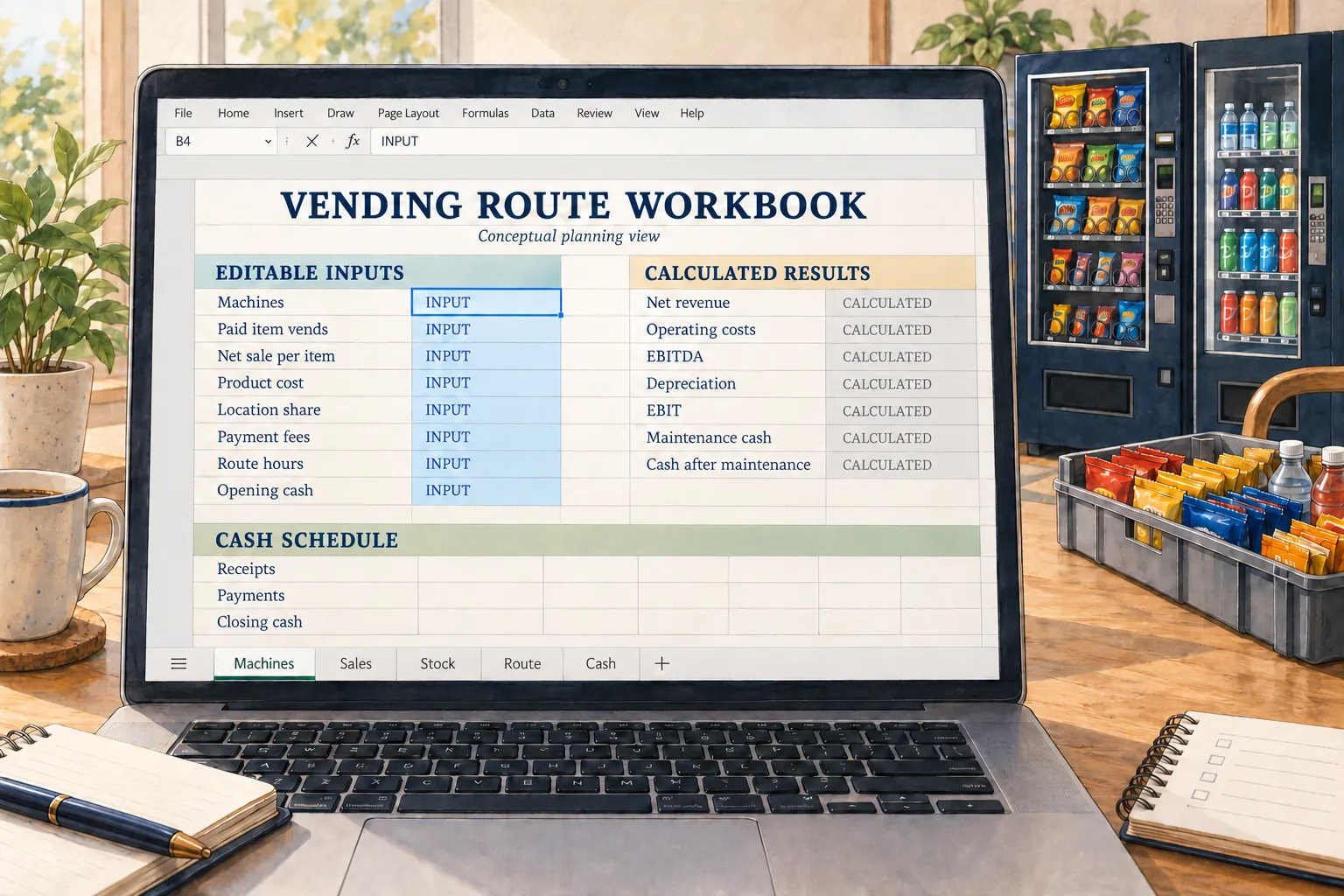
At that snapshot, loaded payroll is $3,650.54, mature EBITDA $764.76, depreciation-inclusive EBIT -$626.90 and cash after capital maintenance $564.76, before settlement movement, financing, income tax and distributions. Those measures answer different questions. The full calculator uses the same costs, stock, route travel and activity-linked recovery assumptions for its cash schedule and exports.
Planning information only. Obtain matched hardware, location, route, inventory, employer and insurance terms for the proposed operation.
What the customer buys and what makes the business repeatable.
The customer buys one packaged item successfully dispensed at a particular machine. A paid item-vend is the earning unit; a location-month describes where the transactions occur. One checkout containing several items, a card authorization without delivery, a free replacement or a refunded failure must not be counted as another successful paid item sale.
The same site can generate repeated purchases, but accepted placement and continuous machine presence do not establish recurring revenue. Products must be available, appropriately priced and delivered successfully. Track per-location item sales, refunds, out-of-stocks and collected contribution over a defined period rather than assuming every installed machine earns the route average.
The format on this site: Owner-operated route of ten indoor packaged snack-and-drink combination machines at ten accepted third-party locations, with paid replacement work. Fresh-food preparation, a staffed shop, micro-markets, coffee service, tobacco, alcohol, refrigerated prepared meals, outdoor sites, franchises, route acquisition with an inherited sales guarantee, machine manufacture, financing, unpaid owner work and multi-item basket pricing are outside this packaged snack-and-drink route reference.
Choose the format before choosing a budget.
Different formats need different operating plans
Format
What changes
How to use it
Local packaged snack-and-drink route
Ten indoor combination machines, ten accepted sites, paid replacement route/repair/management work
The reference format. No paid demand, location acceptance or installation price is inferred from the defaults.
Buy an operating route
Existing site agreements, item-level sales, settlement, stock, machine condition and transfer/exit rights
Use a separate acquisition case. Verify the evidence behind earnings and whether each location actually transfers.
Micro-market or staffed retail
Open shelves or a staffed counter, different checkout, security, shrink, access and operating work
Use a separate scope; vending positions and item-vends do not price that retail format.
Fresh meals, hot drinks or regulated products
Different product handling, temperature, preparation, servicing and permits
Quote the exact format and jurisdiction. These are outside the packaged snack-and-drink reference.
A founder prepared to develop and retain accepted sites, keep the right products available, reconcile small transactions and inventory, drive and service a controlled route, respond to equipment faults, and measure collected contribution after every host and payment charge. The model includes paid replacement work for owner duties.
Understand the reference operating plan.
The figures below are a national wage reference scenario. The paid roster uses May 2025 BLS national occupational medians. Prices, customer volume, rent, equipment and other commercial inputs are authored assumptions. This is not a researched average startup cost, owner-income promise or a funding recommendation.
One defined format · monthly amounts before financing and income taxes
Input or result
Reference
What to verify
Completed sales units
6,000 completed paid item-vends / month
6,000 completed paid item-vends per month; demand requires evidence.
Realized net revenue per paid item-vend
$2.50
Build and test a relevant local menu, package or contract scope.
Revenue
$15,000
Calculated volume × price, not observed sales.
Paid payroll
$3,651 / month
National wage medians × the stated hours × the 18% employer allowance.
Opening payments
$96,995
Authored equipment and setup allowances, deposit and paid training.
After the full paid roster and depreciation; before financing and income taxes.
Approximate EBIT threshold
Approximately 6,641.3 completed paid item-vends per month
A rounded estimate. Test whole permitted activity against the full roster and resource constraints.
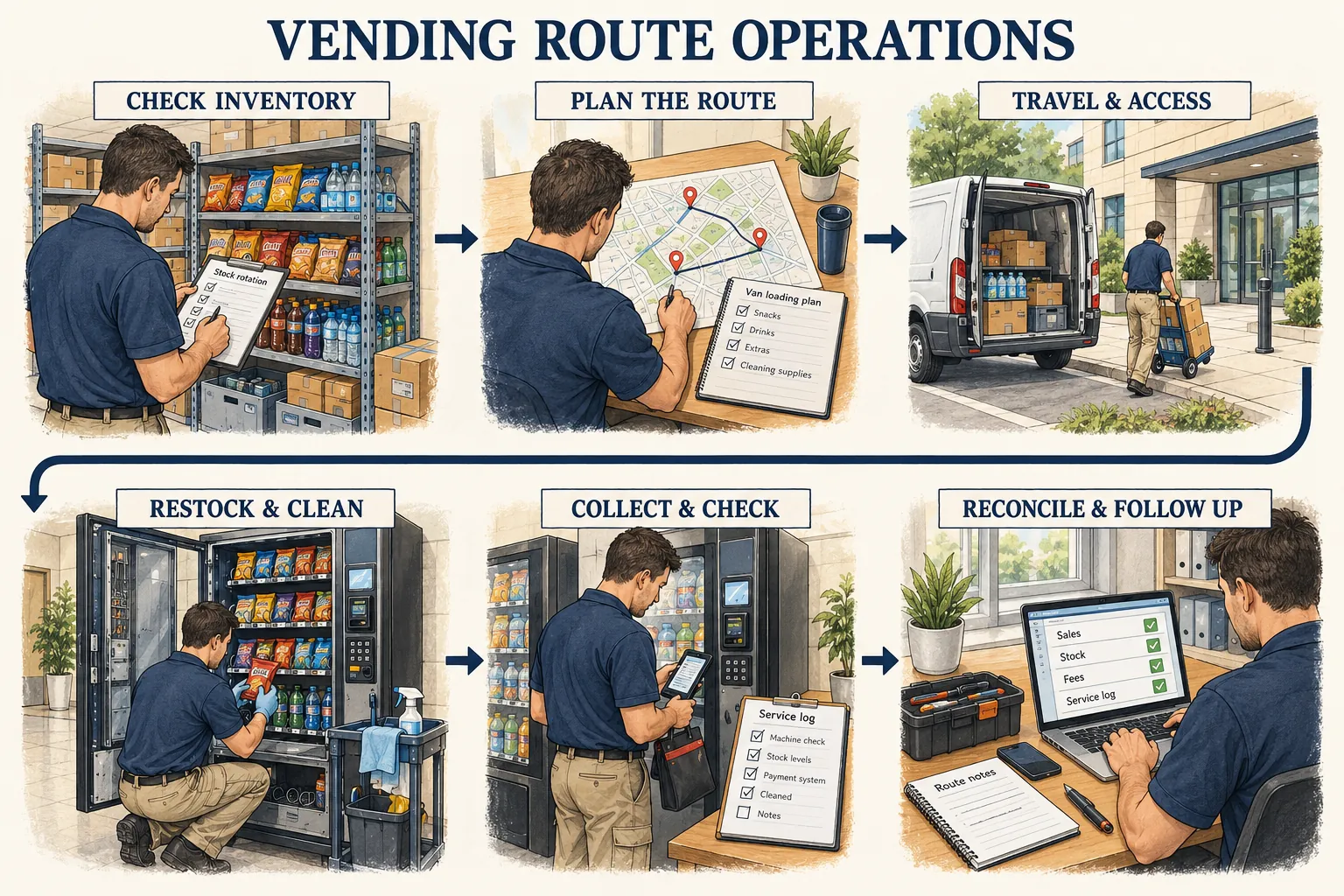
Ten machines at ten accepted indoor locations sell for an assumed 30 days each month. At 20 completed paid item-vends per machine-day, the route completes 6,000 vends. Six replenishment visits per machine make 60 monthly stops; the recurring calendar must actually keep the longest gap to five days. The assumed 180 usable stocked-item positions per machine, before 2% acquired-item loss, support 10,584 monthly paid vends under equal sales and mix; the stock calculation conservatively applies expected loss during that gap. Paid route coverage is 104 person-hours, technical repair 12 and management 17.33. At the complete 8,000-vend ceiling, the route uses 93.6 hours, repair 12 and management 8.8; expected incident work grows with the proposed activity. Vend 8,001 requires 12.00125 repair hours and exceeds that paid clock. Aggregate arithmetic does not establish a safe driving calendar, site access, compatible products, equipment uptime or paid demand; an individual busy machine can bind first.
The assumed $1.10 acquisition cost per stocked item and 2% loss of acquired items produce $1.1224489796 product cost per paid item-vend. A $2.50 realized net sale leaves contribution after that product cost, a 10% location commission and a 6% blended payment allowance. Both percentages are budget assumptions on net revenue, not quoted provider or host terms. The loss is charged once; refunded failed attempts do not become completed paid sales. The $1,000 monthly standing allowance comprises $450 vehicle fuel, registration, insurance and routine servicing, $100 for ten reader/telemetry subscriptions, $150 business insurance, $200 bookkeeping, communications and location development, and $100 cleaning and routine repair materials. These are unquoted allowances. Storage occupancy of $450, paid technical work, product cost and $200 capital-maintenance cash are separate. The $100 subscription budget is distinct from transaction charges; actual hardware, network, payment and minimum fees need a matched provider contract.
May 2025 BLS occupation medians anchor driver/sales, coin-vending-machine repair and general/operations management replacement work. These are cross-industry occupation proxies, not vending-route hiring quotes, contractor rates or a statement that a founder takes the resulting payroll home. The model pays 24 weekly route hours, 12 monthly repair hours and four weekly management hours; weekly amounts are annualized by 52/12. The 18% employer addition is an assumption. The 0.06 route recovery hour per expected customer/access incident is an aggregate allowance for triage, access, collection and extra driving across the assumed incident mix; it is not the duration of every extra trip. The separate 0.25 technical recovery hour adds diagnosis and repair, with that event’s driving already in the route pool. Events may overlap, but the same work is counted once. Verify actual duty scope, worker status, employer costs, relief, overtime and repairs before replacing any role with owner work.
The reference mature month does not cover all operating costs and depreciation. Review price, deliverable volume and the paid cost structure before treating the opening budget as viable.
Make retained item contribution justify the complete paid route
Interpretation of the national reference format
For this packaged snack-and-drink route, an accepted placement becomes useful only when successful paid item sales leave enough contribution after stock loss, host commission, payment costs and every paid route and repair duty. The national reference has positive mature cash but negative depreciation-inclusive EBIT, so machine presence and a cash surplus alone do not establish an adequate return.
The reference EBIT threshold is approximately 6,641.3 completed paid item-vends per month. Its assumed 6,000 completed paid item-vends per month produces -$627 of mature monthly EBIT. The proposed operation needs a change in contribution, deliverable volume or costs before the opening funding total can be treated as sufficient for a viable plan. These are scenario calculations with the other inputs held fixed, not a demand forecast or a recommended safety margin.
At 6,000 assumed monthly paid item-vends, the reference produces approximately $565 cash after capital maintenance but negative $627 EBIT. A 10% net-price reduction makes mature cash approximately negative $695. The feasible 8,000-vend aggregate ceiling still depends on actual access, selection availability, route handling and repair support; neither capacity nor a seller claim establishes demand.
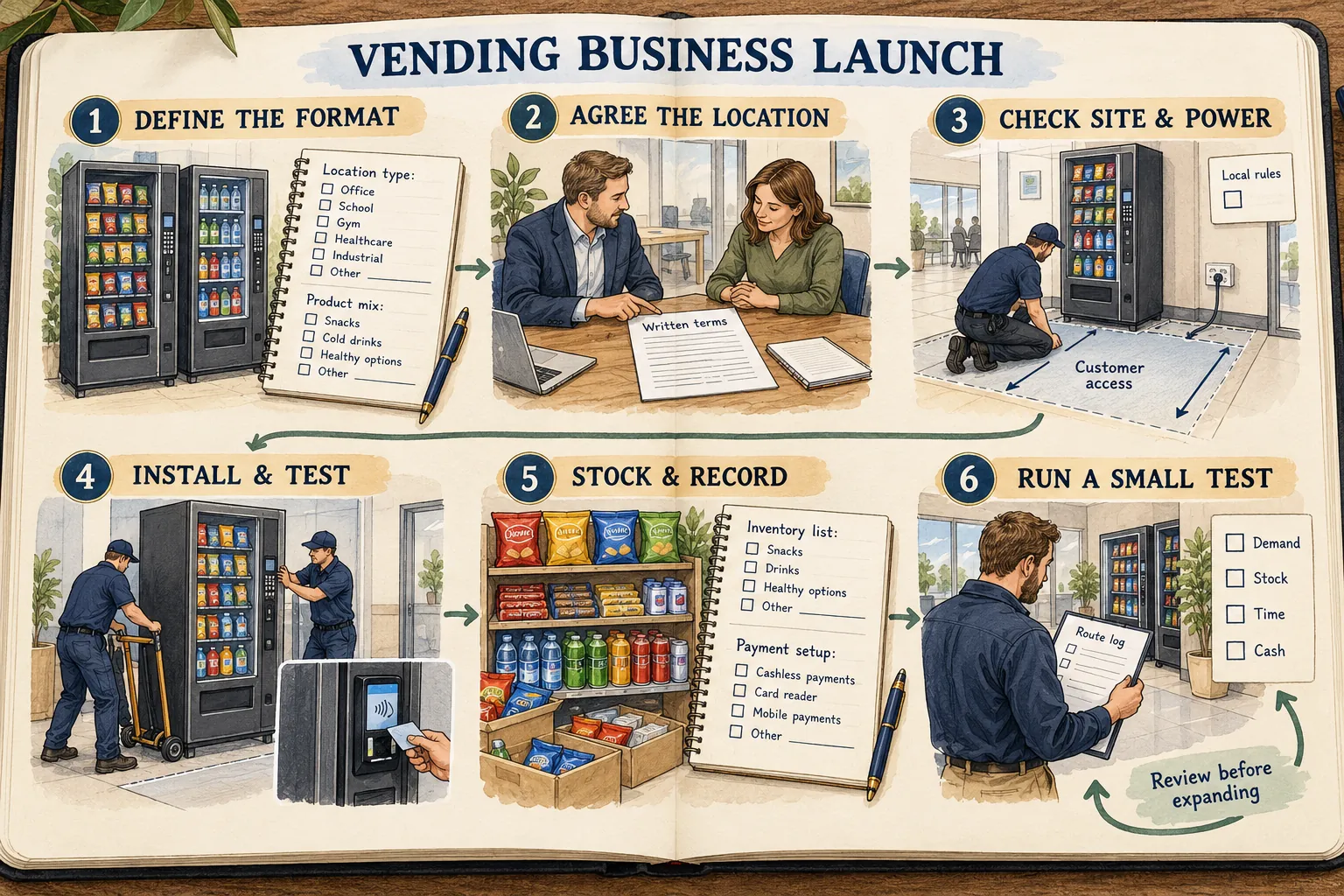
Test one complete replenishment and settlement cycle at an accepted site. Reconcile supplied paid items, net price, stock movement, host/provider terms, tax and all paid work. Reconsider equipment or another placement if the supported contribution cannot cover the complete route, physical stock constraints and asset commitment.
Record one machine per site, successful paid item-vends, product mix, tax treatment, net price and written host responsibilities.
Scope the actual installed commitment
Obtain machine-condition and payment-ready quotes, delivery/access/installation terms, warranty response, storage/vehicle costs and exit/removal obligations.
Pay and time the complete route
Budget preparation, driving, access, restocking, cleaning, collection, customer support, repair, management, relief and employer costs. Owner operation does not make these hours free.
Test cash before scaling
Reconcile a paid location cohort to stock, commissions, payment fees, refunds and settlement; fund inventory and dated deficits from the same inputs before another placement.
Your first evidence task: Follow one accepted location through a complete replenishment and settlement cycle: opening stock, delivery, successful paid items, refunds, losses, closing stock, commission, tax, provider fees, every paid stop/repair hour and actual cash. A 10% net-price fall changes the held national mature cash result from approximately $565 to negative $695, even before any change in sales or acquired-item cost.
What to measure in the first operating weeks.
A small operating dashboard
Measure
Why it changes a decision
Accepted locations and installed availability
Separates signed site rights, installed working machines, access restrictions, outages and removal/redeployment commitments.
Paid item-vends and realized yield
Tracks one successfully supplied item, net of refund and tax, at the identified machine and selling period.
Stock, lost items and selection availability
Reconciles beginning stock, receipts, successful vends, waste/loss, ending stock and the selection that actually sells.
Complete route and repair clocks
Includes warehouse preparation, every stop and drive, access, cleaning, collection, incident recovery, technical repair and management.
Review actuals against the scope you priced. If an extra service, new trading hour or more distant client changes the work, update the roster and contribution calculation before expanding.
Prepare the right approval brief.
Bring the exact locations, product types, temperature/handling scope, machine dimensions and power, delivery and accessibility arrangements, storage, owner/operator responsibilities, taxable sales, payment/refund process, host agreements, employment and repair arrangements to the responsible authorities, landlords/hosts, insurer and qualified advisers. Confirm official requirements for each machine jurisdiction and product rather than applying one state’s food or tax treatment to the entire route.
Pause equipment or placement commitments when the site is unaccepted, the quoted payment-ready scope is unmatched, a machine’s stock or service gap cannot support the promised sales, the complete route is overbooked, or the plan counts unpaid owner work or gross tax collections as profit. A positive mature cash result alone does not recover the installed assets.
Write a response that changes the actual cause: narrower scope, a different site, revised paid staffing, a tested price or a delayed opening. A larger cash buffer only addresses a temporary timing gap.
Restaurant earns from completed paid guest covers at a realized net meal check and is constrained by kitchen and service stations, seats, preparation, cleanup and paid peak coverage. Vending Machine Business earns net product contribution only from successfully supplied paid items at accepted locations, while funding stock, host/payment charges, the complete route and technical recovery. Compare their own earning units, paid resource clocks, installed commitments and cash dates.
Coffee Shop earns from completed counter orders at a realized drink-and-food basket and is constrained by ordering, preparation, pickup, peak queues and paid opening/closing coverage. Vending Machine Business earns net product contribution only from successfully supplied paid items at accepted locations, while funding stock, host/payment charges, the complete route and technical recovery. Compare their own earning units, paid resource clocks, installed commitments and cash dates.
Cleaning Business earns from earned recurring account-months with the promised service scope and visit frequency and is constrained by crew person-hours, access, paid travel, supervision and corrective work. Vending Machine Business earns net product contribution only from successfully supplied paid items at accepted locations, while funding stock, host/payment charges, the complete route and technical recovery. Compare their own earning units, paid resource clocks, installed commitments and cash dates.
Hair Salon earns from completed paid appointments at a weighted hair-service mix and is constrained by stylist clocks, chairs, treatment time, preparation, sanitation and rebooking. Vending Machine Business earns net product contribution only from successfully supplied paid items at accepted locations, while funding stock, host/payment charges, the complete route and technical recovery. Compare their own earning units, paid resource clocks, installed commitments and cash dates.
Auto Detailing Business earns from completed scoped vehicle packages and is constrained by technician person-hours, vehicle condition, bay occupation, preparation and handover. Vending Machine Business earns net product contribution only from successfully supplied paid items at accepted locations, while funding stock, host/payment charges, the complete route and technical recovery. Compare their own earning units, paid resource clocks, installed commitments and cash dates.
Laundromat earns from paid washer starts and associated drying revenue in the defined equipment mix and is constrained by machine cycles, dryer/utility capacity, peak circulation, uptime and maintenance. Vending Machine Business earns net product contribution only from successfully supplied paid items at accepted locations, while funding stock, host/payment charges, the complete route and technical recovery. Compare their own earning units, paid resource clocks, installed commitments and cash dates.
Daycare Center earns from earned enrolled child-weeks by accepted age group and is constrained by licensed rooms, age-group ratios, qualified paid coverage, relief and enrollment. Vending Machine Business earns net product contribution only from successfully supplied paid items at accepted locations, while funding stock, host/payment charges, the complete route and technical recovery. Compare their own earning units, paid resource clocks, installed commitments and cash dates.
Pet Grooming Salon earns from completed grooming visits at a weighted animal-size and service mix and is constrained by groomer/bather time, tubs, drying, tables, sanitation and safe handover. Vending Machine Business earns net product contribution only from successfully supplied paid items at accepted locations, while funding stock, host/payment charges, the complete route and technical recovery. Compare their own earning units, paid resource clocks, installed commitments and cash dates.
Landscaping Company earns from completed recurring property-maintenance visits and is constrained by crew clocks, route density, travel, site access, weather and seasonal completion. Vending Machine Business earns net product contribution only from successfully supplied paid items at accepted locations, while funding stock, host/payment charges, the complete route and technical recovery. Compare their own earning units, paid resource clocks, installed commitments and cash dates.
Food Truck earns from completed paid food orders at a realized net ticket and is constrained by paid preparation, commissary, travel, feasible service windows and truck throughput. Vending Machine Business earns net product contribution only from successfully supplied paid items at accepted locations, while funding stock, host/payment charges, the complete route and technical recovery. Compare their own earning units, paid resource clocks, installed commitments and cash dates.
Bakery earns from paid retail baskets at a realized product mix and is constrained by whole batches, production coverage, counter flow, sell-through, freshness and waste. Vending Machine Business earns net product contribution only from successfully supplied paid items at accepted locations, while funding stock, host/payment charges, the complete route and technical recovery. Compare their own earning units, paid resource clocks, installed commitments and cash dates.
Fitness Studio earns from retained billable member-months at realized net yield and is constrained by class timetable, instructor hours, usable spots, promised access, churn and collections. Vending Machine Business earns net product contribution only from successfully supplied paid items at accepted locations, while funding stock, host/payment charges, the complete route and technical recovery. Compare their own earning units, paid resource clocks, installed commitments and cash dates.
HVAC Company earns from completed service calls and replacement jobs in a stated mix and is constrained by qualified technician clocks, travel, diagnosis, parts, installation and callbacks. Vending Machine Business earns net product contribution only from successfully supplied paid items at accepted locations, while funding stock, host/payment charges, the complete route and technical recovery. Compare their own earning units, paid resource clocks, installed commitments and cash dates.
Moving Company earns from completed local household moves and is constrained by whole crew/truck blocks across origin, travel, destination, handling and reset. Vending Machine Business earns net product contribution only from successfully supplied paid items at accepted locations, while funding stock, host/payment charges, the complete route and technical recovery. Compare their own earning units, paid resource clocks, installed commitments and cash dates.
Auto Repair Shop earns from completed authorized repair orders with realized labor and parts yield and is constrained by technician clocks, bay dwell, lifts, parts readiness, customer authorization and rework. Vending Machine Business earns net product contribution only from successfully supplied paid items at accepted locations, while funding stock, host/payment charges, the complete route and technical recovery. Compare their own earning units, paid resource clocks, installed commitments and cash dates.
Plumbing Company earns from completed and collected residential plumbing jobs and is constrained by qualified plumber clocks, vehicles, travel, diagnosis, materials, permits and callbacks. Vending Machine Business earns net product contribution only from successfully supplied paid items at accepted locations, while funding stock, host/payment charges, the complete route and technical recovery. Compare their own earning units, paid resource clocks, installed commitments and cash dates.
Electrical Contractor earns from completed and collected electrical service and alteration jobs and is constrained by qualified electrician clocks, sold-hour realization, vehicles, materials, inspections and rework. Vending Machine Business earns net product contribution only from successfully supplied paid items at accepted locations, while funding stock, host/payment charges, the complete route and technical recovery. Compare their own earning units, paid resource clocks, installed commitments and cash dates.
Pest Control Company earns from retained paid residential service-plan months and is constrained by qualified technicians, initial and routine visits, travel, records and callbacks. Vending Machine Business earns net product contribution only from successfully supplied paid items at accepted locations, while funding stock, host/payment charges, the complete route and technical recovery. Compare their own earning units, paid resource clocks, installed commitments and cash dates.
Residential Remodeling Company earns from accepted delivered interior scope in earned-project equivalents and is constrained by carpenter/management clocks, selections, authorized trades, inspection timing and rework. Vending Machine Business earns net product contribution only from successfully supplied paid items at accepted locations, while funding stock, host/payment charges, the complete route and technical recovery. Compare their own earning units, paid resource clocks, installed commitments and cash dates.
Self-Storage Facility earns from occupied unit-months by size at realized net rent and is constrained by rentable unit inventory, condition, access, paid accounts/leasing/maintenance and turnover. Vending Machine Business earns net product contribution only from successfully supplied paid items at accepted locations, while funding stock, host/payment charges, the complete route and technical recovery. Compare their own earning units, paid resource clocks, installed commitments and cash dates.
Dog Daycare and Boarding earns from paid day-only animal visits and boarding dog-nights without double-counting residents and is constrained by simultaneous dog places, suites, distinct handlers, rest/isolation, sanitation and night coverage. Vending Machine Business earns net product contribution only from successfully supplied paid items at accepted locations, while funding stock, host/payment charges, the complete route and technical recovery. Compare their own earning units, paid resource clocks, installed commitments and cash dates.
Tutoring Center earns from completed student sessions and whole instructional group blocks and is constrained by competent tutors, rooms, compatible groups, preparation, enrollment and family coordination. Vending Machine Business earns net product contribution only from successfully supplied paid items at accepted locations, while funding stock, host/payment charges, the complete route and technical recovery. Compare their own earning units, paid resource clocks, installed commitments and cash dates.
Home Health Care Agency earns from completed private-pay RN visits and delivered supervised aide-care hours and is constrained by qualified field/clinical-direction/alternate pools, care plans, travel, records and availability. Vending Machine Business earns net product contribution only from successfully supplied paid items at accepted locations, while funding stock, host/payment charges, the complete route and technical recovery. Compare their own earning units, paid resource clocks, installed commitments and cash dates.
No. It is an authored case: ten machines × 30 selling days × 20 successful paid item-vends per machine-day. It is neither observed site demand nor a seller earnings claim.
Does the model pay the owner?
It budgets paid replacement route, repair and management work using occupation wage anchors and an assumed employer addition. This payroll is an operating cost proxy; the resulting profit or cash is not an owner take-home amount.
How is 2% inventory loss charged?
It is 2% of acquired items. Supplying one paid item therefore requires 1 ÷ 0.98 acquired items on average, making product cost $1.10 ÷ 0.98. The loss is not charged again as 2% of sales.
Why can cash be positive when EBIT is negative?
The reference charges approximately $1,392 monthly depreciation in EBIT but pays $200 capital-maintenance cash. These answer different questions; the smaller cash allowance does not prove that future asset replacement is fully funded.
Are the 10% commission and 6% payment charge quoted terms?
No. They are teaching allowances on net sales. The actual host and provider may use gross tax-inclusive sales, fixed transaction charges, cashless share, subscriptions or minimums; calculate the matched effective cost.
Does a machine’s nominal capacity prove the route sales ceiling?
No. Stock mix, the busiest machine, shelf life, access, downtime and paid service work can bind first. The disclosed 8,000-vend ceiling checks expected recovery at that proposed activity and is not a sales forecast.
Sorting compares one defined format. It does not rank states for attractiveness or prove demand. Funding includes opening payments, the deepest cumulative operating cash deficit in the 60-month model and the retained cash buffer.
Vending Machine Business · same commercial assumptions, state occupational wage medians
State
Funding scenario
Loaded payroll / month
Approximate EBIT threshold completed paid item-vends per month
Published research and calculations support business planning and education. They are not personalized financial, investment, tax or legal advice, and they do not guarantee costs, revenue, profit or financing. Estimates depend on the stated format, location, source periods and assumptions. Check the requirements and commitments that apply to your circumstances.