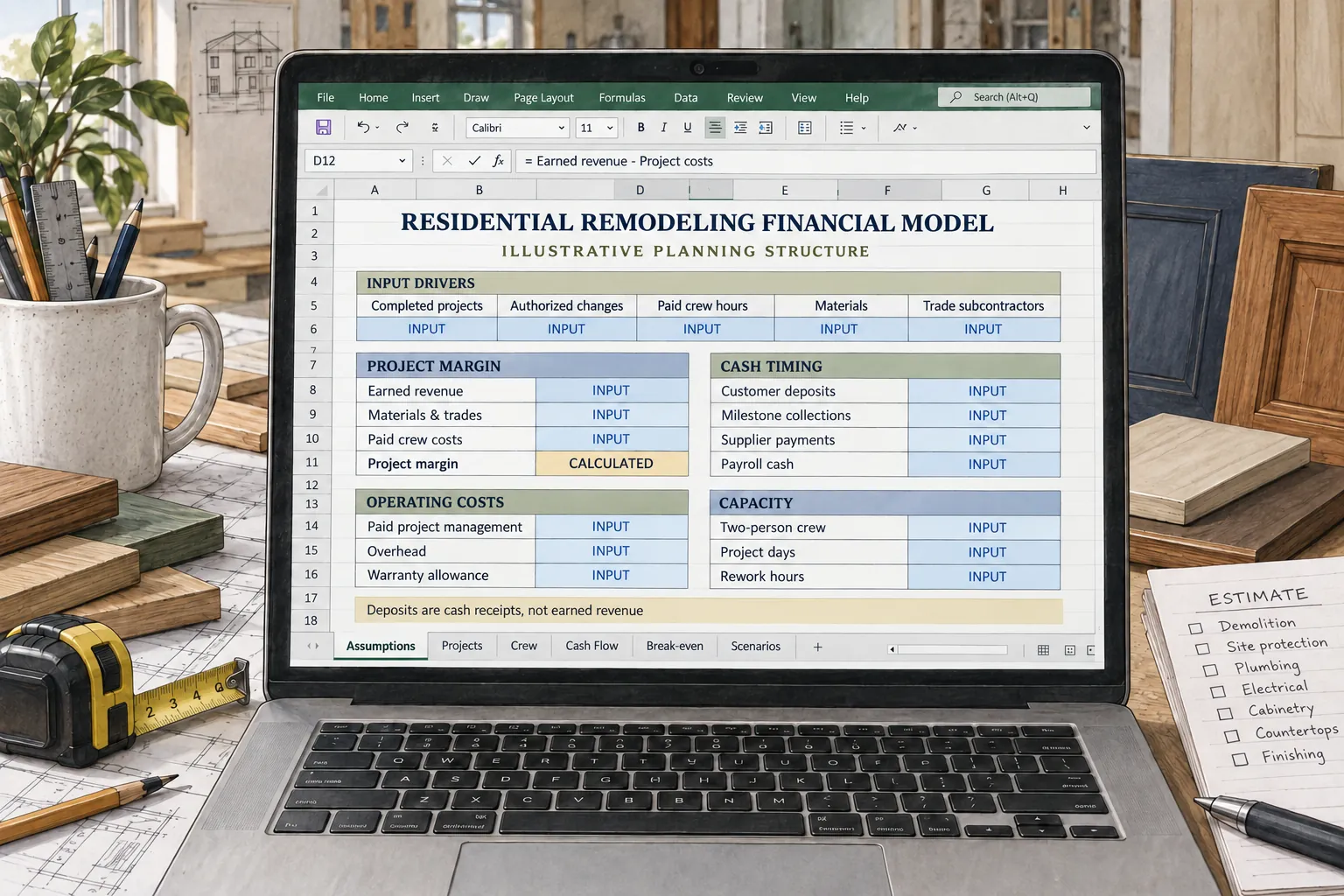
Start a Residential Remodeling Company by defining a measured interior scope, confirming contractor and specialty-trade authority, and pricing the complete paid-work and cash sequence. At 2 earned-project equivalents a month and $28,000 per equivalent, the reference models $56,000 earned revenue and $1,126 monthly cash after maintenance before receivable movement. Cash break-even is 1.9212 equivalents against a 2.2-equivalent management ceiling. All commercial values are assumptions; customer advances and signed backlog are separate from earned income.
What the customer buys and what makes the business repeatable.
One earned-project equivalent is $28,000 of accepted delivered scope from comparable interior remodeling work. A calendar month can contain partial earned scope from several whole projects. The equivalent measure reconciles delivered value to the financial plan; it is not a count of signed jobs, deposits, households served or guaranteed monthly completions.
Referrals and additional work can support future contracts, but a signed backlog still needs accepted scope, customer decisions, trade availability and funded delivery. Track repeat customers, referral sources, estimate conversion and cash separately. Avoid treating every accepted change order as pure profit: additional material, specialist work, crew time, delay and collection risk travel with it.
The format on this site: Two-carpenter residential interior remodeling company with paid project management and licensed specialty subcontractors. New houses, additions, structural changes, whole-house major reconstruction, commercial work, developer speculation, insurance-restoration programs, franchises and unpaid owner labor are outside this interior reference. Specialty electrical, plumbing and HVAC work requires its own authorized trade scope; hazardous-material remediation, asbestos and lead obligations require separate applicability checks.
Choose the format before choosing a budget.
Different formats need different operating plans
Format
What changes
How to use it
Two-carpenter interior remodeling operator
Paid employee carpentry, paid project management and administration, specialty trades under their own authorized scope
Reference format: comparable interior projects, written selections, protection, earned milestones, acceptance and collections.
Owner-only repair and handyman service
A different labor model, transaction size, authority boundary and schedule
Do not remove management or payroll from this reference to manufacture an owner-only profit. Build that narrower service separately.
Additions, structural conversion or major whole-house work
Design, engineering, larger specialist and procurement commitments, inspections and longer cash cycles
Use a separate scope, credentials, cost and dated cash model; the small interior project value does not establish its economics.
A founder prepared to manage measured scopes, customer selections, employee carpentry, authorized specialty trades, purchase commitments, job costing, site protection, inspections, change orders and customer cash. This format calls for calm scope control and records that expose problems before the next contract is promised.
Understand the reference operating plan.
The figures below are a national wage reference scenario. The paid roster uses May 2025 BLS national occupational medians. Prices, customer volume, rent, equipment and other commercial inputs are authored assumptions. This is not a researched average startup cost, owner-income promise or a funding recommendation.
One defined format · monthly amounts before financing and income taxes
Input or result
Reference
What to verify
Earned-project equivalents
2 earned-project equivalents / month
2 earned-project equivalents per month; demand requires evidence.
Net selling price
$28,000.00
Build and test a relevant local menu, package or contract scope.
Revenue
$56,000
Calculated volume × price, not observed sales.
Paid payroll
$18,734 / month
National wage medians × the stated hours × the 18% employer allowance.
Opening payments
$93,544
Authored equipment and setup allowances, deposit and paid training.
After the full paid roster and depreciation; before financing and income taxes.
EBIT break-even
1.9 earned-project equivalents per month
A sales threshold to compare with capacity and tested demand.
Two paid carpenters provide 346.67 person-hours per month. After 32 hours of nonproject work, the assumed 140 person-hours per earned-project equivalent supports 2.2476 equivalents on an average-hours basis. A separate authored management ceiling reduces the reference to 2.2. At 2 equivalents, the crew uses 312 hours including nonproject work. Equivalents express earned value of comparable scope; they are not fractional physical jobs, and a dated sequence of whole projects, subcontractors, deliveries and inspections must fit the same paid roster.
48% of earned contract value for materials, licensed specialty subcontractors, disposal and other job-specific cash costs, plus a 1% collection-cost provision. Employee carpentry, owner management and administration are paid once in payroll. These are assumed project-cost shares, not a verified local bid or industry margin. The $6,500 monthly standing allowance covers vehicle running costs, insurance, estimating and project software, communication, marketing, professional support, small tools and administration. The $1,200 storage/dispatch allowance and $1,000 maintenance investment are separate. Obtain matched entity, vehicle, work-category and address quotes.
May 2025 Carpenter, Construction Manager and Administrative Assistant occupation medians anchor the complete paid roster. The construction-manager wage is a replacement-cost proxy for the stated owner duties, not a draw, recruiting quote or proof of qualifying-person eligibility. The 18% employer allowance is an authored teaching input; benefits, overtime and actual employer costs require a separate quote and sensitivity.
Opening funding includes the van, tools and protection, storage setup, credentials and insurance deposits, systems, marketing, opening materials, contingency, a refundable premises deposit, paid pre-opening training, the modeled operating ramp and retained cash buffer. The 15-day receivable assumption creates cash needs even when earned contribution is positive. No customer advance funds the default national scenario.
Recognize revenue only for accepted delivered scope under the stated contract and accounting policy, expressed as comparable earned-project equivalents. Signed estimates, backlog, purchased materials, customer advances and open invoices are different records. The monthly reference assumes 15 days of earned revenue remains receivable and no advance; the separate milestone guide shows how collections can lag earned work. Track actual dated receipts, supplier payments, paid wages, customer advances, retainage, tax, refunds and changes independently.
A positive reference EBIT depends on the assumed paid sales volume and costs. It does not establish local demand or cash available for owner withdrawals.
Protect contribution before funding the next milestone
Interpretation of the national reference format
This interior remodeling format warrants a narrow operating test before accepting the paid roster and supplier commitments. The reference produces only $1,126 of mature monthly cash after maintenance at 2 earned-project equivalents. Scope overruns, extra employer costs or delayed earning can reverse that result; a signed backlog cannot establish either margin or cash.
The reference requires 1.9 earned-project equivalents per month for EBIT break-even. At 1.6 earned-project equivalents per month (20% below the volume assumption), monthly EBIT falls to -$4,503. This exposes the need to substantiate paid volume before relying on the positive reference month. These are scenario calculations with the other inputs held fixed, not a demand forecast or a recommended safety margin.
The national teaching case requires $227,450 of opening funding including its reserve, models -$62,186 of first-year operating cash and has no cumulative cash payback within 60 months. Its small stabilized surplus is therefore a reason to test cost and earning assumptions carefully, not evidence that the full opening commitment will repay itself.
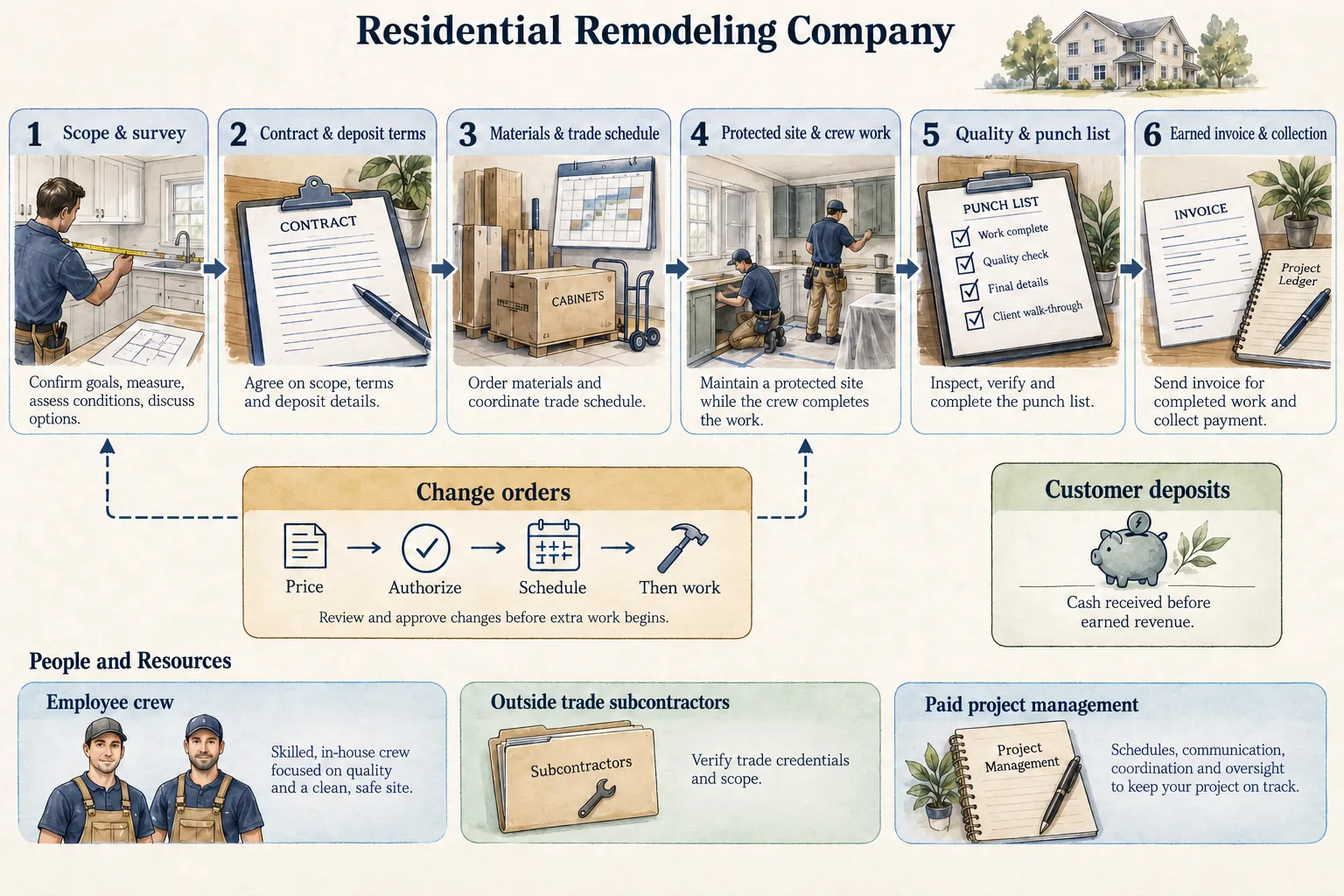
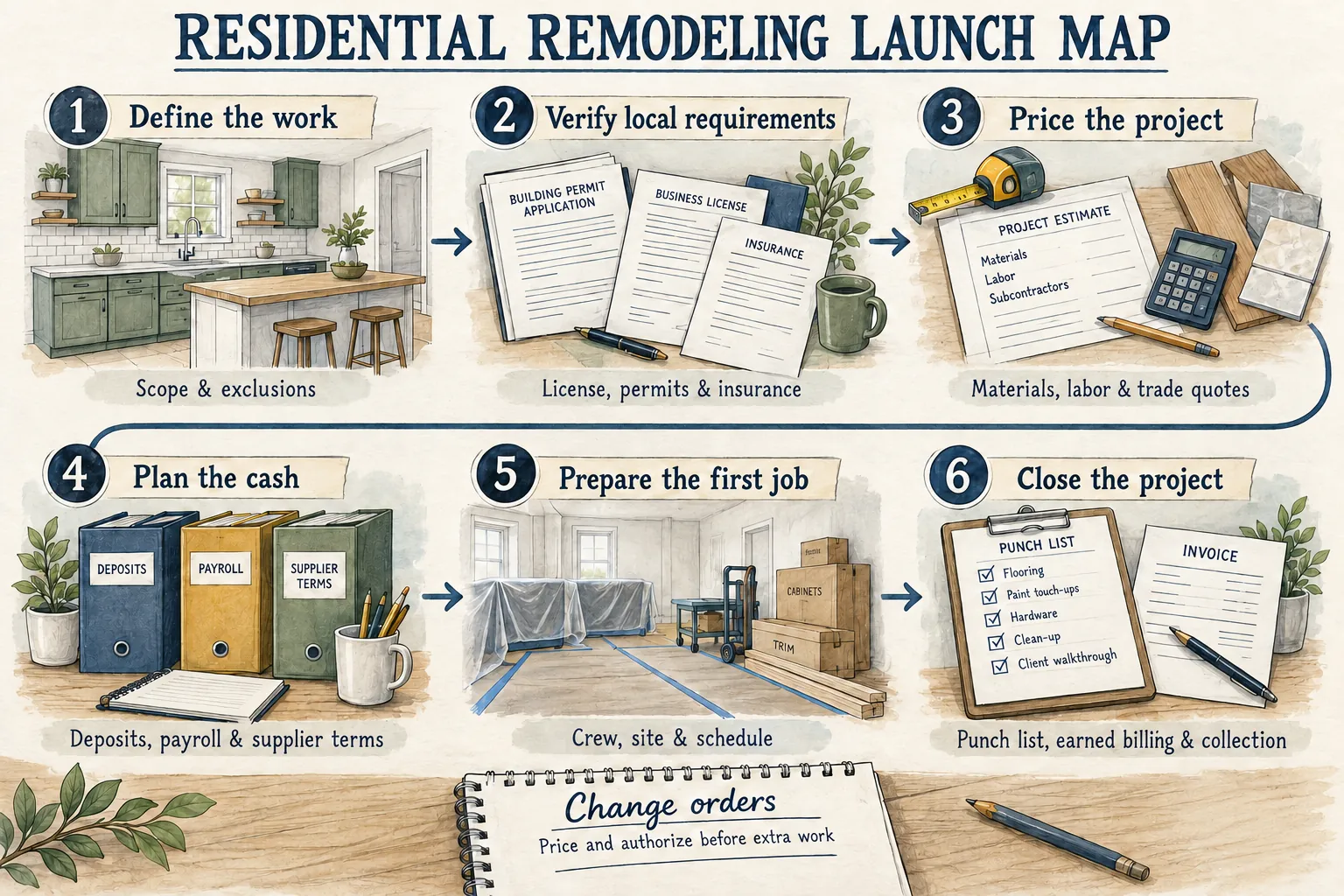
Price one measured scope from matched supplier and authorized specialty-trade quotes, record every employee person-hour, and connect delivered acceptance to compliant invoice and actual cash dates. Reconsider scope, price, sequencing or commitments when supported contribution and dated funding cannot serve the same paid calendar.
Survey one representative property and write included work, quantities, customer selections, allowances, specialist scope, exclusions and the acceptance record. Separate hidden-condition discovery from a confirmed fixed scope.
Resolve authority and consumer terms
Check the exact contracting entity, qualifying person, subcontracted trades, permits, lead-safe applicability, insurance, cancellation rights and deposit/payment rules with the responsible offices and advisers.
Quote full delivery
Obtain scope-matched supplier and authorized specialty-trade quotes, then measure complete employee person-hours. Attach changes and rework to the original project.
Rehearse the milestone cash sequence
Schedule deliveries, work, inspections, acceptance, earned invoices and collections. Reprice, narrow work or defer a commitment if the paid roster and cash balance cannot support the sequence.
Your first evidence task: For one representative interior project, connect the measured survey and accepted scope to supplier quotes, authorized specialist scopes, every paid crew hour, dated delivery and inspections, customer selections, priced changes, earned milestones, invoices, advance applications, collections, punch-list and warranty recovery. Use that complete record to test the next comparable bid.
What to measure in the first operating weeks.
A small operating dashboard
Measure
Why it changes a decision
Earned delivered value and accepted scope
Separates work earned from signed backlog, advances, material orders, open invoices and collections.
Direct cost and change-order margin
Reconciles materials, specialist work, freight, disposal, supplier credits, approved changes and cost to complete.
Carpenter person-hours and whole-project sequence
Counts protection, travel, receiving, preparation, installation, cleanup and rework against paid crew capacity.
Records customer selections, trade tests, required inspection status, punch-list closure and warranty work against the original scope.
Review actuals against the scope you priced. If an extra service, new trading hour or more distant client changes the work, update the roster and contribution calculation before expanding.
Prepare the right approval brief.
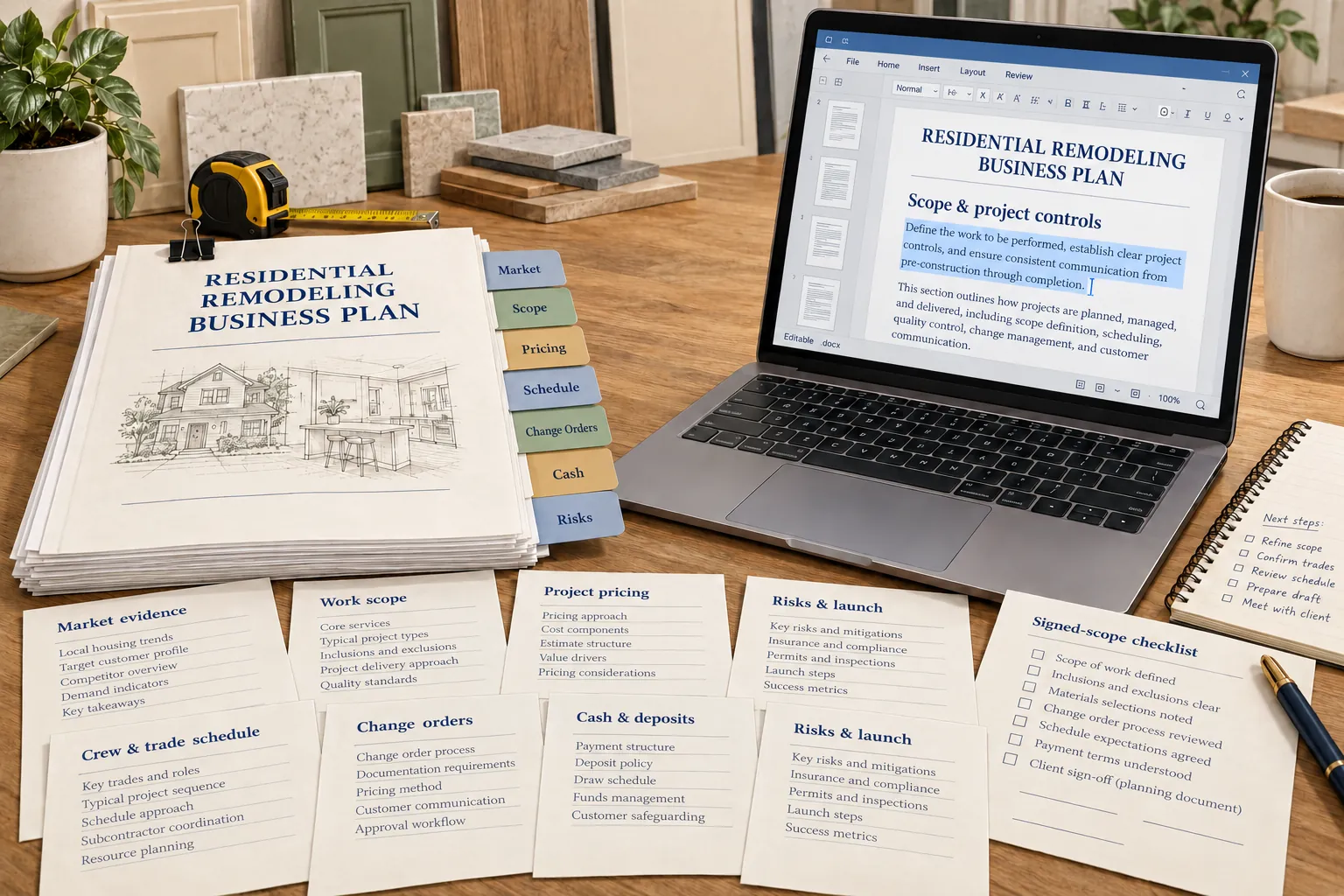
Take the exact business entity, ownership, qualifying person, service jurisdiction, interior work categories, existing structure, specialty electrical/plumbing/HVAC scope, paint disturbance, customer contracts, cancellation and advance terms, premises and vehicle use, employees, waste handling, insurance and record obligations to the responsible contractor authority, building department, labor and safety agencies, consumer office, insurer and advisers. Confirm which credentials, permits, inspections, bonds, contract disclosures and payment restrictions apply to the actual operation.
Pause a commitment when modeled break-even needs more earned scope than the paid calendar can deliver, specialty trade work lacks matched authority or insurance, the quoted scope hides unpriced quantities, the customer-selection schedule is unresolved, or supplier and payroll payments fall before supported collections without funded cash.
Write a response that changes the actual cause: narrower scope, a different site, revised paid staffing, a tested price or a delayed opening. A larger cash buffer only addresses a temporary timing gap.
Test remodeling earned-project contribution, paid crew and overhead break-even, customer advances and collected milestone cash in one independent teaching calculator.
Build a measured remodeling scope, coordinate paid crews and specialty trades, control changes and connect accepted work to earned invoices and customer cash.
Restaurant earns from paid guest covers and realized meal check and is constrained by kitchen stations, paid preparation, service peaks and guest handling. Residential Remodeling Company earns accepted interior scope, expressed as comparable project equivalents, while controlling a paid carpenter crew and authorized specialty trades. Compare the complete paid operating mechanism and dated cash, using each format’s own unit.
Coffee Shop earns from completed counter orders and a realized drink-and-food basket and is constrained by ordering, beverage production and pickup within short buying windows. Residential Remodeling Company earns accepted interior scope, expressed as comparable project equivalents, while controlling a paid carpenter crew and authorized specialty trades. Compare the complete paid operating mechanism and dated cash, using each format’s own unit.
Cleaning Business earns from an active recurring commercial account-month and is constrained by account scope, visit frequency, paid travel, access and supervision. Residential Remodeling Company earns accepted interior scope, expressed as comparable project equivalents, while controlling a paid carpenter crew and authorized specialty trades. Compare the complete paid operating mechanism and dated cash, using each format’s own unit.
Hair Salon earns from completed appointments and a service-mix ticket and is constrained by paid stylist time, service duration, stations and the actual appointment diary. Residential Remodeling Company earns accepted interior scope, expressed as comparable project equivalents, while controlling a paid carpenter crew and authorized specialty trades. Compare the complete paid operating mechanism and dated cash, using each format’s own unit.
Auto Detailing Business earns from completed scoped vehicle packages and is constrained by technician person-hours, vehicle condition, bay occupation and handover. Residential Remodeling Company earns accepted interior scope, expressed as comparable project equivalents, while controlling a paid carpenter crew and authorized specialty trades. Compare the complete paid operating mechanism and dated cash, using each format’s own unit.
Laundromat earns from paid washer starts and attached drying revenue and is constrained by washer-size mix, dryers, utility capacity, uptime and peak customer circulation. Residential Remodeling Company earns accepted interior scope, expressed as comparable project equivalents, while controlling a paid carpenter crew and authorized specialty trades. Compare the complete paid operating mechanism and dated cash, using each format’s own unit.
Daycare Center earns from paid enrolled child-weeks by age group and is constrained by licensed rooms, applicable group/ratio rules, qualified staff and full-day relief. Residential Remodeling Company earns accepted interior scope, expressed as comparable project equivalents, while controlling a paid carpenter crew and authorized specialty trades. Compare the complete paid operating mechanism and dated cash, using each format’s own unit.
Pet Grooming Salon earns from completed grooming visits at a weighted size-and-service mix and is constrained by groomer and bather time, tubs, drying, tables and safe handover. Residential Remodeling Company earns accepted interior scope, expressed as comparable project equivalents, while controlling a paid carpenter crew and authorized specialty trades. Compare the complete paid operating mechanism and dated cash, using each format’s own unit.
Landscaping Company earns from completed recurring maintenance visits and is constrained by crew person-hours, route density, seasonal availability, access and weather-adjusted completions. Residential Remodeling Company earns accepted interior scope, expressed as comparable project equivalents, while controlling a paid carpenter crew and authorized specialty trades. Compare the complete paid operating mechanism and dated cash, using each format’s own unit.
Food Truck earns from completed paid food orders at a realized net ticket and is constrained by paid preparation, commissary, travel, feasible service windows and truck throughput. Residential Remodeling Company earns accepted interior scope, expressed as comparable project equivalents, while controlling a paid carpenter crew and authorized specialty trades. Compare the complete paid operating mechanism and dated cash, using each format’s own unit.
Bakery earns from paid retail baskets at a realized product mix and is constrained by whole batches, paid production coverage, counter flow, sell-through and waste. Residential Remodeling Company earns accepted interior scope, expressed as comparable project equivalents, while controlling a paid carpenter crew and authorized specialty trades. Compare the complete paid operating mechanism and dated cash, using each format’s own unit.
Fitness Studio earns from retained billable member-months at realized net yield and is constrained by class timetable, instructor hours, usable spots, promised access, churn and collections. Residential Remodeling Company earns accepted interior scope, expressed as comparable project equivalents, while controlling a paid carpenter crew and authorized specialty trades. Compare the complete paid operating mechanism and dated cash, using each format’s own unit.
HVAC Company earns from completed service calls and replacement jobs in a disclosed mix and is constrained by paid technicians, travel, diagnosis, parts, equipment, installation mix and callbacks. Residential Remodeling Company earns accepted interior scope, expressed as comparable project equivalents, while controlling a paid carpenter crew and authorized specialty trades. Compare the complete paid operating mechanism and dated cash, using each format’s own unit.
Moving Company earns from completed local household moves and is constrained by whole crew-and-truck blocks across yard, origin, route, destination and reset. Residential Remodeling Company earns accepted interior scope, expressed as comparable project equivalents, while controlling a paid carpenter crew and authorized specialty trades. Compare the complete paid operating mechanism and dated cash, using each format’s own unit.
Auto Repair Shop earns from completed repair orders with realized labor and parts revenue and is constrained by paid technician hours, bay dwell, lifts, parts readiness, authorization and rework. Residential Remodeling Company earns accepted interior scope, expressed as comparable project equivalents, while controlling a paid carpenter crew and authorized specialty trades. Compare the complete paid operating mechanism and dated cash, using each format’s own unit.
Plumbing Company earns from completed and collected residential plumbing jobs and is constrained by paid plumber time, vehicles, travel, diagnosis, materials, permits and callbacks. Residential Remodeling Company earns accepted interior scope, expressed as comparable project equivalents, while controlling a paid carpenter crew and authorized specialty trades. Compare the complete paid operating mechanism and dated cash, using each format’s own unit.
Electrical Contractor earns from completed and collected electrical service and small-alteration jobs and is constrained by paid electrician time, sold-hour realization, vehicles, materials, permits, inspections and rework. Residential Remodeling Company earns accepted interior scope, expressed as comparable project equivalents, while controlling a paid carpenter crew and authorized specialty trades. Compare the complete paid operating mechanism and dated cash, using each format’s own unit.
Pest Control Company earns from retained paid residential service-plan months and is constrained by qualified technicians, initial visits, routine obligations, travel, records and callbacks. Residential Remodeling Company earns accepted interior scope, expressed as comparable project equivalents, while controlling a paid carpenter crew and authorized specialty trades. Compare the complete paid operating mechanism and dated cash, using each format’s own unit.
Does a signed remodeling contract count as revenue?
A signature establishes contracted work, not delivered earned scope. Keep backlog, customer advances, earned milestones, invoices and collections separate under the stated accounting and contract policy.
Why does the model use earned-project equivalents?
The unit connects accepted delivered value to one comparable $28,000 assumed interior scope. A month may earn portions of several whole projects. It does not imply fractional houses or guaranteed complete-project demand.
Are employee wages included in the 49% direct-cost share?
No. The share comprises assumed materials, specialty subcontractors, disposal and collection costs. Employee carpenters, project management and administration are paid once in the roster. Subcontractor scope must identify who supplies and installs each item to avoid duplicated material costs.
Can a customer deposit fund the opening plan?
The default reference assumes no advance. A lawful advance is a customer obligation, applied against earned invoices and governed by actual contract and jurisdiction rules. Enter it only after confirming permitted terms and retain enough cash for unperformed work and refunds.
Does a profitable project guarantee enough monthly cash?
No. Margin, monthly throughput, paid overhead, receivables and dated cash commitments answer different questions. Delayed acceptance or collection can create a cash gap even when the final project surplus is positive.
Sorting compares one defined format. It does not rank states for attractiveness or prove demand. Funding includes a 60-month cash reserve under each scenario.
Residential Remodeling Company · same commercial assumptions, state occupational wage medians
State
Funding scenario
Loaded payroll / month
EBIT break-even earned-project equivalents per month
Published research and calculations support business planning and education. They are not personalized financial, investment, tax or legal advice, and they do not guarantee costs, revenue, profit or financing. Estimates depend on the stated format, location, source periods and assumptions. Check the requirements and commitments that apply to your circumstances.