
How to control remodeling scope, schedules and change orders
Control a remodel through one measured scope, a dated paid-work sequence and a project ledger that keeps changes, earned milestones and cash connected. The two-carpenter reference uses 312 monthly field person-hours at 2 earned equivalents, including 32 nonproject hours. Its remaining time is limited, so missing selections, unpriced discoveries and rework can overturn the small modeled surplus.
What you will produce: A complete scope-to-handover operating record, including customer decisions, specialty-trade dependencies, approved changes, earned-value evidence, dated payments and warranty recovery.
Updated October 2, 2026 · Worked examples and editable worksheets
What to have ready
Bring the survey, exact work jurisdiction, contractor and trade authority, customer contract, selections, supplier and specialty scopes, paid crew calendar, property-protection plan, inspection route, change-order form and collection terms.
Work through the calculation and decision
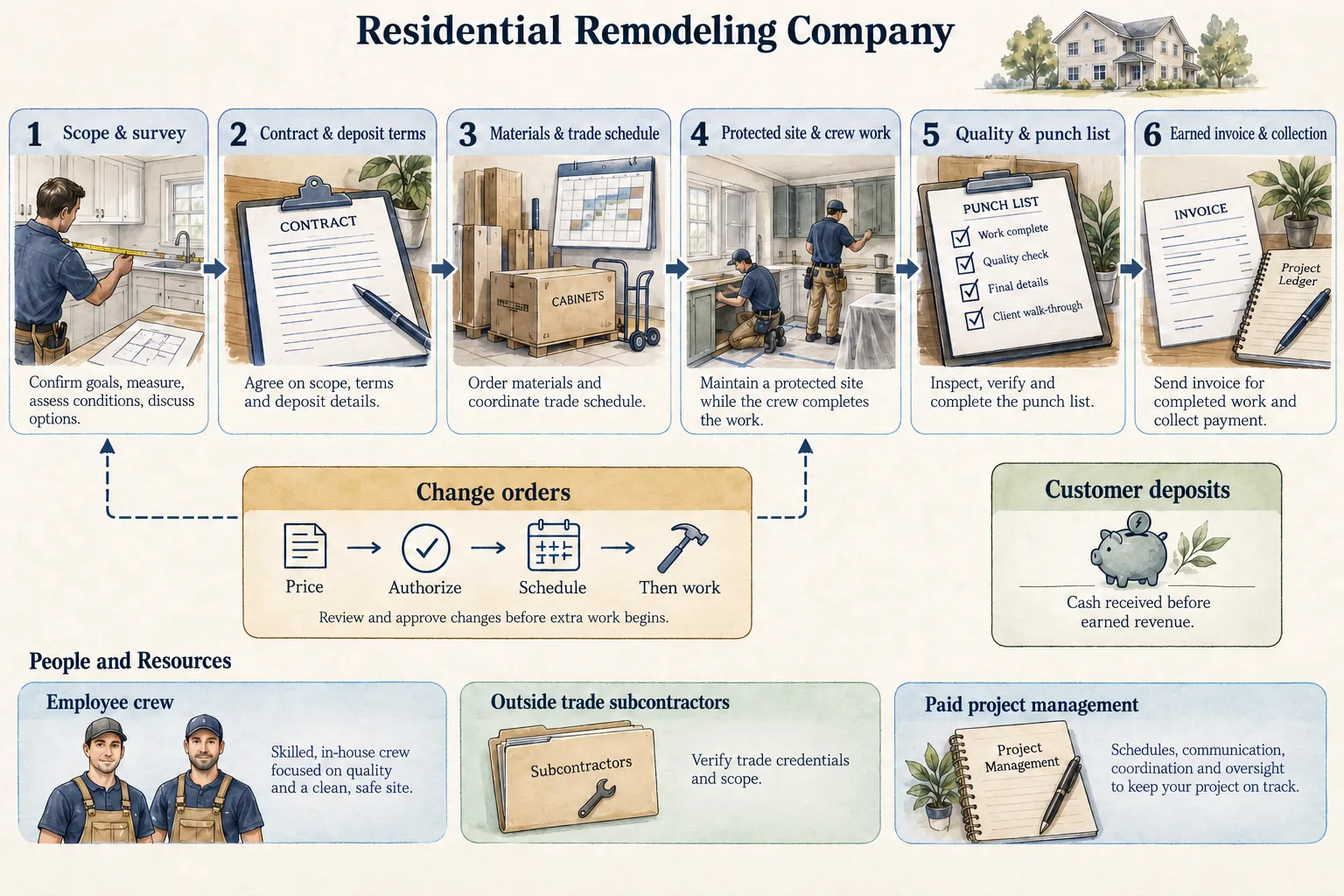
Begin with the existing property
Record dimensions, access, occupied rooms, known services, finishes to retain, fixtures to replace, visible condition, protection and disposal. Keep the initial survey distinct from destructive investigation and from professional design or engineering where required. Photographs document the known starting condition; they do not prove concealed systems are sound.
State the accepted interior format and excluded work. The reference excludes structural additions and major reconstruction. Paint disturbance in covered older property requires a separately resolved lead-safe path. The location, exact trade work and entity determine the authority and permit questions.
Turn a proposal into a measurable scope
List quantities and responsibility for supply, installation, connection, testing, protection, cleanup and disposal. Name fixtures and finishes or disclose allowances with an adjustment rule. An unspecified allowance can postpone a cost decision until after the price has been promised.
Attach exclusions, customer duties, selection dates, start conditions, interruption handling, accepted milestones, warranty and the change process to the contract. Confirm applicable consumer disclosures, cancellation rights and payment restrictions for the actual jurisdiction. A template from another state does not establish compliance.
Make procurement and specialty work ready before promising a start
Use dated scope-matched supplier quotes with freight, taxes where applicable, returns, delivery, storage, condition and lead time. Match specialty subcontractor work to credentials, insurance, exact scope, supply responsibility, testing, permit and inspection responsibility.
Create dependencies for customer choices, materials, demolition/protection, rough work, inspections, finish work and handover. Confirm readiness instead of assigning invented universal durations. If an unavailable item moves a trade visit, document the effect on crew availability, customer access, temporary protection and cash.
Schedule complete paid person-hours
Two carpenters together for one hour consume two person-hours. Include travel, loading, receiving, protection, preparation, installation, cleanup, documentation and recovery. Paid owner-management and administration are separate coverage; they do not add free field capacity.
At the assumed 140 field person-hours per earned equivalent, 2 equivalents use 280 project hours plus 32 nonproject hours, leaving 34.67 paid field hours. That arithmetic is an average workload check. Put whole project tasks into a dated calendar and identify which tasks can actually overlap without double-booking the same worker or site.
Control a discovery or requested change before expanding work
Document the trigger, condition, proposed work, exclusions and any temporary protection needed. Estimate additional employee person-hours, specialist scope, materials, disposal, cost to complete, price and schedule effect. Separate safety or emergency action from elective work and follow the applicable duties.
Obtain the required written customer authorization and any permit or trade approvals before treating additional scope as accepted. Keep the original contract, each change, revised price, revised completion conditions and earned milestone basis together. An unsigned change is not a receivable or guaranteed contribution.
Inspect, accept and invoice the same delivered scope
Record task completion, required trade tests and inspections, defects, punch-list responsibility, manuals and customer handover. A delivered box of fixtures does not establish installed accepted work. Required approval cannot be assumed from the presence of a subcontractor.
Issue the earned invoice under the contract and accounting policy, apply any customer advance, track retainage separately and record actual settlement. Customer disagreement or an unresolved defect can affect acceptance and cash. Separate earned work, cash receipts and outstanding service/refund obligations.
Measure recovery against the original project
Tie punch-list, callback, warranty and rework to their original cause, paid travel and crew hours, additional materials, specialist cost, supplier recovery, customer outcome and closure. A return visit creates no additional revenue unless distinct lawful accepted paid scope is established.
Review the estimate-to-actual difference by work package. Change estimating allowances or operating procedures only when the measured records support it. A busy calendar can conceal repeated underestimates and recovery work; do not add projects until the paid clock and margin reconcile.
Choose the next commitment from cost to complete and cash
At each milestone compare accepted contract value, earned value, unearned scope, unpaid suppliers, paid coverage still required, customer advances, receivables and available unrestricted cash. Cost to complete is an obligation estimate, not an additional sale.
Continue only with resolved authority, supported next-step scope, a feasible paid sequence and funded dated commitments. If a customer selection, specialist slot, hidden-condition quote or collection remains unresolved, narrow or defer the next commitment rather than counting it as completed capacity.
A scope change that must enter four records
This is a qualitative operating example. It invents no local price, duration, permit approval or customer demand.
| Record | Before accepting the change | What changes afterward |
|---|---|---|
| Scope | Customer requests an additional fixture beyond the accepted schedule | Written quantity, supply, installation, test, exclusion and acceptance description |
| Price and job cost | Original bid excludes that fixture and the specialist connection | Matched supplier/specialist cost, employee hours and accepted price adjustment |
| Paid sequence | Existing crew and specialist calendar serves the original work | Availability, delivery, protection, inspection and handover dependencies |
| Earned milestone and cash | Original milestone and advance apply to original accepted scope | Revised earned basis, compliant invoice, advance application and dated receipts/payments |
What this changes: A change belongs in scope, price, schedule and cash together. Customer enthusiasm or an unsigned request does not establish earned revenue.
Reference paid-work capacity
| Paid work | Assumed monthly record | Boundary |
|---|---|---|
| Carpenter person-hours | 346.67 | Two paid carpenters; no owner field work added |
| Nonproject carpenter hours | 32 | Already paid, separate from project hours |
| Project field hours at 2 equivalents | 280 | 140 person-hours per earned equivalent, including rework |
| Total field clock | 312 | Project plus nonproject work |
| Owner management / administration | 86.67 / 43.33 hours | Separately paid; not free delivery capacity |
The remaining average hours do not establish room for another physical project. Confirm dated whole tasks, customer access and specialty-trade dependencies.
Complete your decision record
A complete scope-to-handover operating record, including customer decisions, specialty-trade dependencies, approved changes, earned-value evidence, dated payments and warranty recovery. Enter the finding or number, the source and the next action for each row. “Supported” records your assessment of that item; it does not approve the business or certify completed research.
| Item and what to record | Your finding and evidence | Status and next action |
|---|---|---|
| Survey and accepted scopeProperty conditions, measured quantities, protected areas, exact supplies, inclusions and exclusions | ||
| Authority and contract routeEntity and qualifying person; authorized specialty trades; permits, consumer terms and lead-safe applicability | ||
| Selections and procurementCustomer decision dates, dated supplier scopes, availability, delivery, returns and specialist readiness | ||
| Paid-work sequenceEvery crew person-hour, nonproject work, management, administration, inspection and handover dependency | ||
| Change controlWritten trigger, measured additional scope, price/cost, schedule impact and customer authorization | ||
| Earned acceptance and cashDelivered acceptance, punch list, earned invoice, advance applied, retainage, settlement and cost to complete | ||
| RecoveryOriginal cause, paid hours, materials, specialist expense, supplier credit, warranty result and closure |
7 items have no evidence recorded yet.
Entries are temporary and are not sent to us or saved automatically. Download your completed work before leaving or refreshing this page.
Choose your next action
| If your finding is… | Your next action |
|---|---|
| Survey cannot support the promised fixed scope | Price the defined investigation or narrow accepted work before promising unsupported quantities. |
| Customer selections or specialist readiness block the sequence | Confirm readiness and rework dated commitments before starting another task. |
| A proposed change has no accepted price or schedule adjustment | Document and authorize the revised scope under applicable rules before expanding elective work. |
| The paid calendar or dated cash is overcommitted | Revise scope, price, sequencing or funded capacity before accepting another contract. |
Errors that can change the result
- Treating a fixture allowance as a full installed quote.
- Adding the same person-hour to two overlapping jobs.
- Calling project-management time unpaid owner availability.
- Using a customer advance or unsigned change as earned profit.
- Ignoring inspection, selection and specialist dependencies because carpenter hours appear free.
- Counting warranty recovery as another completed sale.
Apply this to your business
These operating formats match the decisions in this guide.
Residential Remodeling Company
Two-carpenter residential interior remodeling company with paid project management and licensed specialty subcontractors
Open the operating guide and state profiles →Apply the documented scope, complete paid crew clock, authorized specialty trades and cash dates to the same reference inputs. Values entered here are not automatically transferred to another calculator.
Continue with the next part of your plan
- Can remodeling project margin cover the crew and milestone cash gaps?
A contribution and break-even calculation tied to complete paid coverage, a crew-capacity check, and one comparable project schedule that separates earned value, customer advances, actual receipts and cash payments.
- How to find the permits and approvals your business actually needs
An approval register with official responses and the next unresolved question.
- How to compare equipment quotes and build the opening budget
A comparable two-quote cost calculation and a supplier commitment record.
- How to build a staffing roster before estimating payroll
A roster with complete task coverage and an annualized monthly staffing budget.
- How to build a 13-week cash plan for your first 90 days
A weekly cash schedule, the lowest balance and the extra funding needed to retain your chosen minimum.
Sources and limits
The sources below provide the stated background. The worked examples, calculator defaults and decision exercises are authored teaching material. They do not establish market prices, local demand, legal applicability or completed state research.
- Residential Remodeling Company reference economics
Authored two-carpenter interior scenario, complete paid roster, earned-value unit and opening ramp; not observed business performance.
- BLS May 2025 Occupational Employment and Wage Estimates
Carpenter, Construction Manager and Administrative Assistant occupation medians. Cross-industry wage anchors do not establish hiring rates, overtime, legal eligibility or complete employer costs.
- California CSLB: What is a home improvement contract?
California-specific written contract and payment guidance. The downpayment limit is the lower of $1,000 or 10%; progress payments cannot exceed performed work value. This does not establish permitted terms for another jurisdiction or all exceptions for an individual contract.
- EPA renovation, repair and painting program for contractors
Federal background for paid paint-disturbing work in covered pre-1978 property. Confirm applicable certification, exclusions, authorized state programs and the actual accepted work; this is not an abatement authority.
- IRS: business recordkeeping
Keeping supporting business records.
Source pages checked October 2, 2026. Research and review standards · Report an issue
When you need a longer financial plan
Use a financial model to organize a broader forecast after defining your own operating assumptions. The site’s research, your worksheet entries and any purchased workbook are separate; entries are not transferred automatically.
Continue with the published financial scenario