How many pet grooming appointments does a salon need to break even?
Test realized dog-grooming tickets, groomer and bather time, tubs, dryers, tables, completion and break-even in one service mix.
Work through the guide →
Time a dog-service mix across groomers, bathing, drying and secure handoff before committing to a grooming salon's lease and installed wet zone. The stated national wage scenario uses 10 completed appointments per trading day at $115.00 per completed appointment, producing $1,049 mature monthly EBIT and $169,418 modeled opening funding. Sales, capacity and nonwage costs remain planning assumptions.

The narrow contribution margin makes kept completions and job duration consequential. An attractive premium ticket may require longer grooming or drying and cannot be added independently of resource use.
One completed dog appointment earns the net service ticket. Deposits, bookings, no-shows, same-visit add-ons and no-charge corrections do not create another completed appointment.
At the assumed activity, the mature month produces $2,382 EBITDA, $1,049 EBIT and $1,982 cash after maintenance. The first twelve modeled months use $16,778 of operating cash; they do not represent a full year at the mature run rate.
The EBIT threshold is approximately 9.57 completed appointments per trading day; it uses the same price, variable-cost basis and complete paid roster. The listed ceiling is 12 completed appointments per trading day, with the operating qualifications in the capacity explanation below. Build the whole diary through each groomer, bather, tub, dryer, table and holding area. Include dog condition, behavior, late handoff and an ordinary staffing interruption.
| Test | Entered activity or cost | Monthly EBIT |
|---|---|---|
| Published reference | 10 completed appointments per trading day | $1,049 |
| 20% less earned activity | 8 completed appointments per trading day | -$3,809 |
| 10% higher wage benchmarks | 1.10 × the same occupational wage anchors | -$492 |
| 20% higher occupancy cost | $4,200.00 monthly occupancy | $349 |
Of the three separate tests shown, 20% less earned activity makes the largest change to monthly EBIT: -$4,858. This is a result of the stated test sizes, not a probability or a universal risk ranking.
Grooming, bathing, cleaning and client-handoff coverage are paid. Reserve supervision and sanitation; a drying interval frees a groomer only when equipment and handling responsibilities permit it.
Opening payments of $95,926, the deepest cumulative operating cash deficit of $29,680 in month 5, and the retained buffer of $43,812 add to $169,418 modeled funding. Refundable deposits are included in opening cash uses; they are not operating expenses. Funding is a scenario total, not a quote or a financing recommendation.
Pickup collections support prompt receipts, but paid staffing and installed premises precede a stable diary. Positive mature EBIT can coexist with an opening-year operating cash deficit.
EBITDA pays the full modeled roster and operating costs. EBIT also deducts depreciation. Mature cash deducts maintenance investment from EBITDA, after receivables stop growing. All three exclude financing, income taxes and additional owner distributions.
If break-even appointments exceed any safely staffed resource, narrow the mix, reprice or revise the layout before selling more bookings. Time representative dog and service cohorts, record completed and collected appointments, and quote the full water, drainage, ventilation, power and secure animal-flow scope.
The wage observation is the BLS May 2025 national occupational median for each stated role. Hours, employer allowance, sales, prices, capacity and all nonwage costs are authored assumptions. Read the calculation definitions.
Calculations retain the exact input values. USD totals are displayed to whole dollars and blended prices to cents; activity and threshold estimates are displayed to up to two decimals. Rounded thresholds are estimates, not prescriptions for a sufficient whole job, visit or member count.
The reference unit is one completed grooming appointment for one dog. A booking, inquiry, deposit, cancellation, no-show, unfinished visit, complimentary correction or same-visit add-on is not another completed appointment. The realized ticket includes only earned service revenue after discounts, refunds and credits.
Rebooking can support a future diary, but it is not completed demand. Track booked, completed, canceled and no-show appointments separately, then record return intervals, realized revenue, complaints, corrections and client concentration without counting tips or deposits twice.
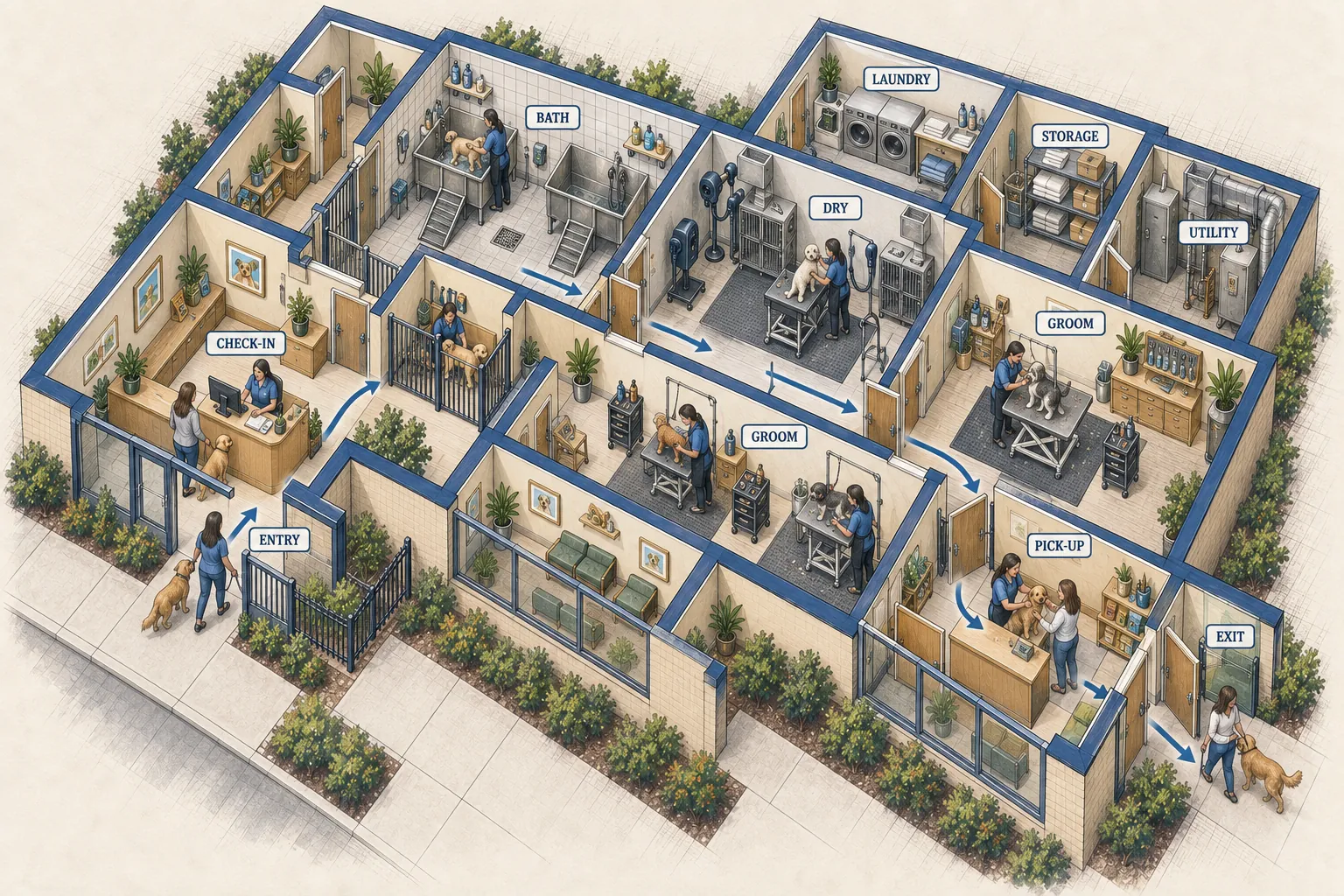
| Format | What changes | How to use it |
|---|---|---|
| Employee-staffed fixed-site dog grooming salon | Three paid groomers and paid bathing, reception and management coverage work from equipped leased premises | The reference format here; it excludes cats, boarding, daycare, veterinary treatment, retail revenue and independent booth rental. |
| Mobile grooming | A fitted vehicle travels to the customer | Vehicle investment, travel, route density, parking, utilities and weather require a separate model. |
| Self-service dog wash | Customers use the equipment themselves | Machine use, cleaning, supervision and pricing differ from a staff-delivered grooming appointment. |
A founder prepared to manage skilled service quality, animal handling, customer handoff, staff development and a fitted wet-service premises. The operation rewards careful scheduling and documentation because dog condition, behavior and service scope can change the time needed.
The figures below are a national wage reference scenario. The paid roster uses May 2025 BLS national occupational medians. Prices, customer volume, rent, equipment and other commercial inputs are authored assumptions. This is not a researched average startup cost, owner-income promise or a funding recommendation.
| Input or result | Reference | What to verify |
|---|---|---|
| Completed sales units | 240 completed appointments / month | 10 completed appointments per trading day; demand requires evidence. |
| Net selling price | $115.00 | Build and test a relevant local menu, package or contract scope. |
| Revenue | $27,600 | Calculated volume × price, not observed sales. |
| Paid payroll | $15,406 / month | National wage medians × the stated hours × the 18% employer allowance. |
| Opening payments | $95,926 | Authored equipment and setup allowances, deposit and paid training. |
| Funding including reserve | $169,418 | Opening payments + deepest modeled operating deficit + retained buffer. |
| Mature operating profit (EBIT) | $1,049 / month | After the full paid roster and depreciation; before financing and income taxes. |
| Approximate EBIT threshold | Approximately 9.6 completed appointments per trading day | A rounded estimate. Test whole permitted activity against the full roster and resource constraints. |
Three groomers × 8 paid hours × 75% productive appointment time ÷ 1.45 weighted groomer-hours per completed appointment supports 12 whole appointments per day after conservative rounding. The authored mix is 30% bath-and-brush at 1 groomer-hour, 50% standard full grooms at 1.5 hours and 20% long full grooms at 2 hours. Bathing, drying, safe holding, cleaning, dog behavior, late handoffs and the actual diary can reduce this ceiling.
6% shampoos, conditioners, blade care, bows and other appointment consumables plus 4% payment processing and 2% variable laundry and rework allowance; employee compensation remains in payroll. Utilities and fixed laundry service $900; insurance $450; marketing $600; scheduling, communications and administration $550; cleaning, waste, pest control and professional costs $500 per month. Maintenance investment is modeled separately at $400 per month.
Animal Caretakers is a broad occupational benchmark that includes pet groomers as well as workers in kennels, shelters, pet stores and other animal-care settings. It does not establish a groomer hiring quote, skill premium, commission plan or lawful compensation arrangement. All groomer, bathing, cleaning and client-handoff work is paid in the reference roster, including the owner-lead role.
BLS May 2025 national wage workbook · Calculation definitions · How owner income differs from EBIT
| Workstream | What the brief needs | Decision before spending |
|---|---|---|
| Bathing and drying | Raised tubs, access aids, hot water, drainage, ventilation and drying equipment outside the splash zone | Reconcile manuals and installed loads with the actual site before ordering. |
| Grooming and animal flow | Height-adjustable tables, tools, controlled handoff, separation and secure short-stay holding | Match the equipment and handling plan to the intended dog and service range. |
| Laundry and sanitation | Clean and dirty towel paths, washable finishes, handwash, closed chemical storage, hair capture and waste handling | Price the complete cleaning workflow and maintenance access, not only the visible stations. |
Compare installed scope, exclusions and payment dates. Do not treat an unquoted item as zero or count a bundled installation twice. How to compare equipment quotes and build the opening budget explains a reusable quote ledger.
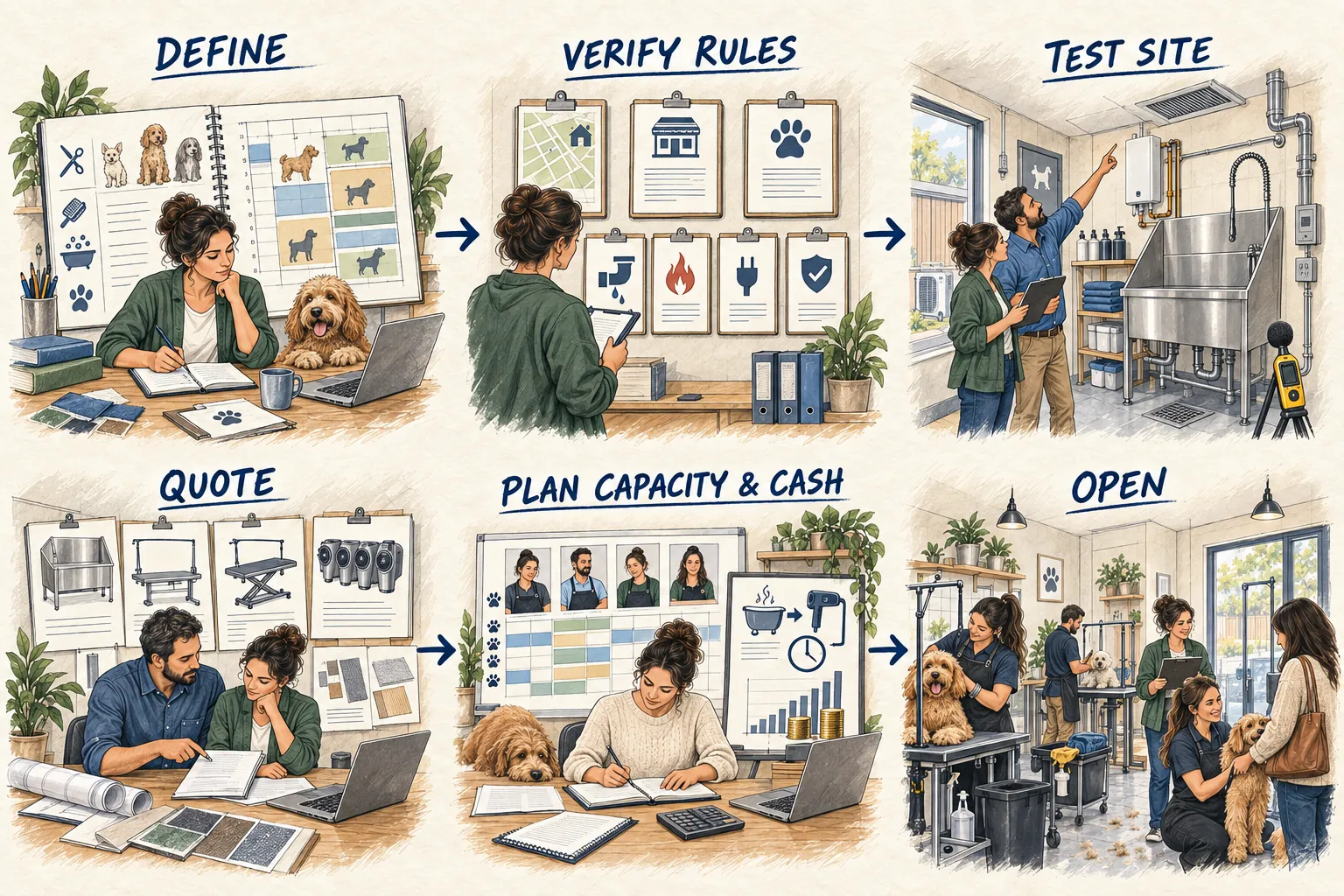
List service scope, dog size or coat boundary, realized ticket, groomer and bather minutes, tub, dryer and table time, consumables and completion rules for each cohort.
Bring the exact service scope and proposed animal flow to the responsible state and local business, land-use, building, fire, plumbing, wastewater and other authorities. Confirm insurance questions separately.
Measure the secure threshold, wet zone, drainage, hot water, ventilation, power, noise path, holding, laundry, storage and service access. Obtain written landlord and contractor responsibilities.
Place intake, bathing, drying, grooming, sanitation, breaks, handoff, late arrivals, cancellations and an ordinary absence into the same schedule before opening the full diary.
| Measure | Why it changes a decision |
|---|---|
| Completed paid appointments by service cohort | Keeps bookings, cancellations, add-ons and corrections from inflating the sales unit. |
| Occupied groomer and support hours | Tests whether the service mix fits the paid roster rather than a theoretical table count. |
| Tub, dryer and table load | Shows which sequential resource prevents the next safe completion. |
| Realized ticket, rework and no-shows | Connects collected service revenue with the ordinary variation that consumes contribution. |
Review actuals against the scope you priced. If an extra service, new trading hour or more distant client changes the work, update the roster and contribution calculation before expanding.
Describe the fixed-site dog-only service menu, staff arrangements, controlled intake and holding, bathing, drying, grooming, sanitation, laundry, water, drainage, ventilation, power, waste, noise and operating hours. Ask the relevant agencies and address-level authorities which business, animal-service, land-use, building, fire, plumbing, wastewater, accessibility and other reviews apply.
Each state profile links to official registration, tax and employer routes, together with the questions still requiring an address-specific answer. How to find the permits and approvals your business actually needs provides the record to keep.
Stop when break-even appointments exceed groomer, bather, tub, drying, table or handoff capacity; when a dog could move unsecured through the customer threshold; or when lease and equipment payments precede written answers about the site systems.
Write a response that changes the actual cause: narrower scope, a different site, revised paid staffing, a tested price or a delayed opening. A larger cash buffer only addresses a temporary timing gap.

Test realized dog-grooming tickets, groomer and bather time, tubs, dryers, tables, completion and break-even in one service mix.
Work through the guide →Map controlled animal and staff flow, bathing, drying, tables, holding, sanitation, utilities and lease dependencies before committing to a grooming salon site.
Work through the guide →Calculate paid service capacity, allow for cancellations, and compare completed appointments with operating cash break-even.
Work through the guide →Compare total occupancy cash, upfront commitments and site dependencies using a worked premises budget and a practical review record.
Work through the guide →A restaurant earns meal-period transactions through food production and service. A pet grooming salon earns completed dog appointments whose paid labor and station time change with the service cohort. Both need fitted premises, but the site systems and completion risks differ.
Compare the operating choices →A coffee shop needs many short orders in concentrated buying windows. A pet grooming salon needs fewer, longer booked services supported by skilled hands-on time and a sequence of bathing, drying, grooming and handoff resources.
Compare the operating choices →A cleaning business delivers recurring scopes across client sites. A pet grooming salon concentrates booked animal-care work, skilled people and fitted resources at one premises. Both depend on repeat relationships and complete paid time records.
Compare the operating choices →Both formats sell skilled booked time, but the clients, service classification, handling, sanitation, premises and duration uncertainty differ. Each needs a truthful service mix and paid diary.
Compare the operating choices →Both businesses complete condition-sensitive jobs through skilled labor and fitted resources. Detailing manages vehicles and bay occupation; pet grooming adds live-animal handling, controlled handoff and sequential bathing, drying and table work.
Compare the operating choices →A laundromat sells customer access to installed machines. A pet grooming salon sells staff-delivered skilled appointments. Both use wet-service premises, but labor, customer involvement and the binding capacity are different.
Compare the operating choices →A daycare center sells reserved child-weeks supported by continuous qualified room coverage. A pet grooming salon sells discrete completed dog appointments through a service mix whose labor and station load varies by dog and scope.
Compare the operating choices →A pet grooming salon sells skilled completed dog appointments at one wet-service premises. A landscaping company sells completed residential maintenance visits through two mobile crews. Both face condition-sensitive service time, but animal workflow and route-weather exposure create different constraints.
Compare the operating choices →A Pet Grooming Salon sells longer skilled appointments whose time changes with the dog and service cohort. A Food Truck sells many short food orders whose mix and throughput change by service period. Both need sanitation and careful handoff, but their clients, resources and incident paths are distinct.
Compare the operating choices →A Pet Grooming Salon delivers scheduled skilled services to individual dogs through bathing, drying and table work. A Bakery produces whole batches for many later retail orders. Both need fitted wet-service workflows, sanitation and paid teams, but live-animal handling and food production create distinct responsibilities.
Compare the operating choices →A Pet Grooming Salon earns from individual dog appointments that move through bathing, drying and table work. A Fitness Studio earns recurring member-months through shared classes. Both depend on skilled service and safe circulation, but animal handling and group participant access create different schedules and responsibilities.
Compare the operating choices →A Pet Grooming Salon sells scheduled, hands-on appointments at a fitted animal-care premises. An HVAC Company sells technical service and replacement work at customer properties. Both rely on skilled paid time and careful handoff, but HVAC capacity also includes route travel, vehicles, parts, task authorization, and warranty callbacks.
Compare the operating choices →A Pet Grooming Salon sells scheduled hands-on appointments at a fitted animal-care premises. A Moving Company sells whole crew-and-truck projects across customer addresses. Both require careful intake, handling, and customer handoff, but moving adds route, building access, cargo custody, longer schedule blocks, and household-goods claims.
Compare the operating choices →A Pet Grooming Salon sells scheduled hands-on appointments through groomer, bathing, drying, and table capacity. An Auto Repair Shop sells diagnosis, labor operations, and parts through technicians and service bays. Both require careful intake, safe handling, and customer handoff, while repair adds parts logistics, mechanical risk, and vehicle storage.
Compare the operating choices →A Pet Grooming Salon earns from completed grooming appointments through groomer, bathing, drying, table, and animal-handoff capacity. A Plumbing Company earns from completed and collected residential service jobs through licensed plumbers, two vehicles, dispatch, materials, permits, and callback control. Both must fit paid capacity to realized contribution, while plumbing adds address-to-address travel, trade authority, water and gas system risk, material acquisition, and return-service exposure.
Compare the operating choices →A Pet Grooming Salon earns from completed grooming appointments through groomer, bathing, drying, table, and animal-handoff capacity. An Electrical Contractor earns from completed and collected residential service and small-alteration jobs through licensed electricians, two vehicles, dispatch, sold hours, materials, permits, inspections, testing, and rework control. Both must fit paid capacity to realized contribution, while electrical adds address-to-address travel, trade authority, code and energized-work risk, material compatibility, inspection dependencies, and return-service exposure.
Compare the operating choices →Pet Grooming Salon earns from completed grooming appointments and is constrained by groomer, bathing, drying, table, and animal-handoff capacity. Pest Control Company earns a monthly household-plan yield while delivering a separate calendar of inspections, initial visits and callbacks. Compare realized contribution and paid capacity in their own units; a pest contract base is useful only when retention, legal scope and route obligations remain deliverable.
Compare the operating choices →Pet Grooming Salon earns from completed grooming visits at a weighted size-and-service mix and is constrained by groomer and bather time, tubs, drying, tables and safe handover. Residential Remodeling Company earns accepted interior scope, expressed as comparable project equivalents, while controlling a paid carpenter crew and authorized specialty trades. Compare the complete paid operating mechanism and dated cash, using each format’s own unit.
Compare the operating choices →No. It is an authored reference volume. Validate completed appointments by service cohort and confirm the paid team and each physical resource can deliver the mix.
No. Count concurrent work only when the actual equipment, supervision, animal handling and staff responsibilities support it. One person cannot be represented as actively handling two dogs at the same moment.
No. BLS SOC 39-2021 is a broad wage benchmark that includes animal caretakers beyond grooming. Replace it with current hiring evidence for the actual roles and compensation plan.
No. The modeled format is a fixed-site dog grooming salon. Cats, retail merchandise, boarding, daycare, veterinary treatment, mobile service and independent booth rental require separate operating and financial definitions.
No states match these filters.
Sorting compares one defined format. It does not rank states for attractiveness or prove demand. Funding includes opening payments, the deepest cumulative operating cash deficit in the 60-month model and the retained cash buffer.
| State | Funding scenario | Loaded payroll / month | Approximate EBIT threshold completed appointments per trading day |
|---|---|---|---|
| Alabama | $150,883 | $12,343 | 8.3 |
| Alaska | $173,357 | $15,959 | 9.8 |
| Arizona | $178,348 | $16,630 | 10.1 |
| Arkansas | $155,316 | $13,177 | 8.7 |
| California | $180,188 | $16,856 | 10.2 |
| Colorado | $175,875 | $16,312 | 9.9 |
| Connecticut | $175,487 | $16,258 | 9.9 |
| Delaware | $165,085 | $14,772 | 9.3 |
| Florida | $165,751 | $14,880 | 9.4 |
| Georgia | $154,320 | $13,014 | 8.6 |
| Hawaii | $190,311 | $17,481 | 10.4 |
| Idaho | $160,478 | $14,020 | 9 |
| Illinois | $170,063 | $15,497 | 9.6 |
| Indiana | $154,650 | $13,068 | 8.6 |
| Iowa | $154,872 | $13,104 | 8.6 |
| Kansas | $154,227 | $12,995 | 8.6 |
| Kentucky | $156,593 | $13,385 | 8.7 |
| Louisiana | $149,954 | $12,162 | 8.2 |
| Maine | $175,229 | $16,222 | 9.9 |
| Maryland | $173,808 | $16,022 | 9.8 |
| Massachusetts | $183,576 | $17,273 | 10.3 |
| Michigan | $155,538 | $13,213 | 8.7 |
| Minnesota | $172,711 | $15,868 | 9.8 |
| Mississippi | $147,864 | $11,754 | 8.1 |
| Missouri | $157,980 | $13,612 | 8.8 |
| Montana | $165,918 | $14,908 | 9.4 |
| Nebraska | $159,146 | $13,802 | 8.9 |
| Nevada | $155,538 | $13,213 | 8.7 |
| New Hampshire | $167,674 | $15,161 | 9.5 |
| New Jersey | $170,967 | $15,624 | 9.7 |
| New Mexico | $164,197 | $14,627 | 9.2 |
| New York | $177,170 | $16,485 | 10 |
| North Carolina | $156,981 | $13,449 | 8.8 |
| North Dakota | $165,474 | $14,835 | 9.3 |
| Ohio | $155,483 | $13,204 | 8.7 |
| Oklahoma | $152,276 | $12,615 | 8.4 |
| Oregon | $173,227 | $15,941 | 9.8 |
| Pennsylvania | $158,313 | $13,666 | 8.9 |
| Rhode Island | $174,906 | $16,176 | 9.9 |
| South Carolina | $158,091 | $13,630 | 8.8 |
| South Dakota | $155,705 | $13,240 | 8.7 |
| Tennessee | $156,149 | $13,313 | 8.7 |
| Texas | $161,977 | $14,264 | 9.1 |
| Utah | $167,545 | $15,143 | 9.5 |
| Vermont | $171,678 | $15,723 | 9.7 |
| Virginia | $166,383 | $14,980 | 9.4 |
| Washington | $202,697 | $17,681 | 10.5 |
| West Virginia | $151,394 | $12,443 | 8.3 |
| Wisconsin | $155,094 | $13,140 | 8.6 |
| Wyoming | $152,555 | $12,669 | 8.4 |
Published research and calculations support business planning and education. They are not personalized financial, investment, tax or legal advice, and they do not guarantee costs, revenue, profit or financing. Estimates depend on the stated format, location, source periods and assumptions. Check the requirements and commitments that apply to your circumstances.