
How to plan pet grooming salon capacity and layout before signing a lease
Trace every dog and staff member from controlled arrival through assessment, bathing, drying, table work, holding, sanitation and pickup. Reconcile the timed service mix and proposed equipment with water, drainage, hot water, ventilation, power, cleaning, access, noise and the address approval route before a non-refundable commitment.
What you will produce: A salon workflow and site-system matrix, an unresolved critical path and a lease or equipment condition tied to written evidence.
Updated September 9, 2026 · Worked examples and editable worksheets
What to have ready
Bring the dog-only service menu, intended dog range, appointment schedule, paid roster, proposed equipment manuals, measured premises plan, landlord information and contacts for the serving utilities, insurer and responsible address-level authorities.
Work through the calculation and decision
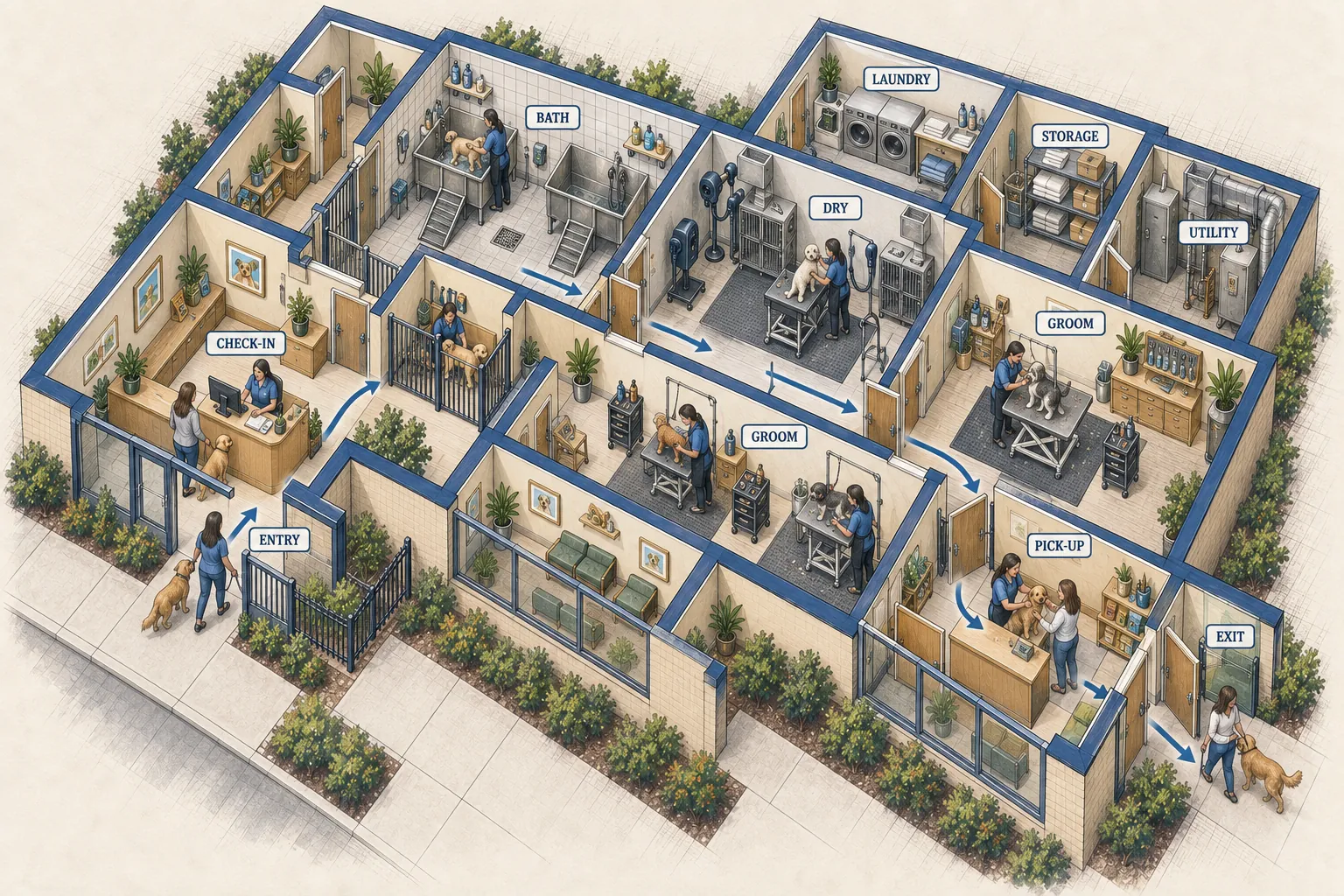
How should animal and staff flow be mapped?
Begin at the exterior threshold. Show controlled check-in, condition notes, secure transition, separation where needed, bathing, drying, grooming, finished holding, pickup and exit. Trace real doors and gates and keep animals from moving loose through a customer or exterior path.
Place staff handwash, clean and dirty towel routes, closed tools and chemicals, hair capture, waste, cleaning and emergency access on the same plan. A row of equipment is not a workflow when people, dogs, carts or doors block the working clearances.
How should the equipment schedule test the premises?
For every tub, dryer, table, laundry unit and support system, record model, count, installed location, required water, drainage, hot water, ventilation, power, anchoring, clearance, noise control, cleaning access and maintenance route. Use current manufacturer information for the equipment actually proposed.
Reconcile the combined load with the site and serving utilities. A former salon, kennel or pet business is not proof that the address can support the proposed operation, and a conceptual illustration is not a code-compliant design.
What should become a lease or payment condition?
Assign landlord and tenant responsibility for plans, approvals, upgrades, access, opening delay, ownership and restoration. Tie rent commencement, fit-out and equipment deposits to the unresolved item that could make the workflow unusable.
Stress the plan with a long appointment, late pickup, ordinary absence, dryer or tub outage and a dog that must be kept separate. Revise the service ceiling if the operation cannot maintain controlled handling, sanitation and clear circulation.
A site-system matrix keeps the unresolved drain route visible
This authored example shows the evidence record. It is not a construction design, code interpretation, approved capacity or cost quote.
| Proposed workflow or system | Evidence needed | Decision status |
|---|---|---|
| Controlled arrival and pickup | Door and gate plan, sight lines, handler path and separation procedure | Measured plan and operating rehearsal required |
| Bathing and hot water | Exact tubs, flow, temperature control, supply and installation scope | Plumber and serving utility must confirm |
| Drainage and hair capture | Combined discharge route, receptor, cleanout, hair handling and local answer | Unresolved; keep fit-out provisional |
| Drying and ventilation | Dryer manuals, room ventilation, heat, humidity, noise and electrical separation | Mechanical and electrical review required |
| Tables, holding and circulation | Service clearances, secure positions, sanitation and emergency movement | Test with the intended dog and staff range |
| Lease allocation | Approvals, upgrades, rent start, delay, ownership and restoration | Make the next payment conditional on written terms |
What this changes: The premises remains provisional while the drainage and ventilation routes are unresolved. Lower rent or more grooming tables cannot repair that dependency.
Illustrative amounts are rounded for display. Use the full inputs and stated units when recalculating; an approximate threshold is not itself a sufficient activity prescription.
Complete your decision record
A salon workflow and site-system matrix, an unresolved critical path and a lease or equipment condition tied to written evidence. Enter the finding or number, the source and the next action for each row. “Supported” records your assessment of that item; it does not approve the business or certify completed research.
| Item and what to record | Your finding and evidence | Status and next action |
|---|---|---|
| Activity and animal scopeDog-only services, exclusions, schedule and operating hours | ||
| Measured animal flowEntry, check-in, separation, service stages, holding, pickup and exit | ||
| Equipment scheduleModel, count, load, connections, clearances and maintenance access | ||
| Site systemsWater, hot water, drainage, ventilation, power, laundry, waste and noise | ||
| Authority and insurer answersAgency or reviewer, direct source, applicability, date, condition and next step | ||
| Lease and quote decisionResponsibility, payment dependency, opening delay and unresolved critical path |
6 items have no evidence recorded yet.
Entries are temporary and are not sent to us or saved automatically. Download your completed work before leaving or refreshing this page.
Choose your next action
| If your finding is… | Your next action |
|---|---|
| A dog cannot move through the site under controlled handling | Revise the threshold, gates, separation and schedule before treating the premises as usable. |
| A combined utility or discharge route is unconfirmed | Keep the site provisional and make dependent payments conditional on a written answer. |
| Downtime or a late pickup blocks sanitation or the next appointment | Reduce the diary ceiling or change equipment, holding and staff coverage. |
Errors that can change the result
- Treating equipment count as safe or saleable capacity.
- Assuming a previous animal-service use proves current site suitability.
- Signing before assigning major utility work and opening-delay risk.
Apply this to your business
These operating formats match the decisions in this guide.
Pet Grooming Salon
Fixed-site dog grooming salon with three paid groomers and dedicated bathing and client-handoff coverage
Open the operating guide and state profiles →Carry the confirmed workflow, installed scope, timing and site costs into the opening cash plan. Values entered here are not automatically transferred to another calculator.
Continue with the next part of your plan
- How many pet grooming appointments does a salon need to break even?
A weighted completed-appointment contribution, a resource-bounded daily ceiling and a monthly break-even test.
- What to check before committing to business premises
A comparable premises cost summary and a list of conditions to resolve before the next commitment.
- How to compare equipment quotes and build the opening budget
A comparable two-quote cost calculation and a supplier commitment record.
- How to find the permits and approvals your business actually needs
An approval register with official responses and the next unresolved question.
Sources and limits
The sources below provide the stated background. The worked examples, calculator defaults and decision exercises are authored teaching material. They do not establish market prices, local demand, legal applicability or completed state research.
- U.S. Census Bureau: NAICS 812910 Pet Care (except Veterinary) Services
Official industry definition. It includes pet-care activities beyond grooming and is not a grooming-salon-only count.
- U.S. Bureau of Labor Statistics: Animal Care and Service Workers
Occupational context confirming pet groomers are included within Animal Caretakers. The broad occupation does not establish a local groomer compensation quote or staffing requirement.
- IRS: state government websites
Starting links to state offices.
Source background and its scope are stated above. The guide update date does not change a source observation period. Research and review standards · Report an issue
When you need a longer financial plan
Use a financial model to organize a broader forecast after defining your own operating assumptions. The site’s research, your worksheet entries and any purchased workbook are separate; entries are not transferred automatically.