Start a Pest Control Company by defining a narrow household-pest plan, confirming business and applicator authority, and proving a two-technician service calendar. The reference assumes 550 paid plan-months at $60 each, models $3,203 monthly cash after maintenance, and needs 490.29 plans for cash break-even. Its 618-plan target ceiling reflects launch onboarding. The $60 yield is an authored target above the observed starting-price equivalents, so pricing and retention are consequential tests. Replace the commercial assumptions before committing $231,762 of modeled funding.
What the customer buys and what makes the business repeatable.
The economic unit is one active paid service-plan month for one accepted residential property and scope. Scheduled inspections and service visits fulfill that plan; an included callback does not create a second sale. Initial service is a longer visit for a new plan and replaces its routine allocation that month. A lead, estimate, signature, annual prepayment, appointment or uncollected invoice is not automatically another realized plan-month.
Recurring billing is valuable only when customers retain the plan and the company fulfills its scope. Reconcile beginning plans, retained plans, cancellations, new starts, credits and collected monthly yield. Track why customers cancel and why callbacks occur; selling replacements consumes acquisition effort and initial-service time even when the total plan count is unchanged.
The format on this site: Local recurring residential general-household pest service company with two paid field technicians, two service vehicles, paid dispatch and paid owner-manager replacement-cost coverage. Termite and other wood-destroying-organism contracts, fumigation, wildlife control and exclusion, bed-bug heat programs, mosquito programs, public-health vector work, lawn and agricultural application, restaurants and other commercial accounts, franchises, multiple branches and unpaid labor are outside this residential reference format.
Choose the format before choosing a budget.
Different formats need different operating plans
Format
What changes
How to use it
Two-technician residential household-pest plan
A defined local territory, two service vehicles and paid field, dispatch and management coverage
Reference format: quarterly scheduled inspection/service allocation, need-based authorized treatment, replacement initial visits and included callbacks.
One-time specialty treatment or infestation project
Problem-specific inspection, proposal, treatment sequence, revisits and outcome documentation
Price and schedule the complete accepted case separately; the recurring monthly-plan yield does not establish its contribution.
Termite, fumigation, wildlife, lawn, agricultural or commercial service
Different work categories, credentials, contracts, equipment, insurance and site controls
Build a separate legal-scope, service-time, cash and customer model rather than extending this household reference.
An operator willing to manage repeat customer promises, regulated field decisions, route density, secure stock, documentation, retention and collection every week. The business suits an active manager who can stop a sale or visit when authority, scope, access or service capacity does not support it.
What should the evidence change in your launch plan?
The BLS occupational profile describes inspection, travel, treatment planning, customer service and recordkeeping as part of pest control work. Allow paid time for the whole visit, and verify the applicable state credentials. EPA labeling guidance makes product handling and use restrictions part of the accepted service scope.
The assumed $60 monthly yield should be tested against a defined service promise. The Sacramento, Austin and Columbus examples show advertised offers with different covered work, initial charges and terms. Those starting prices are not achieved yield or demand for this company.
A mature surplus does not fund the launch by itself. The first twelve months use $22,759 of operating cash despite the $3,203 mature monthly cash surplus. Full paid staffing begins in month one while plans build up and new customers require longer initial visits. The deepest cumulative operating deficit is $42,806 in month 5; the separate retained buffer is $63,248. These are scenario results before financing, income taxes and owner distributions, using the same inputs as the state calculators.
Understand the reference operating plan.
The figures below are a national wage reference scenario. The paid roster uses May 2025 BLS national occupational medians. Prices, customer volume, rent, equipment and other commercial inputs are authored assumptions. This is not a researched average startup cost, owner-income promise or a funding recommendation.
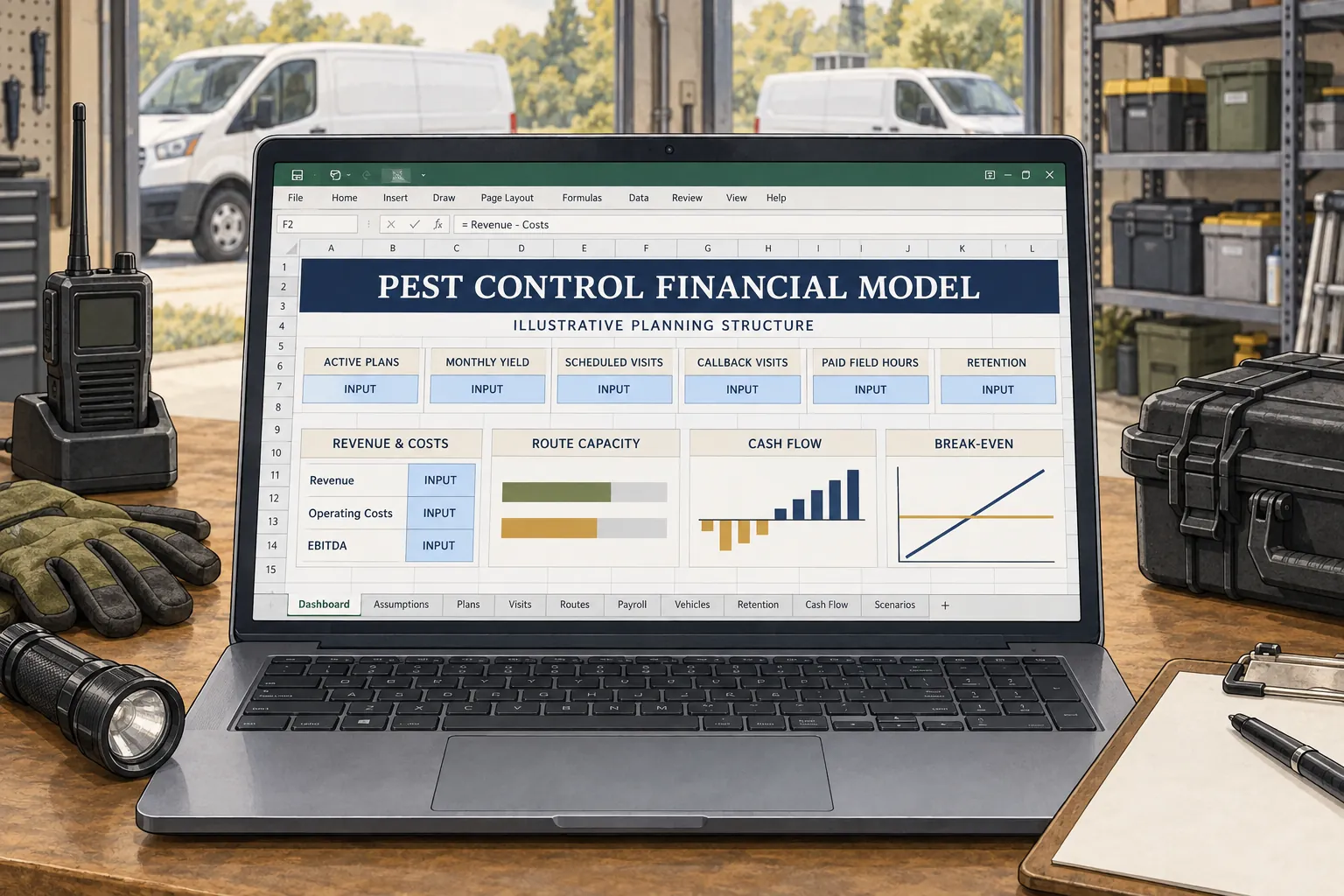
One defined format · monthly amounts before financing and income taxes
Input or result
Reference
What to verify
Completed sales units
550 active paid service-plan months / month
550 active paid service plans per month; demand requires evidence.
Net selling price
$60.00
Build and test a relevant local menu, package or contract scope.
Revenue
$33,000
Calculated volume × price, not observed sales.
Paid payroll
$16,299 / month
National wage medians × the stated hours × the 18% employer allowance.
Opening payments
$125,708
Authored equipment and setup allowances, deposit and paid training.
After the full paid roster and depreciation; before financing and income taxes.
EBIT break-even
494.6 active paid service plans per month
A sales threshold to compare with capacity and tested demand.
Two paid technicians supply 346.67 field hours per month. At 550 steady active plans, the scenario reserves 179.67 routine visits, 11 initial visits replacing lost plans, 16.5 callbacks and 32 nonroute hours: 219.83 total field hours. Initial visits replace those new customers' routine allocation for the month. The 921-plan mature field ceiling is reduced to a 618-target-plan launch ceiling because onboarding 40% of the target in month one consumes more time. Both are scheduling assumptions, not customer demand; whole visits and seasonal cohorts need a real calendar.
At the steady reference mix, service consumables cost $12 per routine visit, $20 per initial visit and $8 per callback, plus processing at 3% of realized plan revenue. The $60 monthly yield is already after discounts, refunds and failed collection. The resulting $6.36 cost per plan-month excludes paid wages, which remain in payroll. New-plan growth adds initial-service cost above the steady mix. The standing-cost allowance covers vehicle running cost and fuel, insurance, utilities, phones, software, marketing, professional support and administration. Maintenance capital expenditure is a separate cash outflow. Obtain actual quotes for the selected entity, storage address, vehicles, accepted work and staffing.
May 2025 occupation wages anchor the paid technicians and customer-service coverage. General and Operations Managers is a broad duty-based replacement-cost proxy for paid owner-management time; it is not proof of qualifying-applicator eligibility or that person's hiring rate. The employer allowance is assumed.
A positive reference EBIT depends on the assumed paid sales volume and costs. It does not establish local demand or cash available for owner withdrawals.
Make retained plan income support the entire visit promise
Interpretation of the national reference format
The deciding test is whether paid household plans can support their entire service promise at the realized monthly yield. The reference needs 491 whole plans for cash break-even, from 490.29 calculated, and starts from 550. Its mature route has spare average hours, but the 618-plan launch ceiling reflects slower initial service. At a conditional $43 yield with other inputs held constant, the cash threshold rises to 708 whole plans and exceeds that launch ceiling. The $60 base yield therefore needs a paid-market test; a full contract list alone cannot substantiate it.
The reference requires 494.6 active paid service plans per month for EBIT break-even. At 440 active paid service plans per month (20% below the volume assumption), monthly EBIT falls to -$2,931. This exposes the need to substantiate paid volume before relying on the positive reference month. These are scenario calculations with the other inputs held fixed, not a demand forecast or a recommended safety margin.
The authored 550-plan reference uses $60 realized monthly yield and needs 491 whole plans for cash-after-maintenance break-even. The 618-plan launch target ceiling is lower than the 921-plan mature average. Actual customer prices, retained plan count, travel, service requirements and direct quotes can change that comparison; an advertised provider price is not achieved yield for this format.
Test net yield and the complete initial-service clock before committing to both vehicles and the full paid roster. Reconsider scope, pricing, territory, acquisition pace or fixed commitments if the financial threshold exceeds the feasible launch schedule or supported paid demand.
Match each carried item to accepted work and product requirements; an empty cargo-van price is not a ready-to-operate fleet quote.
Inspection, monitoring and approved treatment equipment
Inspection lights, identification aids, monitoring devices, application equipment where appropriate, calibration and cleaning provisions, labels, protective equipment and emergency information
An inspection can lead to prevention advice or monitoring. Do not turn every scheduled visit into a pesticide application.
Dispatch, plan and service records
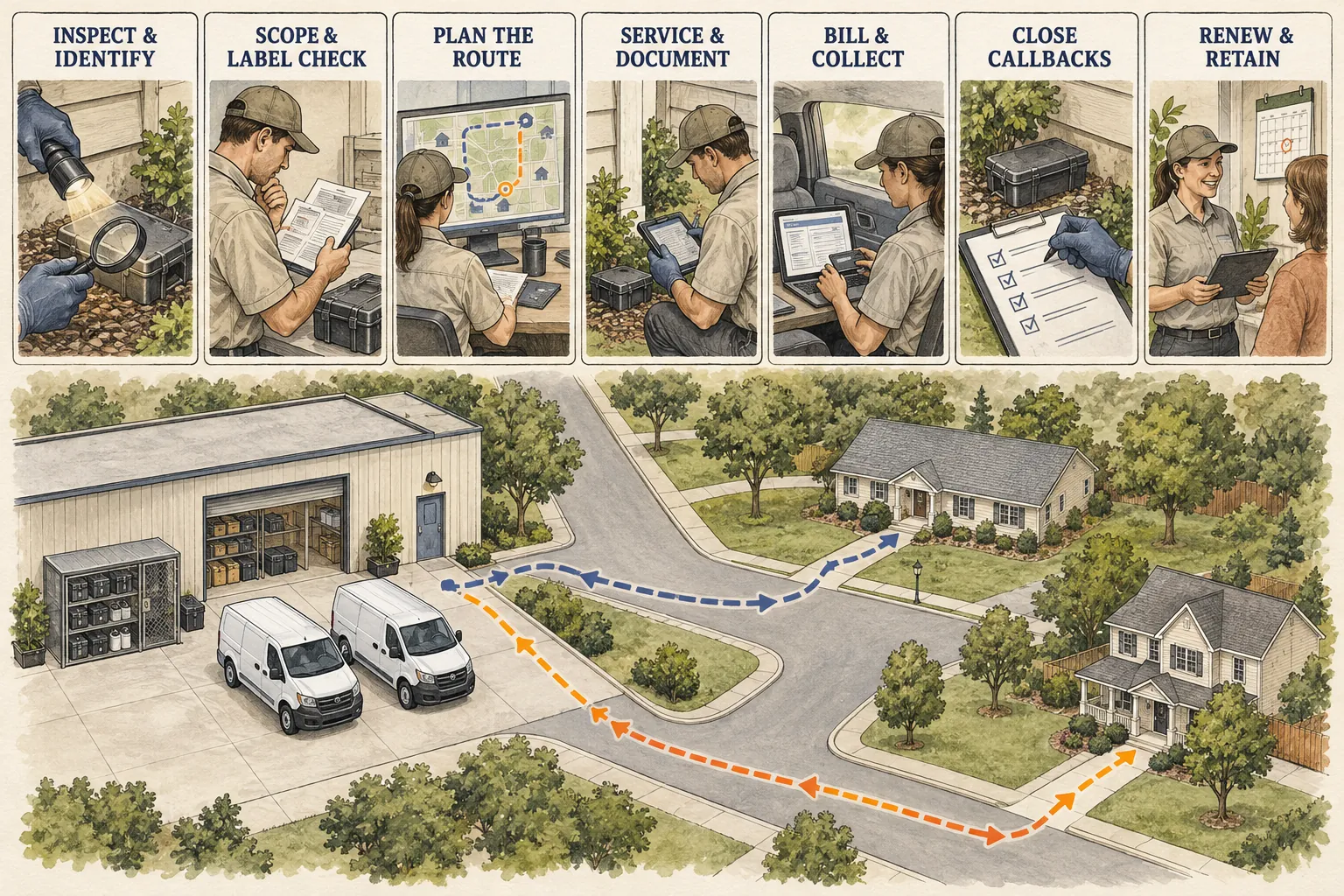
Property and pest scope, authorization, worker eligibility, product records where applicable, visit findings, action taken, customer instructions, billing, collection, callbacks and renewal
One linked record should explain what was promised, what was delivered and whether the customer remained billable.
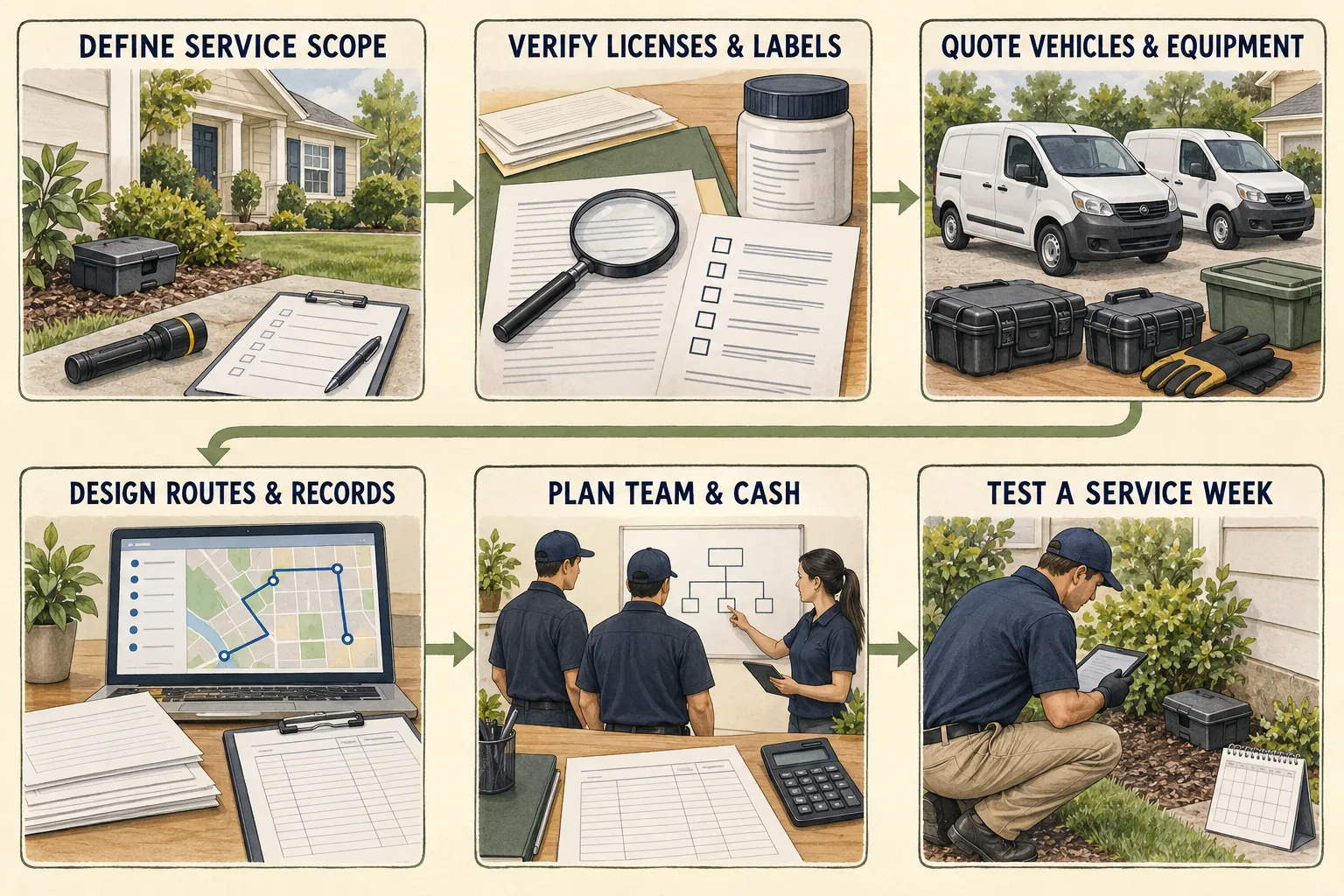
Name the business, qualifying person, field-worker roles, included pests, excluded services, storage address, territory, vehicles and supervision arrangement. Obtain the applicable authority and insurer response for that exact scope.
Write a service promise that can be scheduled
Separate recurring inspection frequency from treatment triggers; state access conditions, callback coverage, exclusions, cancellation terms and collection policy. Reserve time for documentation and recovery.
Test initial and mature service time
Record travel, access, inspection, service decision, authorized work, documentation and reset for routine, initial and callback visits separately. Test the first cohort before using mature route capacity to justify launch.
Replace the funding allowances
Collect delivered equipment and vehicle quotes, storage and occupancy terms, insurance coverage, fees, payroll obligations and dated marketing commitments. Model the actual customer ramp and collections before accepting fixed commitments.
Your first evidence task: Run a lawful paid cohort inside a compact proposed territory. Record each plan's covered scope, first service, complete travel-and-service clock, monthly invoice and collection, subsequent inspection, callback cause, credit and cancellation. Continue through the promised service interval; four busy weeks alone cannot establish quarterly retention or annual seasonality.
What to measure in the first operating weeks.
A small operating dashboard
Measure
Why it changes a decision
Active paid plan-months and realized net yield
Shows whether recurring contracts actually produce the assumed income after credits, refunds and failed collection.
Retention, cancellations and new starts
Separates genuine route growth from replacement sales and reveals the initial-service work caused by churn.
Routine, initial and callback visit counts
Keeps the service obligation and recovery burden visible without treating a no-charge return as new revenue.
Paid field hours by visit type and route
Includes travel, access, service, records, stocking, training, maintenance and time lost to unavailable vehicles or customers.
Scope, documentation and customer outcome
Connects the pest identification and accepted work to authorized decisions, required records, callback cause, customer instructions and closure.
Review actuals against the scope you priced. If an extra service, new trading hour or more distant client changes the work, update the roster and contribution calculation before expanding.
Prepare the right approval brief.
Take the exact residential household-pest scope, ownership, qualifying person, worker training and supervision, storage and dispatch address, vehicles, proposed products and equipment, customer notices, service records, waste arrangements and insurance to the responsible state pesticide or structural-pest authority and applicable local offices. Confirm which entity and individual permissions, category limits, records, notices, renewals, storage and safety rules apply. Federal restricted-use certification is a floor; it does not settle all state commercial requirements.
Reconsider the launch when the whole-plan financial threshold exceeds the onboarding or mature route ceiling; when the business cannot legally deliver its advertised scope; when collection or retention fails to support the assumed yield; or when repeated callbacks consume the remaining paid capacity. More contracts cannot correct an unworkable service promise.
Write a response that changes the actual cause: narrower scope, a different site, revised paid staffing, a tested price or a delayed opening. A larger cash buffer only addresses a temporary timing gap.
Build one operating record from pest identification and accepted scope through technician assignment, service documentation, callback resolution, billing and renewal.
Restaurant earns from completed guest orders and is constrained by kitchen, service, and seating throughput. Pest Control Company earns a monthly household-plan yield while delivering a separate calendar of inspections, initial visits and callbacks. Compare realized contribution and paid capacity in their own units; a pest contract base is useful only when retention, legal scope and route obligations remain deliverable.
Coffee Shop earns from completed beverage and food orders and is constrained by bar, queue, seating, and peak-hour throughput. Pest Control Company earns a monthly household-plan yield while delivering a separate calendar of inspections, initial visits and callbacks. Compare realized contribution and paid capacity in their own units; a pest contract base is useful only when retention, legal scope and route obligations remain deliverable.
Cleaning Business earns from completed account visits and is constrained by crew hours, route density, access, and repeat contracts. Pest Control Company earns a monthly household-plan yield while delivering a separate calendar of inspections, initial visits and callbacks. Compare realized contribution and paid capacity in their own units; a pest contract base is useful only when retention, legal scope and route obligations remain deliverable.
Hair Salon earns from completed appointments and is constrained by licensed stylist hours and usable chairs. Pest Control Company earns a monthly household-plan yield while delivering a separate calendar of inspections, initial visits and callbacks. Compare realized contribution and paid capacity in their own units; a pest contract base is useful only when retention, legal scope and route obligations remain deliverable.
Auto Detailing Business earns from completed detailing packages and is constrained by technician hours, bays, water, tools, and vehicle handoff. Pest Control Company earns a monthly household-plan yield while delivering a separate calendar of inspections, initial visits and callbacks. Compare realized contribution and paid capacity in their own units; a pest contract base is useful only when retention, legal scope and route obligations remain deliverable.
Laundromat earns from paid washer turns and dryer use and is constrained by machine count, cycle time, utilities, uptime, and customer turns. Pest Control Company earns a monthly household-plan yield while delivering a separate calendar of inspections, initial visits and callbacks. Compare realized contribution and paid capacity in their own units; a pest contract base is useful only when retention, legal scope and route obligations remain deliverable.
Daycare Center earns from paid enrolled child-weeks and is constrained by licensed rooms, age-group ratios, staff coverage, and safe occupancy. Pest Control Company earns a monthly household-plan yield while delivering a separate calendar of inspections, initial visits and callbacks. Compare realized contribution and paid capacity in their own units; a pest contract base is useful only when retention, legal scope and route obligations remain deliverable.
Pet Grooming Salon earns from completed grooming appointments and is constrained by groomer, bathing, drying, table, and animal-handoff capacity. Pest Control Company earns a monthly household-plan yield while delivering a separate calendar of inspections, initial visits and callbacks. Compare realized contribution and paid capacity in their own units; a pest contract base is useful only when retention, legal scope and route obligations remain deliverable.
Landscaping Company earns from completed recurring property visits and is constrained by crew hours, route density, weather, equipment, and seasonal scope. Pest Control Company earns a monthly household-plan yield while delivering a separate calendar of inspections, initial visits and callbacks. Compare realized contribution and paid capacity in their own units; a pest contract base is useful only when retention, legal scope and route obligations remain deliverable.
Food Truck earns from completed food orders and is constrained by preparation, travel, commissary, service windows, and truck throughput. Pest Control Company earns a monthly household-plan yield while delivering a separate calendar of inspections, initial visits and callbacks. Compare realized contribution and paid capacity in their own units; a pest contract base is useful only when retention, legal scope and route obligations remain deliverable.
Bakery earns from completed retail baskets and is constrained by batch production, sell-through, staffing, counter, and freshness. Pest Control Company earns a monthly household-plan yield while delivering a separate calendar of inspections, initial visits and callbacks. Compare realized contribution and paid capacity in their own units; a pest contract base is useful only when retention, legal scope and route obligations remain deliverable.
Fitness Studio earns from paid active member-months and is constrained by class timetable, instructor hours, spots, access, retention, and collections. Pest Control Company earns a monthly household-plan yield while delivering a separate calendar of inspections, initial visits and callbacks. Compare realized contribution and paid capacity in their own units; a pest contract base is useful only when retention, legal scope and route obligations remain deliverable.
HVAC Company earns from completed and collected service calls or replacement jobs and is constrained by technician hours, vehicles, travel, parts, equipment, installation mix, and rework. Pest Control Company earns a monthly household-plan yield while delivering a separate calendar of inspections, initial visits and callbacks. Compare realized contribution and paid capacity in their own units; a pest contract base is useful only when retention, legal scope and route obligations remain deliverable.
Moving Company earns from completed local household moves and is constrained by whole crew-and-truck blocks across yard, origin, route, destination, and reset. Pest Control Company earns a monthly household-plan yield while delivering a separate calendar of inspections, initial visits and callbacks. Compare realized contribution and paid capacity in their own units; a pest contract base is useful only when retention, legal scope and route obligations remain deliverable.
Auto Repair Shop earns from completed repair orders and is constrained by technician hours, bay hours, lifts, tools, parts readiness, authorization, and rework. Pest Control Company earns a monthly household-plan yield while delivering a separate calendar of inspections, initial visits and callbacks. Compare realized contribution and paid capacity in their own units; a pest contract base is useful only when retention, legal scope and route obligations remain deliverable.
Plumbing Company earns from completed and collected residential plumbing jobs and is constrained by paid plumber hours, vehicles, travel, diagnosis, materials, permits, and callbacks. Pest Control Company earns a monthly household-plan yield while delivering a separate calendar of inspections, initial visits and callbacks. Compare realized contribution and paid capacity in their own units; a pest contract base is useful only when retention, legal scope and route obligations remain deliverable.
Electrical Contractor earns from completed and collected residential electrical service and small-alteration jobs and is constrained by paid electricians, vehicles, sold-hour realization, materials, permits, inspections and rework. Pest Control Company earns a monthly household-plan yield while delivering a separate calendar of inspections, initial visits and callbacks. Compare realized contribution and paid capacity in their own units; a pest contract base is useful only when retention, legal scope and route obligations remain deliverable.
Is a monthly pest plan the same as a monthly treatment?
No. Billing frequency, scheduled inspection or service frequency and treatment decisions are different. The reference bills a monthly plan with four scheduled visits a year; actual action depends on the accepted scope, findings and applicable product and operating requirements.
Do callbacks add revenue?
An included callback is a service obligation, not another plan-month. Reserve its materials and paid field time against the original plan, and distinguish any separately authorized excluded work.
Why is launch capacity below mature route capacity?
New customers need initial service. The entered ramp activates 40% of the target in month one, so its initial visits can bind before a mature quarterly route. The calculator tests every launch month as well as steady operations.
Can customer prepayments finance expansion?
A prepayment brings cash forward but leaves future service obligations. Keep its collection date, refunds and earned plan income separate, and do not count the same cash as both a new sale and a reserve.
Does this scenario establish a state startup cost?
No. State wage anchors change paid-roster calculations; nonwage inputs remain disclosed assumptions. Named official state observations inform operating checks without becoming observed local demand, signed quotes or complete feasibility studies.
Sorting compares one defined format. It does not rank states for attractiveness or prove demand. Funding includes a 60-month cash reserve under each scenario.
Pest Control Company · same commercial assumptions, state occupational wage medians
State
Funding scenario
Loaded payroll / month
EBIT break-even active paid service plans per month
Published research and calculations support business planning and education. They are not personalized financial, investment, tax or legal advice, and they do not guarantee costs, revenue, profit or financing. Estimates depend on the stated format, location, source periods and assumptions. Check the requirements and commitments that apply to your circumstances.