
How to control pest-service dispatch, compliance and retention
Dispatch from the service obligation, qualified worker and actual visit clock. The reference has 346.67 paid field hours, including 32 nonroute hours. Its steady 550-plan workload uses 219.83 hours; the first customer cohort uses 311.95. Protect initial service, required records and callbacks before promising additional arrival windows.
What you will produce: An accepted-scope intake, dispatch-readiness check, paid route ledger, documented service closure, callback cause record and cohort retention decision.
Updated October 1, 2026 · Worked examples and editable worksheets
What to have ready
Bring current authority and supervision records, accepted customer terms, route and visit histories, equipment and product information, service documentation, callback outcomes, invoices, refunds and cancellations.
Work through the calculation and decision
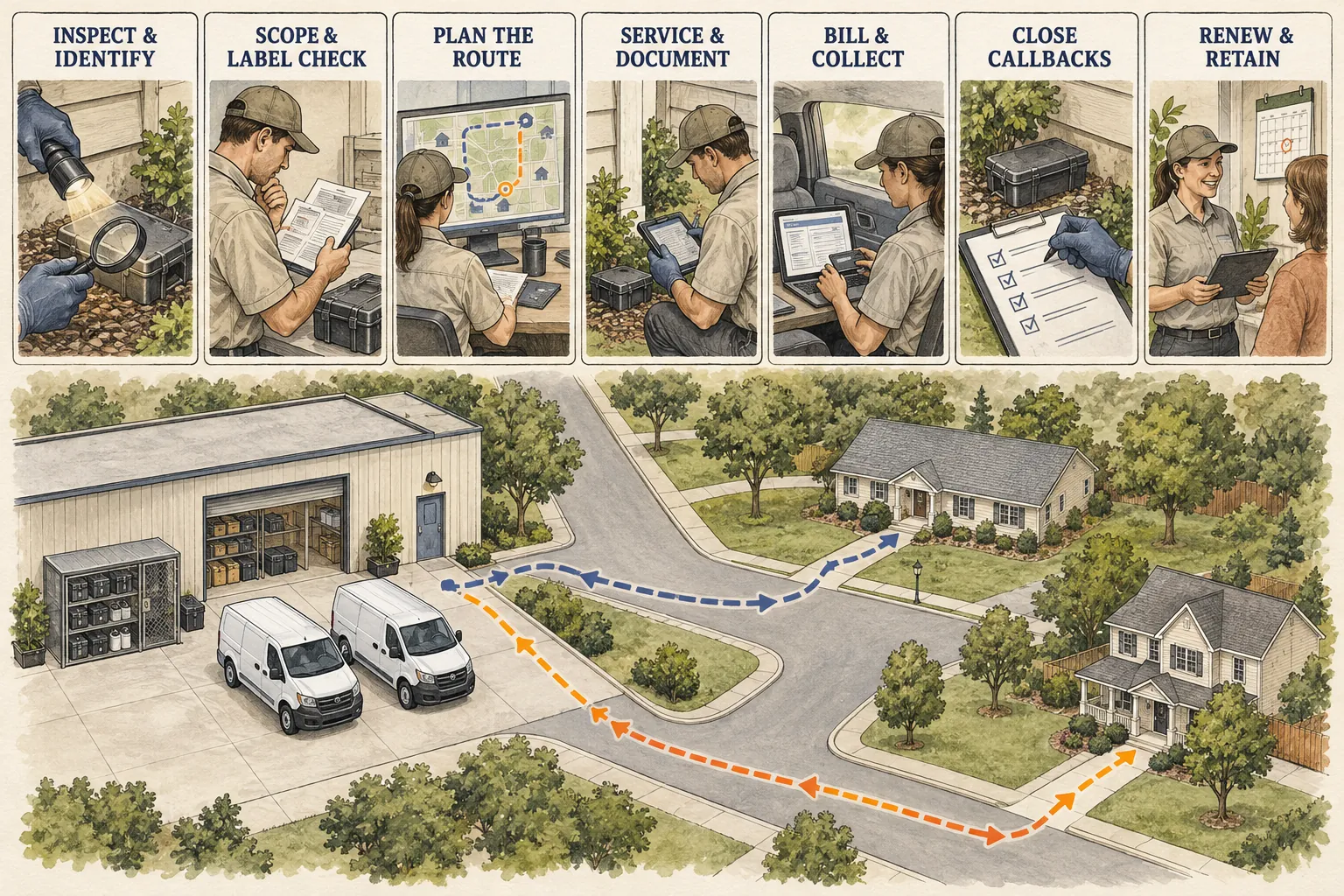
Qualify the property and problem
Record the address, building and access conditions, pest concern, evidence supplied, occupants or pets that affect the service plan, scope requested and any prior treatment. Distinguish an accepted household plan from excluded termite, fumigation, wildlife or other specialty work before quoting or assigning a route.
Resolve authority for the exact service
EPA states that restricted-use pesticide application or supervision requires certification and that states can impose broader commercial requirements. Check the entity, qualifying person, worker category, supervision, renewal and record rules in the relevant state. A familiar job title or completed training course does not by itself establish permission for every product or work category.
Make an inspection-driven service decision
Identify the pest and relevant conditions, consider prevention and monitoring, then determine warranted action within accepted scope. EPA's IPM framework supports this sequence. Record the finding and reason for action; a recurring contract is not a reason to apply a product automatically.
Release a visit only when its prerequisites align
Confirm access, customer instructions, qualified assigned technician, available vehicle, necessary equipment, applicable product information and suitable conditions. Keep restricted or out-of-scope work off the released board. Have the responsible person decide escalation rather than letting calendar pressure decide it.
Schedule the whole visit clock
The default routine visit is 30 minutes onsite, 15 minutes travel/access and 9 minutes for records and reset: 54 minutes total. Initial visits take 75 minutes and callbacks 45 minutes as full-cycle assumptions. Add 32 monthly hours for stocking, training, equipment care and other nonroute work. Measure actual time rather than treating these allowances as productivity standards.
Close service and customer records together
Capture findings, inspection or service actions, required product and application records where applicable, customer instructions, technician identity, time, follow-up need and next scheduled obligation. Connect the record to the accepted plan and invoice. A closed calendar slot with missing service documentation is not operational closure.
Treat callbacks as diagnostic evidence
Link each callback to its original property, finding, date, service scope, reason, action, consumables and paid time. Separate expected monitoring from a service failure, access failure, excluded pest or new condition. Change a recurring cause before promising more volume; never manufacture billable revenue from an included return visit.
Reconcile retention with the service promise
Track customer cancellations by cohort and reason, including scope mismatch, service outcome, communication, access and billing. Eleven replacement plans a month merely hold the reference base at 550 under 2% churn. Evaluate acquisition cost and initial-service capacity before assuming that a stable count means low workload.
Review the route before expansion
Use the actual calendar to inspect travel clusters, long initial visits, callback concentrations, technician eligibility, vehicle downtime and seasonal service demand. A geographic boundary should follow feasible response and service obligations. Expand only after the existing territory supports the stated promise and collection policy.
The disclosed plan and service workload
This is an authored operating scenario. Occupation wages are observed anchors; commercial price, demand, costs, retention, visit frequency and duration remain assumptions.
| Input or result | Basis | Reference |
|---|---|---|
| Paid field hours | Two full-time paid technicians | 346.67 per month |
| Routine / initial / callback full-cycle time | Authored assumptions including travel, service and records | 0.90 / 1.25 / 0.75 hours |
| Nonroute coverage | Authored stocking, training and equipment-care allowance | 32 hours per month |
| Mature routine / initial / callback visits | Derived from 550 plans, 4 annual visits, 2% churn and 3% callbacks | 179.67 / 11 / 16.5 |
| Routine hours | Derived from the stated assumptions | 161.70 |
| Replacement initial-service hours | Derived from the stated assumptions | 13.75 |
| Callback hours | Derived from the stated assumptions | 12.375 |
| Total mature field hours | Derived from the stated assumptions | 219.825 |
| First-month field hours at 220 new plans | Derived from the stated assumptions | 311.95 |
| First-month unused paid field hours | Derived from the stated assumptions | 34.72 |
What this changes: A recurring plan count is usable only when its initial, routine and callback obligations fit qualified paid capacity and customers pay the realized yield.
Complete your decision record
An accepted-scope intake, dispatch-readiness check, paid route ledger, documented service closure, callback cause record and cohort retention decision. Enter the finding or number, the source and the next action for each row. “Supported” records your assessment of that item; it does not approve the business or certify completed research.
| Item and what to record | Your finding and evidence | Status and next action |
|---|---|---|
| Intake and authorityProperty, pest concern, accepted/excluded scope, business and worker authority, supervision and customer terms | ||
| Service decisionIdentification, findings, prevention or monitoring option, warranted action, product and site requirements where applicable | ||
| RouteAssigned technician and vehicle, travel, access, onsite work, records, reset and blocked time | ||
| ClosureCustomer instructions, required records, follow-up date, invoice, collection and unresolved issue | ||
| RetentionCallback cause, resolution, credits, cancellation reason, replacement start and cohort history |
5 items have no evidence recorded yet.
Entries are temporary and are not sent to us or saved automatically. Download your completed work before leaving or refreshing this page.
Choose your next action
| If your finding is… | Your next action |
|---|---|
| Authority or accepted scope is unclear | Pause the proposed service, confirm the applicable category and qualified supervision, or refer the excluded work. |
| The route cannot fit all promised visits | Reschedule transparently, narrow territory, slow onboarding or revise supported capacity before adding commitments. |
| Repeated returns cluster around one cause | Investigate and correct the supported scope, identification, access, service or communication issue; reserve paid recovery time. |
| Customers cancel despite a full service calendar | Compare the delivered scope, outcomes and communications with the sold promise rather than relying on the number of completed visits. |
Errors that can change the result
- Equating monthly billing with a mandatory monthly pesticide application.
- Assuming a federal restricted-use rule settles every state commercial requirement.
- Treating a no-access stop or incomplete record as a fully delivered plan obligation.
- Counting a callback as a new paid customer.
- Expanding the territory from average miles alone without timing its real visits.
Apply this to your business
These operating formats match the decisions in this guide.
Pest Control Company
Local recurring residential general-household pest service company with two paid field technicians, two service vehicles, paid dispatch and paid owner-manager replacement-cost coverage
Open the operating guide and state profiles →Use the accepted scope, visit clock, retention record and direct quotes to revise the paid roster, launch ramp and opening cash. Values entered here are not automatically transferred to another calculator.
Continue with the next part of your plan
- How many recurring pest-control plans are needed to break even?
Contribution per plan-month, monthly operating results, exact and whole-plan break-even, mature and launch capacity, and a twelve-month service-and-cash schedule using the same assumptions.
- How to find the permits and approvals your business actually needs
An approval register with official responses and the next unresolved question.
- How to build a staffing roster before estimating payroll
A roster with complete task coverage and an annualized monthly staffing budget.
- Business opening checklist: the decisions to resolve before launch
A launch decision record with unresolved dependencies and a named next action.
Sources and limits
The sources below provide the stated background. The worked examples, calculator defaults and decision exercises are authored teaching material. They do not establish market prices, local demand, legal applicability or completed state research.
- EPA: How to Get Certified as a Pesticide Applicator
Federal restricted-use certification and the need to check broader state commercial requirements.
- EPA integrated pest management principles
Inspection, identification, prevention and warranted control decisions; not a mandatory application calendar.
- Pest Control Company reference economics
Authored recurring-plan and paid-visit scenario; not observed performance.
Source pages checked October 1, 2026. Research and review standards · Report an issue
When you need a longer financial plan
Use a financial model to organize a broader forecast after defining your own operating assumptions. The site’s research, your worksheet entries and any purchased workbook are separate; entries are not transferred automatically.
Continue with the published financial scenario