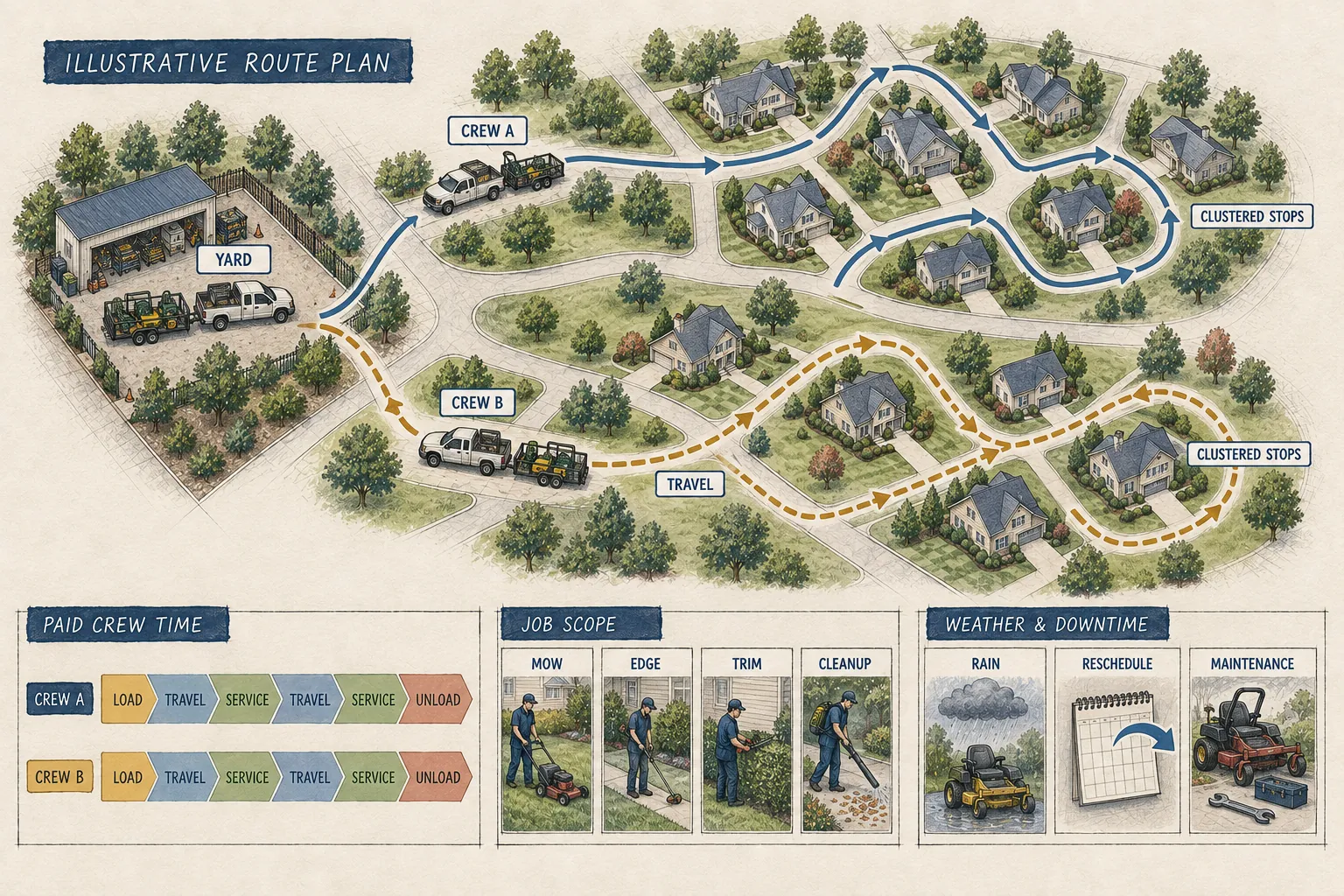
Measure a recurring property visit and each crew's complete route day before buying a second equipment set or extending the service area. The stated national wage scenario uses 14 completed property-service visits per route day at $105.00 per completed property-service visit, producing $3,260 mature monthly EBIT and $210,949 modeled opening funding. Sales, capacity and nonwage costs remain planning assumptions.
Route density protects contribution only when both crews can complete their own stops. Weather deferrals and longer properties can create a backlog that does not fit the next recurring route.
One completed residential maintenance visit earns the agreed scope. Scheduled stops, cancellations, weather deferrals and callbacks are separate; a two-person visit consumes both workers' time.
At the assumed activity, the mature month produces $5,243 EBITDA, $3,260 EBIT and $4,243 cash after maintenance. The first twelve modeled months use $4,157 of operating cash; they do not represent a full year at the mature run rate.
The EBIT threshold is approximately 12.4 completed property-service visits per route day; it uses the same price, variable-cost basis and complete paid roster. The listed ceiling is 16 completed property-service visits per route day, with the operating qualifications in the capacity explanation below. Schedule whole stops separately for the two vehicle-and-equipment sets. Test recovery after an ordinary weather or equipment loss without transferring spare minutes between distant routes.
Separate sensitivity tests · mature monthly EBIT · all other inputs held fixed
Test
Entered activity or cost
Monthly EBIT
Published reference
14 completed property-service visits per route day
$3,260
20% less earned activity
11.2 completed property-service visits per route day
-$2,432
10% higher wage benchmarks
1.10 × the same occupational wage anchors
$1,378
20% higher occupancy cost
$1,200.00 monthly occupancy
$3,060
Of the three separate tests shown, 20% less earned activity makes the largest change to monthly EBIT: -$5,692. This is a result of the stated test sizes, not a probability or a universal risk ranking.
Four field workers and separate route supervision are paid. Loading, travel, access, breaks, equipment care and return to base remain inside each crew's day.
Opening payments of $131,758, the deepest cumulative operating cash deficit of $32,758 in month 4, and the retained buffer of $46,432 add to $210,949 modeled funding. Refundable deposits are included in opening cash uses; they are not operating expenses. Funding is a scenario total, not a quote or a financing recommendation.
The reference includes a collection delay after completed visits. It holds a common monthly volume after the ramp; actual active and shoulder seasons require a dated calendar rather than automatic catch-up revenue.
EBITDA pays the full modeled roster and operating costs. EBIT also deducts depreciation. Mature cash deducts maintenance investment from EBITDA, after receivables stop growing. All three exclude financing, income taxes and additional owner distributions.
If either crew cannot deliver the required paid stops or deferred work displaces the next route, narrow geography, change scope or revise seasonal commitments. Time a whole route day and a disrupted day, retain property-specific realized prices, and quote complete mobilization and seasonal staffing costs.
Calculations retain the exact input values. USD totals are displayed to whole dollars and blended prices to cents; activity and threshold estimates are displayed to up to two decimals. Rounded thresholds are estimates, not prescriptions for a sufficient whole job, visit or member count.
What the customer buys and what makes the business repeatable.
The reference unit is one completed recurring maintenance visit for one residential property. A quote, signed agreement, scheduled stop, skipped visit, weather deferral, cancellation, callback or same-visit add-on is not another completion. Earned revenue is the agreed visit charge after discounts, credits and refunds, before sales tax collected for government.
A recurring agreement reserves future work; it does not prove future completions or collections. Track scheduled, completed, weather-deferred, customer-canceled, reworked and collected visits separately by route day. Retention matters only when the scope still fits the paid route and the customer accepts the realized price.
The format on this site: Two two-person crews providing recurring residential landscape maintenance on compact local routes. Landscape installation, design, hardscape or construction, irrigation installation or repair, pesticide or fertilizer application, arborist and tree-removal work, snow services, commercial properties, one-off cleanups, franchising, subcontracted field crews and unpaid owner labor are outside this recurring residential maintenance format.
Two paid two-person crews complete defined local maintenance visits with paid route supervision
The reference format here; route density, on-property person-hours and seasonal completions govern capacity.
Landscape design and installation
Projects can include design, grading, planting, irrigation, hardscape or construction
Estimating, equipment, crews, permits, payment stages and revenue units require a separate project model.
Chemical lawn treatment or tree service
Applications, diagnosis, climbing, aerial work or removal add specialized work
Credentials, insurance, equipment, safety and applicable rules cannot be inferred from routine maintenance.
A founder prepared to manage paid field teams, routing, equipment readiness, quality and customer communication across changing outdoor conditions. The operation rewards discipline in scope and geography because a small time overrun repeated across many stops can consume the capacity of both crews.
Understand the reference operating plan.
The figures below are a national wage reference scenario. The paid roster uses May 2025 BLS national occupational medians. Prices, customer volume, rent, equipment and other commercial inputs are authored assumptions. This is not a researched average startup cost, owner-income promise or a funding recommendation.
One defined format · monthly amounts before financing and income taxes
Input or result
Reference
What to verify
Completed sales units
308 completed property-service visits / month
14 completed property-service visits per route day; demand requires evidence.
Net selling price
$105.00
Build and test a relevant local menu, package or contract scope.
Revenue
$32,340
Calculated volume × price, not observed sales.
Paid payroll
$18,816 / month
National wage medians × the stated hours × the 18% employer allowance.
Opening payments
$131,758
Authored equipment and setup allowances, deposit and paid training.
After the full paid roster and depreciation; before financing and income taxes.
Approximate EBIT threshold
Approximately 12.4 completed property-service visits per route day
A rounded estimate. Test whole permitted activity against the full roster and resource constraints.
Each crew has eight paid hours. At 90% route availability, 432 minutes remain for a 54-minute stop cycle, supporting eight whole visits per crew or 16 visits across two crews per route day. The authored stop cycle uses 45 on-property minutes plus nine minutes between properties. Four field workers therefore provide 32 paid person-hours per day, while one completed visit uses 1.5 on-property person-hours. Loading, breaks, estimates, equipment care, route imbalance, property variation, traffic, weather, cancellations and rework can reduce the ceiling. These values are planning assumptions, not observed route performance or demand.
5% fuel and visit-driven equipment use, 3% trimmer line, blades, bags, green-waste and other consumables, and 4% payment fees, callbacks and other costs that move with completed visits; all employee compensation remains in payroll. Commercial auto and general insurance $1,000; yard utilities, waste and security $500; route, scheduling and communication systems $400; marketing $650; accounting, administration and professional costs $450; non-visit vehicle and equipment standing costs $400 per month. Maintenance investment is modeled separately at $1,000 per month.
Landscaping and Groundskeeping Workers is the primary field-work benchmark; First-Line Supervisors of Landscaping, Lawn Service, and Groundskeeping Workers is the route-supervision benchmark. These broad occupations do not establish local hiring quotes, crew skill, overtime, employer obligations or a lawful compensation arrangement. The four field positions and all supervision, estimating and client coordination are paid; the supervisor hours do not add field-crew capacity unless the actual schedule assigns that person to a crew and removes the simultaneous office duty.
A positive reference EBIT depends on the assumed paid sales volume and costs. It does not establish local demand or cash available for owner withdrawals.
For this recurring residential maintenance format, the decision turns on completed property-service visits at a realized price that covers four paid field positions, route supervision, two matched vehicle-and-equipment systems, travel, weather loss, standing costs and the weaker seasonal period. A recurring agreement or address inside the service radius does not establish a deliverable completion.
The reference EBIT threshold is approximately 12.4 completed property-service visits per route day. At 11.2 completed property-service visits per route day (20% below the volume assumption), monthly EBIT falls to -$2,432. This exposes the need to substantiate paid volume before relying on the positive reference month. These are scenario calculations with the other inputs held fixed, not a demand forecast or a recommended safety margin.
The authored teaching case gives each crew eight whole-stop slots, schedules 15 visits across both crews and retains about 13.97 expected completions after entered customer and weather loss. Those route times, losses, seasonal availability, price and cost values are sensitivities rather than observed national or local performance; NAICS 561730 also covers landscaping activities outside this narrower maintenance format.
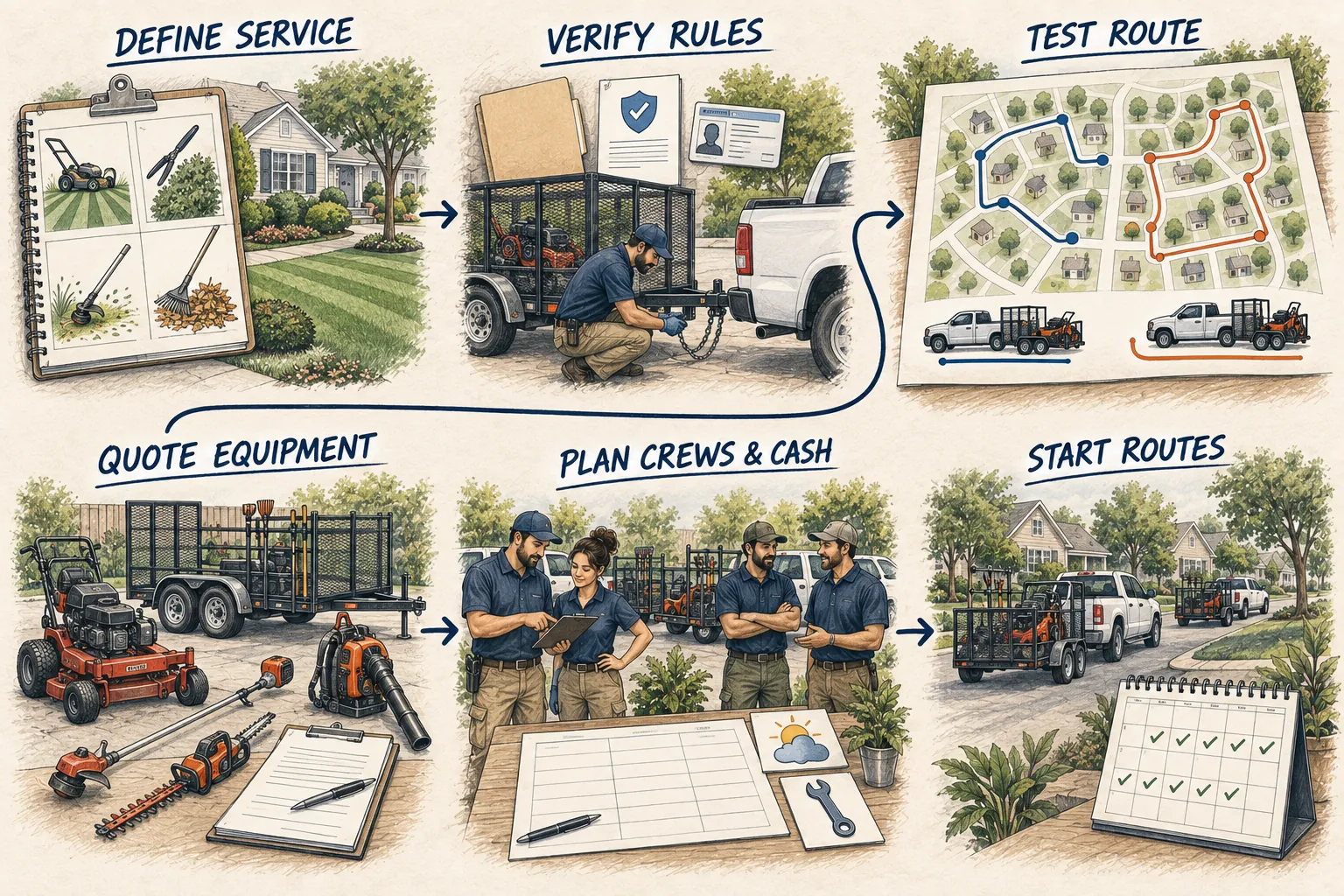
Time complete route days for both crews and reconcile scheduled, canceled, weather-deferred, recovered, reworked, completed and collected visits. Revise geography, service scope, cadence, price, roster or equipment commitment when break-even needs more whole stops than either route can deliver under an ordinary disruption.
Write included tasks, property boundaries, visit frequency, quality standard, exclusions, earned-price rule and what triggers a re-quote. Keep installation, pesticide, tree, snow and one-off work outside the reference.
Measure complete route days
Record yard loading, travel, access, on-property crew minutes, cleanup, breaks, disposal, equipment care, callbacks and return to base. Test both crews without transferring leftover minutes between routes on paper.
Resolve equipment and operating scope
Obtain matched truck, trailer, mower, handheld, storage, insurance and maintenance quotes. Ask the responsible agencies about the exact business, yard, vehicle, waste, noise, employer and activity scope.
Stress the seasonal schedule
Model active and shoulder periods, rain or heat disruption, cancellations, catch-up capacity, overtime and payroll timing. Keep every required role paid while demand is being established.
Your first evidence task: Choose one representative route day and deliver the defined maintenance scope in an appropriate authorized setting. Record crew members, every elapsed interval, on-property person-hours, travel, access, materials, equipment interruptions, callbacks, earned price and collection date. Repeat under an ordinary disruption before extrapolating to two crews.
What to measure in the first operating weeks.
A small operating dashboard
Measure
Why it changes a decision
Completed visits by route day
Separates scheduled addresses and deferred work from delivered, earned service.
On-property and travel person-hours
Shows whether density and scope fit every paid field hour.
Realized price and callback cost
Connects the collected visit charge with discounts, extra work, credits and rework.
Weather backlog, cancellations and route retention
Makes seasonal loss and recoverable work visible before it overloads the next route day.
Review actuals against the scope you priced. If an extra service, new trading hour or more distant client changes the work, update the roster and contribution calculation before expanding.
Prepare the right approval brief.
Describe the residential maintenance menu, excluded application, tree and construction work, crew employment, yard and storage, vehicles and trailers, operating hours, noise, fuel or other stored materials, green waste and disposal. Ask the responsible state and local agencies which business, employer, land-use, parking, vehicle, waste, environmental, occupational or activity-specific requirements apply to the actual locations and services.
Stop when break-even visits exceed the whole-stop capacity of either crew, when the plan assumes every weather deferral can be recovered without displacing recurring work, when an advertised scope lacks a timed boundary, or when the second crew depends on a vehicle, equipment or supervisor that has not been paid and scheduled.
Write a response that changes the actual cause: narrower scope, a different site, revised paid staffing, a tested price or a delayed opening. A larger cash buffer only addresses a temporary timing gap.
Test whole-stop route capacity, sold on-property hours, seasonality, cancellations, weather and operating break-even for two paid residential maintenance crews.
A restaurant concentrates food production and guest service at one fitted premises. A landscaping company sends two paid crews through recurring residential routes. Both need a complete paid operating day, but one is constrained by meal-period stations and the other by route time, property scope, weather and equipment mobility.
A coffee shop needs many short transactions in defined buying windows at one location. A landscaping company earns fewer, longer property completions across route days. Convenience drives repeat demand in both, but counter throughput and route density are different operating systems.
Both businesses send paid teams to recurring client locations, so scope, route density and collection timing matter. The cleaning reference serves commercial accounts indoors; the landscaping reference completes residential outdoor maintenance visits through two equipment-equipped crews.
A hair salon brings scheduled clients to skilled practitioners at one premises. A landscaping company sends two crews and equipment to recurring properties. Both sell paid labor time, but service mix, travel, seasonality and asset use shape capacity differently.
Both formats use paid field or technical labor and equipment to complete condition-sensitive work. The detailing studio brings vehicles to fixed bays; the landscaping company moves two crew-and-equipment systems among residential properties.
A laundromat concentrates installed machines and utilities at one customer-operated site. A landscaping company distributes trucks, equipment and paid crews across residential routes. Both require asset uptime, but their demand units and labor dependency differ.
A daycare center sells reserved child-weeks under continuous room-level staffing obligations. A landscaping company sells discrete completed property visits through mobile crews whose routes can change with weather and season. Both need paid absence coverage, but their operating obligations are fundamentally different.
A pet grooming salon sells skilled completed dog appointments at one wet-service premises. A landscaping company sells completed residential maintenance visits through two mobile crews. Both face condition-sensitive service time, but animal workflow and route-weather exposure create different constraints.
A Landscaping Company completes recurring property visits through two crew-and-equipment routes. A Food Truck moves one production unit among vending locations and completes retail orders during short windows. Both are mobile, but route recurrence, weather, product perishability and customer units differ.
A Landscaping Company moves paid crews and equipment through recurring property routes. A Bakery concentrates paid production and retail service at one fitted premises. Both must schedule equipment and labor, but outdoor route disruption and perishable inventory create different recovery problems.
A Landscaping Company earns completed property-service visits through mobile paid crews. A Fitness Studio earns recurring member-months through a fixed class timetable. Both schedule labor ahead of demand, but routes, weather and equipment travel differ from room capacity, member access and instructor substitution.
Both formats dispatch paid field workers and equipment across a service area. A Landscaping Company earns from completed property-service visits; an HVAC Company separates diagnostic or repair calls from equipment-replacement jobs. Route density matters to both, while HVAC adds technical authorization, refrigerant handling, equipment procurement, and callback records.
Both formats dispatch a paid crew and equipment across a service area. A Landscaping Company earns from recurring property-service visits on compact routes; a Moving Company earns from distinct origin-to-destination projects using one truck. Route density matters to both, while moving adds inventory, building access, custody, billed duration, and household-goods claims.
A Landscaping Company earns from recurring property-service visits across compact routes. An Auto Repair Shop earns from completed repair orders at one equipped site. Both depend on paid skilled labor and equipment uptime, while repair adds customer authorization, parts, vehicle custody, bay dwell, and warranty work.
A Landscaping Company earns from completed recurring property visits through crew hours, route density, weather, equipment, and seasonal scope. A Plumbing Company earns from completed and collected residential service jobs through licensed plumbers, two vehicles, dispatch, materials, permits, and callback control. Both must fit paid capacity to realized contribution, while plumbing adds address-to-address travel, trade authority, water and gas system risk, material acquisition, and return-service exposure.
A Landscaping Company earns from completed recurring property visits through crew hours, route density, weather, equipment, and seasonal scope. An Electrical Contractor earns from completed and collected residential service and small-alteration jobs through licensed electricians, two vehicles, dispatch, sold hours, materials, permits, inspections, testing, and rework control. Both must fit paid capacity to realized contribution, while electrical adds address-to-address travel, trade authority, code and energized-work risk, material compatibility, inspection dependencies, and return-service exposure.
Landscaping Company earns from completed recurring property visits and is constrained by crew hours, route density, weather, equipment, and seasonal scope. Pest Control Company earns a monthly household-plan yield while delivering a separate calendar of inspections, initial visits and callbacks. Compare realized contribution and paid capacity in their own units; a pest contract base is useful only when retention, legal scope and route obligations remain deliverable.
Landscaping Company earns from completed recurring maintenance visits and is constrained by crew person-hours, route density, seasonal availability, access and weather-adjusted completions. Residential Remodeling Company earns accepted interior scope, expressed as comparable project equivalents, while controlling a paid carpenter crew and authorized specialty trades. Compare the complete paid operating mechanism and dated cash, using each format’s own unit.
Does a recurring agreement count as completed demand?
No. Count a property-service visit only when the defined work is completed and its earned charge is recorded. Track scheduled, deferred, canceled, reworked and collected visits separately.
Why is capacity calculated by crew rather than by total company hours?
Each route has its own truck, equipment, geography and leftover time. Minutes left on one crew cannot automatically complete a stop assigned to the other crew.
Does NAICS 561730 describe only recurring residential maintenance?
No. The industry also includes landscape care and maintenance as well as installation and design activities. Its establishment counts are broader context, not a direct measure of this fixed two-crew format or local demand.
Can winter or a wet week simply be moved into the next month?
Only if the service agreement, weather window, customer need and paid schedule leave recoverable capacity. Model deferred, recovered, credited and lost visits separately rather than moving all revenue automatically.
Sorting compares one defined format. It does not rank states for attractiveness or prove demand. Funding includes opening payments, the deepest cumulative operating cash deficit in the 60-month model and the retained cash buffer.
Landscaping Company · same commercial assumptions, state occupational wage medians
State
Funding scenario
Loaded payroll / month
Approximate EBIT threshold completed property-service visits per route day
Published research and calculations support business planning and education. They are not personalized financial, investment, tax or legal advice, and they do not guarantee costs, revenue, profit or financing. Estimates depend on the stated format, location, source periods and assumptions. Check the requirements and commitments that apply to your circumstances.