
How to plan landscaping crew capacity across routes, weather and seasons
Assign recurring properties to real crew-days, reserve whole-stop recovery capacity and define what happens when weather, access, cancellation, absence or equipment failure prevents service. Reconcile active and shoulder-season commitments with the paid roster, equipment sets, customer policy and cash plan before selling the route as full.
What you will produce: A two-crew weekly route board, capacity and disruption ledger, seasonal staffing decision and an escalation rule for visits that cannot be recovered.
Updated September 10, 2026 · Worked examples and editable worksheets
What to have ready
Bring the recurring service agreements, address list, property scope and cadence, route map, timed stops, both paid crew rosters, vehicle and equipment assignments, loading and maintenance plan, weather policy, cancellation and credit rules, historical completed and deferred visits, customer communication process and monthly cash commitments.
Work through the calculation and decision
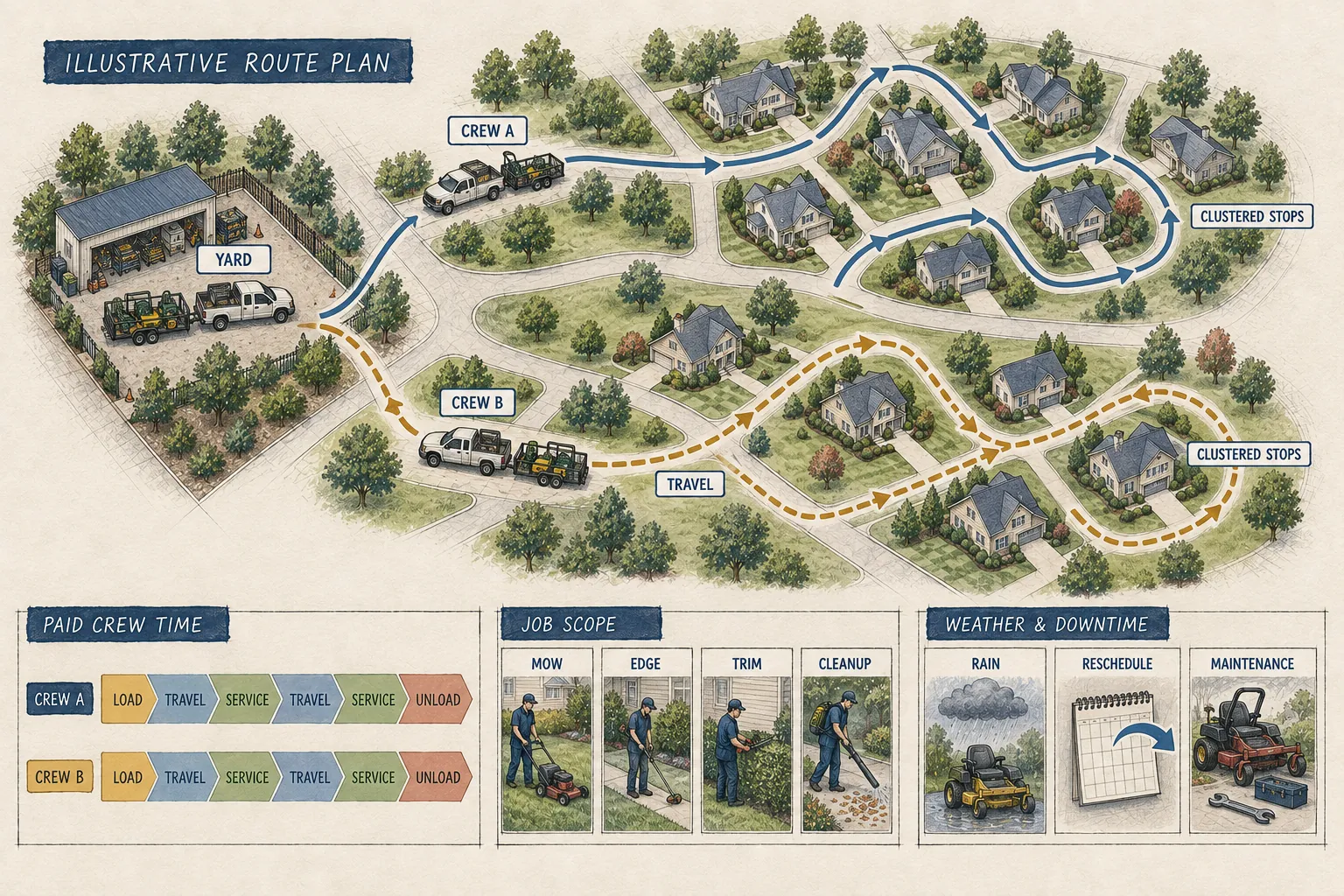
How should the weekly route board be built?
Give every property a crew, route day, sequence, service window, scope, normal on-property minutes, access note and earned charge. Add yard departure and return, fuel or charging, breaks, disposal, equipment care, estimates and supervisor duties. A radius or address count is not a route board.
Calculate whole stops for Crew A and Crew B separately. Reserve identified slots only where the equipment, geography and paid schedule can accept them. An unused 20-minute fragment after one route cannot recover a 54-minute stop, and spare time on one truck does not move the other truck across town.
What happens when work is deferred?
Record the cause, notice time, service status, customer entitlement, next feasible whole slot, crew and effect on the following route. Distinguish weather-deferred, customer-canceled, skipped, credited, recovered and completed visits so backlog is not counted as revenue.
Stress the board with one lost crew-day and one equipment outage. If recovery displaces a recurring visit, requires overtime, changes service quality or exceeds the customer agreement, show that consequence rather than marking every stop as moved.
How should the operating plan change by season?
Define active, shoulder and dormant service calendars from applicable customer agreements and observed local conditions. Recalculate available visits, paid work, equipment maintenance, estimates, training and collection timing. Do not preserve an active-season revenue total merely because the four field workers remain on payroll.
Choose the role of seasonal cash before the weak period: retained cash, a lawful roster change, complementary work inside a separately defined and authorized format, or a narrower commitment. New installation, snow, chemical or tree work is not automatically part of this maintenance case and needs its own scope, evidence and risk plan.
Five spare weekly stops cannot absorb one lost eight-stop crew-day
This authored route-board example applies the same eight whole visits per crew-day ceiling used in the calculator. It schedules 15 visits across the company each day for five days, with Crew A assigned eight and Crew B seven. The example illustrates recovery logic; it is not a recommended route, service time or weather assumption.
| Weekly route item | Calculation | Result |
|---|---|---|
| Whole weekly company capacity | 2 crews × 8 visits × 5 days | 80 visits |
| Regular visits scheduled | 15 visits × 5 days | 75 visits |
| Named whole-stop recovery space | 80 − 75 | 5 visits |
| One Crew A day lost | 1 crew × 8 assigned visits | 8 deferred visits |
| Deferred visits beyond current-week space | 8 − 5 | 3 visits without a feasible current-week slot |
| Maximum current-week completions before other loss | 75 − 8 + 5 | 72 visits |
| Status of the remaining three | No whole slot identified | Deferred, credited or lost under the agreement; not completed revenue |
What this changes: The route was below its headline weekly capacity before the disruption, yet it still cannot recover a full lost crew-day. The operator needs an explicit customer and cash decision for the three visits rather than counting all 75 scheduled stops as earned revenue.
Illustrative amounts are rounded for display. Use the full inputs and stated units when recalculating; an approximate threshold is not itself a sufficient activity prescription.
A route-capacity ledger keeps schedule and evidence together
| Lane | Required record | Decision signal |
|---|---|---|
| Regular recurring work | Crew, day, sequence, scope, normal minutes and earned charge | Does every committed visit have a feasible whole slot? |
| Recovery capacity | Named open slot, crew, geography, equipment and notice deadline | Can a deferred visit move without displacing another commitment? |
| Disruption | Weather, access, cancellation, absence, breakdown and service status | Which completions and collections changed? |
| Seasonal plan | Active, shoulder and dormant cadence, paid work and cash dates | Does the paid structure fit the completed seasonal volume? |
This is the guide visual plan rendered as a functional decision table. It communicates the route lanes and their evidence requirements without implying a geographic map or schedule that has not been measured.
Complete your decision record
A two-crew weekly route board, capacity and disruption ledger, seasonal staffing decision and an escalation rule for visits that cannot be recovered. Enter the finding or number, the source and the next action for each row. “Supported” records your assessment of that item; it does not approve the business or certify completed research.
| Item and what to record | Your finding and evidence | Status and next action |
|---|---|---|
| Service agreement and cadenceIncluded work, frequency, weather and cancellation rule, credit or recovery promise and price-change trigger | ||
| Crew-day route boardCrew, equipment set, property sequence, normal minutes, access, route window and whole-stop ceiling | ||
| Recovery inventoryActual whole slots, geography, notice cutoff and work displaced when used | ||
| Disruption ledgerScheduled, deferred, canceled, recovered, reworked, credited, completed and collected visits | ||
| Seasonal roster and assetsPaid roles, shifts, maintenance, training, lawful scope changes and standing cash costs by period | ||
| Decision and escalationBacklog threshold, customer response, overtime or scope rule, cash action and accountable owner |
6 items have no evidence recorded yet.
Entries are temporary and are not sent to us or saved automatically. Download your completed work before leaving or refreshing this page.
Choose your next action
| If your finding is… | Your next action |
|---|---|
| One lost crew-day exceeds named recovery slots | Apply the agreement, prioritize routes, communicate promptly and revise revenue and cash rather than double-booking. |
| A route repeatedly uses overtime or displaces recovery capacity | Narrow geography, re-time scope, change cadence or reprice before selling additional properties. |
| Shoulder-season completions do not support the paid structure | Fund the planned gap, make a lawful roster decision or reduce commitments before the active season ends. |
Errors that can change the result
- Calling every gap flex capacity without checking whole-stop time and geography.
- Marking a weather-deferred visit completed when it is only moved on the board.
- Adding installation, snow, chemical or tree revenue without defining another operating format.
Apply this to your business
These operating formats match the decisions in this guide.
Landscaping Company
Two two-person crews providing recurring residential landscape maintenance on compact local routes
Open the operating guide and state profiles →Carry the route board, disruption rules, paid seasonal roster and unresolved evidence into the business scenario before adding another service area. Values entered here are not automatically transferred to another calculator.
Continue with the next part of your plan
- How many landscaping visits does a two-crew route need to break even?
A crew-by-crew route ceiling, expected completed visits, sold on-property person-hours, monthly result and the full-season schedule needed for break-even.
- How to build a staffing roster before estimating payroll
A roster with complete task coverage and an annualized monthly staffing budget.
- How to build a 13-week cash plan for your first 90 days
A weekly cash schedule, the lowest balance and the extra funding needed to retain your chosen minimum.
- How to price a service and cover the work behind it
A tested price, contribution per completed sale and the sales needed to cover monthly fixed costs.
Sources and limits
The sources below provide the stated background. The worked examples, calculator defaults and decision exercises are authored teaching material. They do not establish market prices, local demand, legal applicability or completed state research.
- U.S. Census Bureau: NAICS 561730 Landscaping Services
Official industry definition. It includes landscape care and maintenance as well as installation and design activities, so it is broader than the recurring residential maintenance format in this guide.
- U.S. Bureau of Labor Statistics: Grounds Maintenance Workers
Occupational background for landscaping and groundskeeping work. It does not establish a local hiring quote, crew productivity, lawful scope, employer cost or staffing requirement.
- U.S. Census Bureau: 2023 County Business Patterns
Employer-establishment context for NAICS 561730; it does not measure recurring residential routes, completed visits, prices, startup cost, profitability or local demand.
- IRS: business recordkeeping
Keeping supporting business records.
Source background and its scope are stated above. The guide update date does not change a source observation period. Research and review standards · Report an issue
When you need a longer financial plan
Use a financial model to organize a broader forecast after defining your own operating assumptions. The site’s research, your worksheet entries and any purchased workbook are separate; entries are not transferred automatically.