Can dog daycare and boarding cover the complete paid care roster?
Test separate earned daycare and overnight care, shared peak capacity, paid coverage, three operating boundaries and one opening cash schedule.
Work through the guide →
Define accepted dogs, verify the site for daytime and overnight care, and fund a complete paid roster before opening. The disclosed national wage scenario earns $40,040 from 35 completed daycare admissions on each of 22 days at $52, plus $19,200 from eight earned overnight dogs per night at $80 over 30 nights. Boarding includes daytime care. The mature month produces $849 EBIT and $2,382 cash after maintenance; modeled opening funding is $367,442. The $52 realized daycare rate is a premium teaching assumption above the six named local group drop-ins ($27–$45). At a $42 realized day rate with the same overnight activity and paid costs, mature cash is approximately negative $4,394. These commercial and capacity values are assumptions, not observed demand or a local quote.

First reconcile earned daycare and boarding to the accepted peak care calendar. Boarding dogs occupy shared daytime groups while earning only their included boarding rate. Whole overnight places do not create additional group capacity or customer demand.
The assumed mature month earns $59,240, leaving $3,182 EBITDA, $849 depreciation-inclusive EBIT and $2,382 cash after capital maintenance. The first twelve planning months use $58,473 operating cash. These boundaries exclude financing, income taxes and additional owner distributions.
| Test | Changed input | Mature EBIT | Mature cash after maintenance |
|---|---|---|---|
| Reference | 35 average daycare dogs; 8 average overnight dogs | $849 | $2,382 |
| 20% less earned activity in both services | 28 average daycare dogs; 6.4 average overnight dogs | -$9,577 | -$8,044 |
| 10% higher wage benchmarks | 1.10 × the same three wage anchors | -$2,896 | -$1,363 |
| 20% higher occupancy cost | $8,400 monthly premises allowance | -$551 | $982 |
| Lower daycare yield condition | $42 realized daycare rate; overnight rate and activity held fixed | -$5,927 | -$4,394 |
Of the three proportional activity/wage/premises tests, 20% less earned activity in both services has the largest EBIT effect (-$10,426). This follows the declared test sizes, not a measured probability. The separate $42 daycare-rate condition makes mature cash -$4,394. A provider asking price does not prove this realized rate or this operator's costs.
Holding both earned activities at 35 daycare admissions and eight overnight dogs, with the overnight rate at $80, the continuous daycare rate needed for EBIT is approximately $50.75. A realized net rate of $50.75 produces nonnegative EBIT at cent resolution; the prior cent does not. This price condition exceeds the named observed group drop-ins and needs its own paid-yield evidence.
Holding eight earned overnight dogs and the complete paid costs fixed, the continuous daycare cash threshold is approximately 32.63 average admissions per daycare day, and the EBIT threshold is approximately 34.16. At 0.1-average-admission resolution, 34.2 produces nonnegative EBIT; the prior 0.1 increment does not. This is an average completed-care condition, requiring a feasible calendar of whole accepted dogs.
With the assumed eight peak boarders held fixed, the full conditional daycare peak ceiling is 37. At that ceiling the shared rooms use 45 places, weekday care uses 47.705 of 48 person-hours and customer service uses 85.31 of 86.67 monthly hours. The next whole daycare dog fails shared space. With 12 peak boarders, room space alone allows 33 daycare dogs, but the unchanged weekday care clock permits only 25. Reprice and pay for additional care before offering a wider boarding peak.
Opening payments of $196,481, the deepest cumulative operating deficit of $73,063 in month 5, and the retained buffer of $97,898 add to $367,442 modeled funding. The deposit uses opening cash without becoming a monthly expense. The reference does not sustainably recover its opening payments within 60 planning months.
Average and peak occupancy, compatibility, group size, care durations, staffing and the incident allowance are assumptions. Paid clocks are pooled coverage, scheduled across lawful individual shifts with breaks, relief, overtime and competent response. Isolation or incompatible cohorts can consume relief and reduce admission capacity. Customer advances and unredeemed packages remain liabilities; they do not add earned care or fund this default.
The observed wage anchors are the BLS May 2025 national occupation medians; the two-service financial guide and complete care coverage guide explain the same input set. Local operator offers and rules on the state pages retain their exact scope.
Full precision is retained in calculations and downloads. Whole-dollar display is independent rounding. Approximate thresholds are estimates; the explicitly upward-rounded condition is checked at the stated value. The month-end schedule does not establish the largest within-month cash need.
The six named providers below advertise single full group-day offers from $27 to $45. The reference uses $52 realized net per completed daycare dog-day, a premium assumption above those observed offers. A posted drop-in rate does not establish the net earned yield after package discounts, concessions, refunds and collection losses, or the number of dogs that will attend. The reference’s separate variable-cost allowance includes payment costs.
| Locality and provider | Daycare offer | Daycare scope | Overnight offer | Overnight scope |
|---|---|---|---|---|
| Sacramento — Grateful Dog | $42.00 | Single full day, more than five hours | $105.00 | Nonmember cage-free overnight; daytime care included |
| Sacramento — ChaCha’s Dog Daycare | $38.00 | Single full day | $65.00 | Standard overnight with day play; pickup after 8 a.m. adds daycare |
| Austin — Austin Dogtown | $39.00 | Single weekday group day | $70.00 | Private overnight with daycare; crate offer is $55 |
| Austin — WOOF on Rainey | $45.00 | Single full day, more than five hours | $135.00 | Fixed-site luxury suite including daycare |
| Columbus — Playful Pets | $27.00 | Single group day, credit-card price | $50.00 | Single dog; daycare, potty breaks and basic medication included |
| Columbus — All Paws Retreat | $35.00 | 2026 group full-day offer; one-to-one Day Stay excluded | $65.00 | Overnight with daycare; company says no on-site person overnight |
Overnight prices include daytime care in these captured offers. Count the boarder in the shared daytime places and paid work, then recognize one overnight care charge under the stated terms. Different enclosure types, food, checkout windows, household discounts, membership fees and add-ons prevent these offers from being a matched price quote for the teaching facility. No offer replaces a calculator input.
Overnight response scope also changes the comparison. Grateful Dog describes staff sleeping with its cage-free boarding dogs; Austin Dogtown describes an on-site night manager; All Paws Retreat explicitly describes no person on site overnight and remote cameras/alarms. The teaching case keeps its paid on-site duty pool independently of those offers.
For covered nonexempt duty under 24 hours, permitted sleep remains paid working time. An unpaid meal also requires complete relief from duty. Office of the Federal Register / U.S. Department of Labor: 29 CFR 785.21: duty under 24 hours · Office of the Federal Register / U.S. Department of Labor: 29 CFR 785.19: meal duty relief. The assumed 12-hour overnight pool plus one paid relief/handover hour must be scheduled across workers with applicable breaks, leave and overtime priced separately.
Holding 35 completed daycare admissions on 22 days, eight earned boarders on each of 30 nights, $80 net boarding, national wages and every paid cost fixed, entering $42 net daycare yield calculates -$4,393.83 mature monthly cash after maintenance. This is a conditional yield test, before financing, income tax and owner distributions; the Grateful Dog offer does not establish that realized yield or this facility’s demand.
The $180,000 opening allowances also remain authored planning amounts. Obtain a matched lease, approved layout and installed quotations for drainage, cleanable surfaces, fencing, ventilation, sleeping enclosures, isolation, laundry and fire/security measures. For a narrowly observed operating component, Gingr Stay advertises $179 monthly with active integrated payments or $209 without; setup, add-ons, processing and tax require their own terms. That subscription is not the complete $350 systems-and-communications allowance.
Prices are scoped October 7, 2026 observations. Confirm current terms, accepted dogs, permitted use and the actual paid response plan before committing to a property.
A daycare customer buys a completed care day for an accepted dog within a stated arrival/pickup and supervision plan. A boarding customer buys an earned overnight period with its defined daytime care; that dog is not also sold as another daycare admission. Count dog-days and dog-nights separately, with the exact included scope and realized net rate. A booking, compatibility assessment or prepaid package is a different record.
Repeat daycare visits and returning boarding customers can create recurring care, but neither repeat bookings nor a package balance proves completed, collected contribution. Work patterns, travel, holidays, acceptance, illness, cancellations and refunds can change the mix. A retained dog must still fit the actual peak groups, promised care and paid roster each time it attends.
| Format | What changes | How to use it |
|---|---|---|
| Fixed-site adult-dog daycare with limited overnight boarding | Three supervised compatible groups, individual overnight places, shared daytime capacity, paid relief and overnight coverage | Reference format. A boarding night includes daytime care and uses the same group plan. |
| Daycare only | No overnight promise, another paid schedule, premises brief, customer mix and cash plan | Build a separate roster and cost case; removing night revenue alone does not remove its paid coverage automatically. |
| Home-based boarding or dog walking | Residential use, smaller or mobile care units, different permissions, household exposure and transport/travel | Do not use this commercial fitted-site budget or group clock as its operating plan. |
| Grooming, training, transport or veterinary services | Different qualifications, animal handling, equipment, service time, authority and liability | Quote and model each accepted additional service separately; these revenues are excluded here. |
A founder prepared to control screened animal care, compatible groups, continuous paid supervision, shift coverage, sanitation, customer trust, incident escalation, accurate earning and cash records. Limited overnight inventory still creates a care obligation every night it is offered.
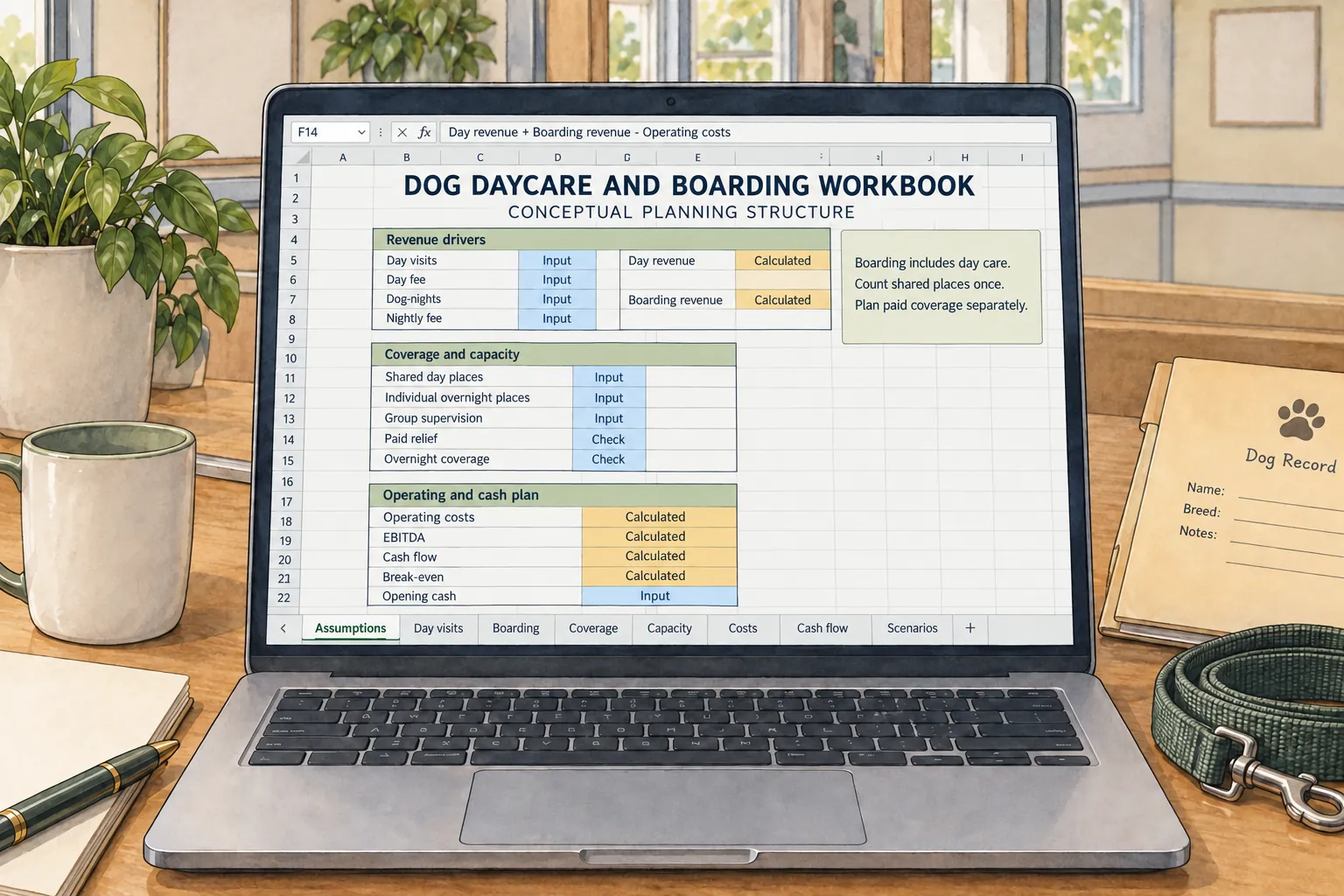
The figures below are a national wage reference scenario. The paid roster uses May 2025 BLS national occupational medians. Prices, customer volume, rent, equipment and other commercial inputs are authored assumptions. This is not a researched average startup cost, owner-income promise or a funding recommendation.
| Input or result | Reference | What to verify |
|---|---|---|
| Completed daycare dog-days; overnight nights shown separately below | 770 completed daycare dog-days / month | 35 average completed daycare admissions per daycare day; demand requires evidence. |
| Realized net daycare rate | $52.00 | Build and test a relevant local menu, package or contract scope. |
| Revenue | $59,240 | Daycare earning plus boarding earning, counted once; no advance payments. |
| Paid payroll | $37,449 / month | National wage medians × the stated hours × the 18% employer allowance. |
| Opening payments | $196,481 | Authored equipment and setup allowances, deposit and paid training. |
| Funding including reserve | $367,442 | Opening payments + deepest modeled operating deficit + retained buffer. |
| Mature operating profit (EBIT) | $849 / month | After the full paid roster and depreciation; before financing and income taxes. |
| Approximate EBIT threshold | Approximately 34.2 average completed daycare admissions per daycare day | Eight earned overnight dogs held fixed; check the actual peak calendar and every paid clock. |
| Service | Assumed earned activity | Realized net rate assumption | Earned monthly revenue |
|---|---|---|---|
| Daycare-only completed care | 35 admissions × 22 days = 770 dog-days | $52.00 / dog-day | $40,040 |
| Overnight boarding, including its daytime care | 8 average dogs × 30 nights = 240 dog-nights | $80.00 / dog-night | $19,200 |
| Total earned care | The two services are added once | Deposits and future package/stay payments excluded | $59,240 |
The $52 realized daycare rate is an authored premium-yield case; the named local group-day drop-in observations are lower and do not establish achieved yield. The $80 boarding rate is also an assumption. Compare the exact included care and overnight staffing before using an advertised offer. Average earning and actual simultaneous peaks are different: the default assumes 35 peak daycare dogs and eight peak boarders; a different arriving/departing cohort must use its actual higher peak.
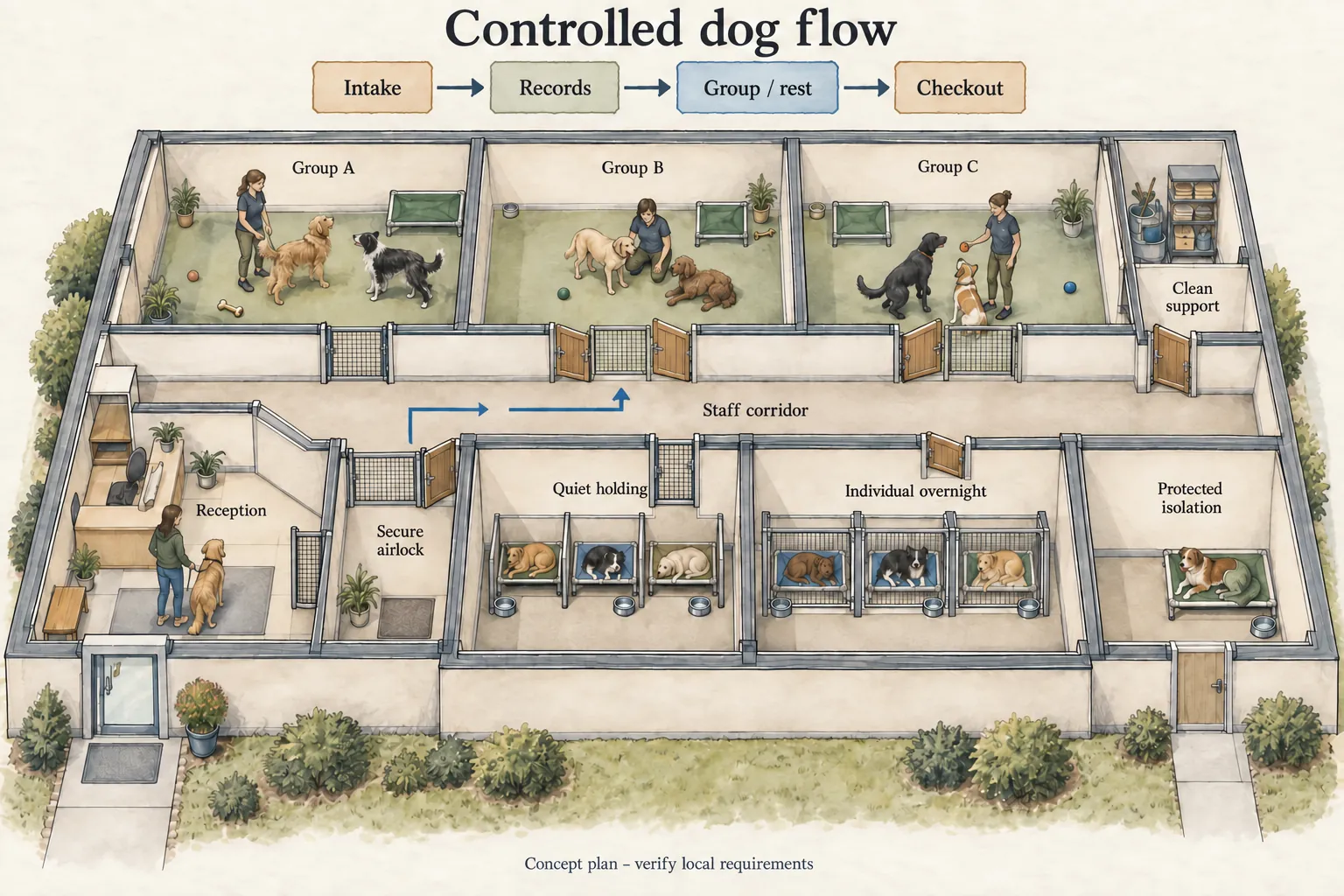
The authored layout has three separately supervised 15-dog groups, or 45 shared daytime places, and 12 individual overnight places. Quiet holding and protected isolation are not sale capacity. The default assumes 35 daycare-only dogs and eight average and peak boarding dogs: 43 dogs sharing the weekday plan. The identical eight average and peak boarding count is an even-occupancy assumption, not an inference from average nights sold. Actual arrivals and departures must fit a peak calendar without overlapping a promised place. With the boarding peak held at eight, the complete conditional weekday ceiling is 37 daycare dogs; the next whole dog would require 46 shared places. At that ceiling, weekday care uses 47.705 of 48 paid person-hours and customer service uses 85.31 of 86.67 monthly hours. At the default 35, the weekday care workload is 47.535 hours, including continuous group supervision, standing duties and activity-linked recovery. Weekend boarding uses one assumed group, 18.56 of 24 daytime person-hours, and overnight duties use 9.16 of 13 paid hours alongside the separate 13-hour coverage-and-relief requirement. The capacity calculator also checks management, overnight places, weekend groups and average-versus-peak relationships. These group sizes, work rates and recovery allowances are teaching assumptions, not a national legal ratio, a safety certification or demand.
The assumed 12% of realized earned care revenue comprises 9% care consumables, any included food, use-driven laundry and waste, plus 3% payment costs. Realized rates already reflect concessions and expected collection losses, so those are not deducted again. Every employee role remains in payroll; routine, recovery and relief hours are not charged a second time as a labor percentage. The $4,500 monthly standing allowance comprises $1,000 utilities, $900 insurance, $850 marketing, $350 booking systems and communications, $500 standing waste and outsourced services, $500 professional/administrative support and $400 other standing support. The $7,000 premises allowance and $800 capital-maintenance cash are separate. Match standing service charges and use-driven consumables to avoid overlap. Noise control, drainage, ventilation, emergency veterinary costs, business interruption and a specific insurance package still require applicable quotes.
May 2025 BLS Animal Caretakers, First-Line Supervisors of Personal Service Workers and Customer Service Representatives medians anchor the specified paid duties. The animal-care pool is 1,638 person-hours per 30-day planning month: 48 per daycare weekday, 24 per boarding-only daytime day and 13 per night. Supervisor and customer-service pools are each 20 weekly hours annualized by 52/12, or 86.67 monthly hours; neither adds simultaneous handler coverage. Four weekday care positions cover three continuous groups plus relief and ancillary work; two boarding-only daytime positions cover one group plus relief. Overnight coverage comprises a 12-hour care window and one additional paid relief/handover hour. These are pooled staffing clocks to distribute across lawful individual shifts, breaks, rest, relief and overtime. They do not mean one employee works a 12-hour shift at straight time. The 18% employer addition is an assumption, and observed occupation medians are neither hiring quotes nor legal wage floors.
The national wage scenario models approximately $196,481 opening payments, including $180,000 of authored setup allowances, a refundable $14,000 premises deposit and $2,481 paid training. The deepest cumulative operating deficit is approximately $73,063 in planning month 5; the retained two-month standing-cost buffer is approximately $97,898. Together they produce approximately $367,442 opening funding. These amounts are a coherent scenario, not a quoted building conversion or a funding recommendation.
Recognize only completed daycare and overnight care earned in the stated period at the realized net rates. A booked place, screening appointment, package sale, future stay, customer security deposit or advance payment is not additional current care revenue. Keep customer advances, unused package balances, refunds, credits, taxes collected for an authority and any restricted funds in a separate liability and dated cash ledger. The default assumes same-period collection and no customer-advance funding. Month-end balances can miss a larger daily payroll or premises gap; debt, taxes and owner distributions need separate schedules.
BLS May 2025 national wage workbook · Calculation definitions · How owner income differs from EBIT
| Workstream | What the brief needs | Decision before spending |
|---|---|---|
| Secure dog and customer flow | Public intake airlock, separately supervised groups, safe doors and barriers, quiet rest, individual overnight holding and protected isolation | Trace every dog and staff task. Isolation and circulation are not sale places; compatibility and actual permitted capacity control the layout. |
| Installed premises and sanitation | Matched use, surfaces, drainage, washing/laundry, water, ventilation, sound control, lighting, waste, storage, alarms and fire/access scope | Obtain full installed quotes and address approval conditions. A kennel or gate price does not price a usable dog-care site. |
| Care, booking and liability records | Accepted profile and emergency consent, daily presence, group assignment, feeding and care, incidents, pickups, earned periods, deposits, packages, refunds and cash | Use one dog/customer record that shows which care was delivered, which obligation remains, and who must act next. |
Compare installed scope, exclusions and payment dates. Do not treat an unquoted item as zero or count a bundled installation twice. How to compare equipment quotes and build the opening budget explains a reusable quote ledger.
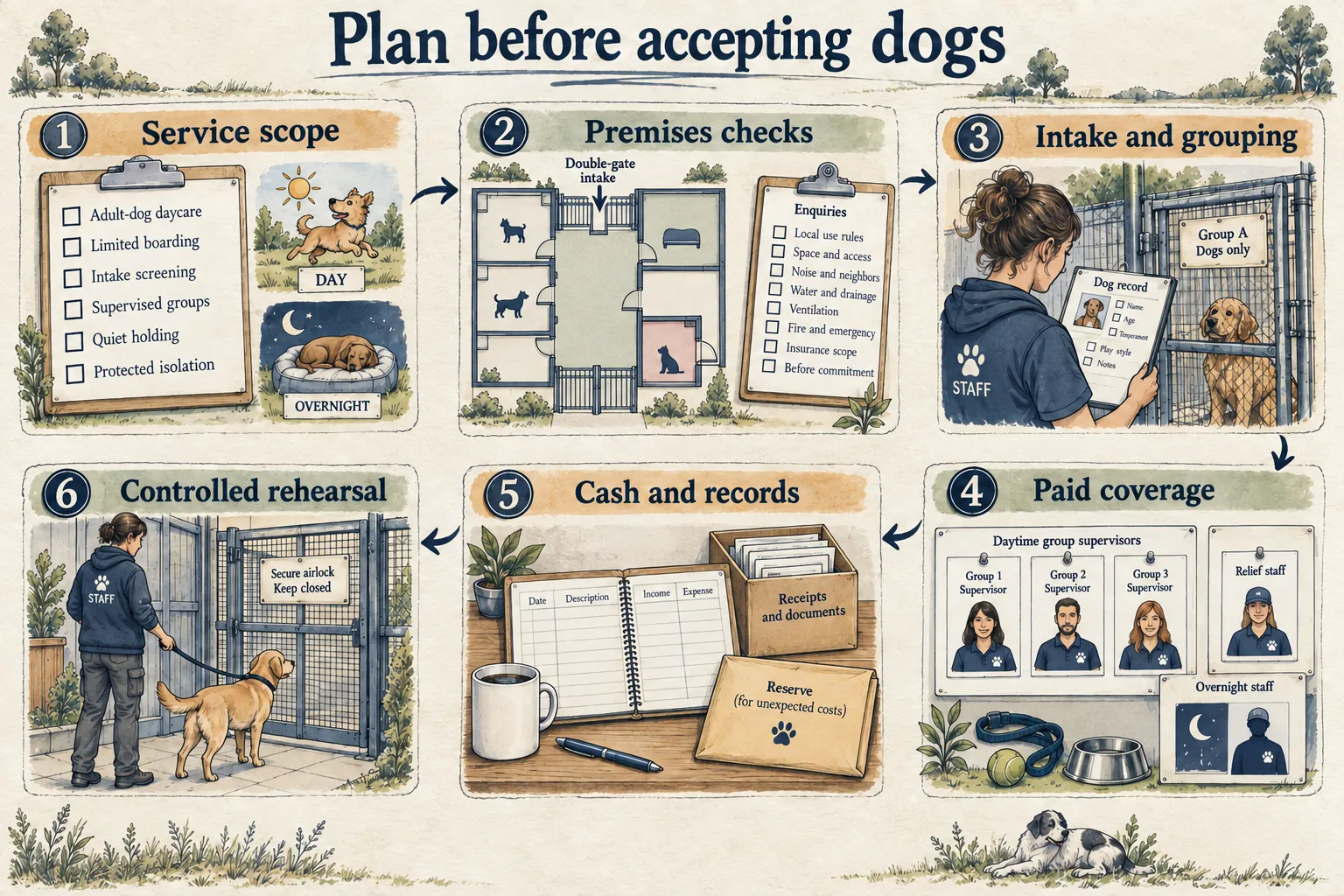
Write the adult-dog acceptance, screening and records policy, compatible-group process, day and overnight periods, feeding/rest responsibility, exclusions, pickup terms, emergency consent, refund terms and realized price hypothesis.
Resolve use and overnight authority with the landlord and responsible agencies. Measure usable group/overnight areas and preserve non-sale isolation, public separation, sanitation, drainage, ventilation, noise and response space.
Place daycare-only dogs, boarders, arrivals/departures, incompatibilities, quiet rest, sanitation, breaks, handovers and incident recovery into the full day/night clock. Schedule individual employees lawfully from the paid coverage pools.
Track completed paid days and nights, repeat attendance, net rate, refunds, package redemption and collections. Fund the ramp and retained buffer from actual commitments; keep advances and deposits out of current earned sales.
| Measure | Why it changes a decision |
|---|---|
| Completed day admissions and earned nights | Separates two earning units, accepted bookings, cancellations, isolated/rejected care and deposits. |
| Average occupancy and simultaneous peak dogs | Reconciles the booking ledger to real groups, boarder arrivals/departures, individual overnight places and non-sale isolation. |
| Realized net rate and redeemed packages | Shows discounts, credits, expected losses, future-care obligations and current earning without counting an advance twice. |
| Full paid day, night, relief and recovery clocks | Tests continuous supervision, ancillary work, shift handovers, breaks, overtime, expected incidents and competent response. |
| Care conditions, incidents and dated cash | Connects records, incompatibility, illness/injury action, staffing changes, refund exposure, wages and unrestricted cash before the next admission. |
Review actuals against the scope you priced. If an extra service, new trading hour or more distant client changes the work, update the roster and contribution calculation before expanding.
Bring the exact business entity and address, daytime and overnight animal-care scope, accepted dogs, maximum simultaneous animals, group compatibility and supervision, quiet holding and isolation, building/fire/access, drainage, ventilation, noise, waste, feeding, care records, emergency response, customer contracts, packages and deposits, employees, individual shifts, relief, overtime, insurance and landlord permissions to the responsible planning/building/fire, animal-care, labor, tax and employer offices and qualified advisers. Requirements are jurisdiction- and activity-specific; a state directory, broad industry code or published operator offer does not approve the address.
Each state profile links to official registration, tax and employer routes, together with the questions still requiring an address-specific answer. How to find the permits and approvals your business actually needs provides the record to keep.
Pause admissions or the site commitment when accepted peak dogs cannot fit compatible groups and non-sale isolation, a paid care or relief period is uncovered, fit-out or overnight permission is unconfirmed, realized rates and completed demand cannot cover the full costs, or deposits and future package/stay money are being treated as current profit.
Write a response that changes the actual cause: narrower scope, a different site, revised paid staffing, a tested price or a delayed opening. A larger cash buffer only addresses a temporary timing gap.
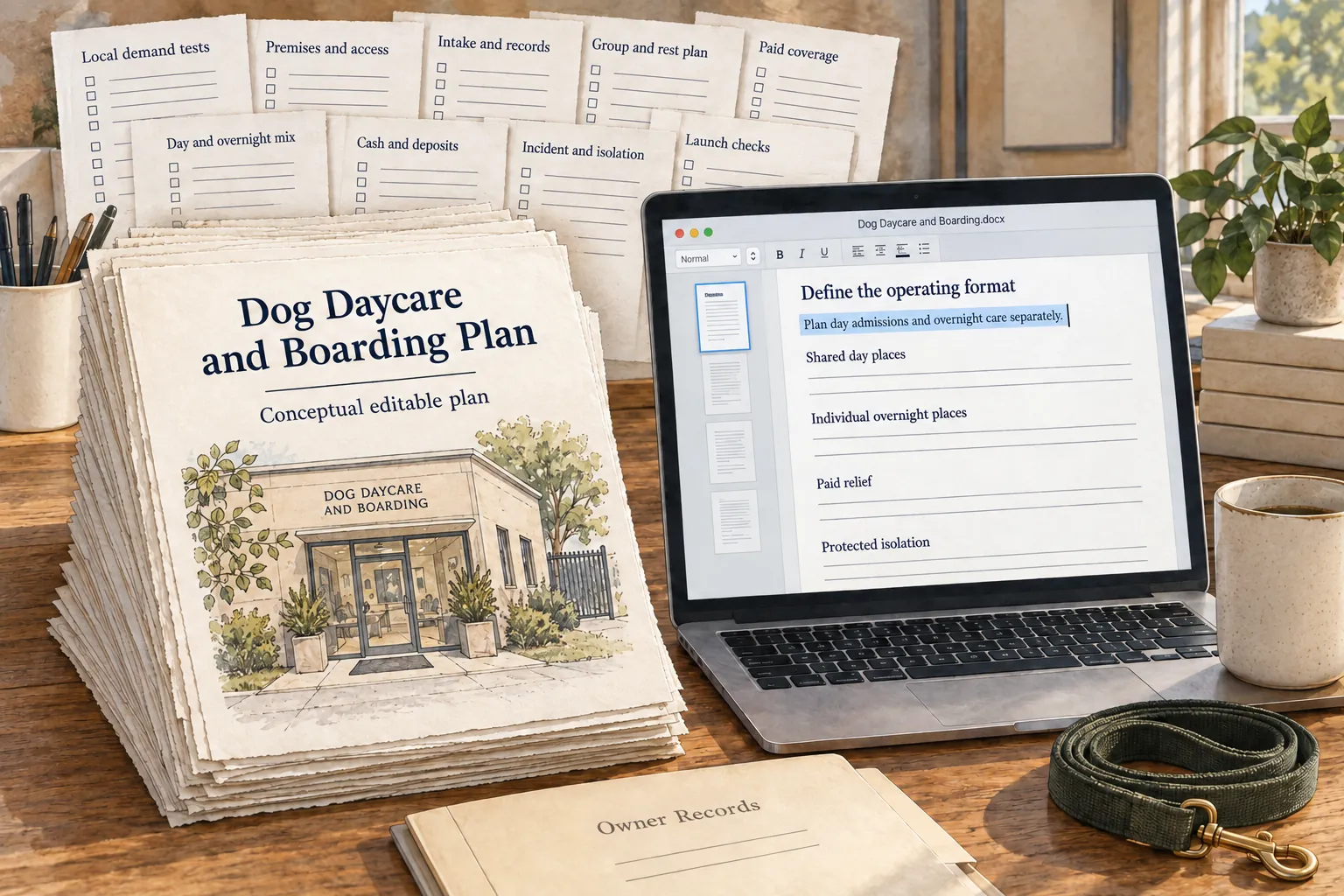
Test separate earned daycare and overnight care, shared peak capacity, paid coverage, three operating boundaries and one opening cash schedule.
Work through the guide →Build a compatible peak dog calendar, secure care flow, complete paid rota, incident record and earning/liability ledger before accepting daycare and boarding.
Work through the guide →Compare total occupancy cash, upfront commitments and site dependencies using a worked premises budget and a practical review record.
Work through the guide →Compare equipment at installed usable scope, account for excluded costs and connect supplier payment terms to the opening cash plan.
Work through the guide →Account for service, setup, cleaning, travel and owner work, then turn a complete paid week into a monthly staffing budget.
Work through the guide →Reconcile profit with customer payments, inventory, equipment and debt, then distinguish operating break-even from cash recovery.
Work through the guide →Restaurant earns from completed paid guest covers at a realized meal check and is constrained by paid preparation, kitchen stations, service peaks and guest handling. Dog Daycare and Boarding earns separate completed day visits and overnight care, with boarding dogs sharing daytime space and counted once. Compare deliverable earning, all paid work, customer obligations and dated cash using each format’s own unit.
Compare the operating choices →Coffee Shop earns from completed counter orders at a realized drink-and-food basket and is constrained by ordering, beverage preparation and pickup within concentrated buying windows. Dog Daycare and Boarding earns separate completed day visits and overnight care, with boarding dogs sharing daytime space and counted once. Compare deliverable earning, all paid work, customer obligations and dated cash using each format’s own unit.
Compare the operating choices →Cleaning Business earns from retained recurring commercial account-months with the promised visits and is constrained by measured account scope, visit frequency, paid travel, access and supervision. Dog Daycare and Boarding earns separate completed day visits and overnight care, with boarding dogs sharing daytime space and counted once. Compare deliverable earning, all paid work, customer obligations and dated cash using each format’s own unit.
Compare the operating choices →Hair Salon earns from completed paid appointments in a stated service mix and is constrained by paid stylist time, service duration, stations and the actual appointment diary. Dog Daycare and Boarding earns separate completed day visits and overnight care, with boarding dogs sharing daytime space and counted once. Compare deliverable earning, all paid work, customer obligations and dated cash using each format’s own unit.
Compare the operating choices →Auto Detailing Business earns from completed condition-scoped vehicle packages and is constrained by technician person-hours, vehicle condition, bay occupancy and handover. Dog Daycare and Boarding earns separate completed day visits and overnight care, with boarding dogs sharing daytime space and counted once. Compare deliverable earning, all paid work, customer obligations and dated cash using each format’s own unit.
Compare the operating choices →Laundromat earns from paid washer starts and attached drying revenue and is constrained by machine mix, dryers, utilities, uptime and peak circulation. Dog Daycare and Boarding earns separate completed day visits and overnight care, with boarding dogs sharing daytime space and counted once. Compare deliverable earning, all paid work, customer obligations and dated cash using each format’s own unit.
Compare the operating choices →Daycare Center earns from paid enrolled child-weeks by age group and is constrained by licensed rooms, applicable age-specific groups and ratios, qualified coverage and relief. Dog Daycare and Boarding earns separate completed day visits and overnight care, with boarding dogs sharing daytime space and counted once. Compare deliverable earning, all paid work, customer obligations and dated cash using each format’s own unit.
Compare the operating choices →Pet Grooming Salon earns from completed grooming visits at a weighted size-and-service mix and is constrained by groomer and bather time, tubs, drying, tables and safe handover. Dog Daycare and Boarding earns separate completed day visits and overnight care, with boarding dogs sharing daytime space and counted once. Compare deliverable earning, all paid work, customer obligations and dated cash using each format’s own unit.
Compare the operating choices →Landscaping Company earns from completed recurring residential maintenance visits and is constrained by crew person-hours, route density, access, seasonality and weather-adjusted completions. Dog Daycare and Boarding earns separate completed day visits and overnight care, with boarding dogs sharing daytime space and counted once. Compare deliverable earning, all paid work, customer obligations and dated cash using each format’s own unit.
Compare the operating choices →Food Truck earns from completed paid food orders at a realized net ticket and is constrained by preparation, commissary, travel, feasible service windows and truck throughput. Dog Daycare and Boarding earns separate completed day visits and overnight care, with boarding dogs sharing daytime space and counted once. Compare deliverable earning, all paid work, customer obligations and dated cash using each format’s own unit.
Compare the operating choices →Bakery earns from paid retail baskets at a realized product mix and is constrained by whole batches, paid production, counter flow, sell-through and waste. Dog Daycare and Boarding earns separate completed day visits and overnight care, with boarding dogs sharing daytime space and counted once. Compare deliverable earning, all paid work, customer obligations and dated cash using each format’s own unit.
Compare the operating choices →Fitness Studio earns from retained billable member-months at realized net yield and is constrained by class timetable, instructor hours, usable spots, promised access, churn and collections. Dog Daycare and Boarding earns separate completed day visits and overnight care, with boarding dogs sharing daytime space and counted once. Compare deliverable earning, all paid work, customer obligations and dated cash using each format’s own unit.
Compare the operating choices →HVAC Company earns from completed service calls and replacement jobs in a defined mix and is constrained by qualified technicians, travel, diagnosis, equipment, installation and callbacks. Dog Daycare and Boarding earns separate completed day visits and overnight care, with boarding dogs sharing daytime space and counted once. Compare deliverable earning, all paid work, customer obligations and dated cash using each format’s own unit.
Compare the operating choices →Moving Company earns from completed local household moves and is constrained by whole crew-and-truck blocks across origin, route, destination and reset. Dog Daycare and Boarding earns separate completed day visits and overnight care, with boarding dogs sharing daytime space and counted once. Compare deliverable earning, all paid work, customer obligations and dated cash using each format’s own unit.
Compare the operating choices →Auto Repair Shop earns from completed repair orders with realized labor and parts revenue and is constrained by paid technician time, bay dwell, lifts, parts, authorization and rework. Dog Daycare and Boarding earns separate completed day visits and overnight care, with boarding dogs sharing daytime space and counted once. Compare deliverable earning, all paid work, customer obligations and dated cash using each format’s own unit.
Compare the operating choices →Plumbing Company earns from completed and collected residential plumbing jobs and is constrained by qualified plumber time, vehicles, travel, diagnosis, materials, permits and callbacks. Dog Daycare and Boarding earns separate completed day visits and overnight care, with boarding dogs sharing daytime space and counted once. Compare deliverable earning, all paid work, customer obligations and dated cash using each format’s own unit.
Compare the operating choices →Electrical Contractor earns from completed and collected electrical service and small-alteration jobs and is constrained by qualified electricians, sold-hour realization, vehicles, materials, permits and rework. Dog Daycare and Boarding earns separate completed day visits and overnight care, with boarding dogs sharing daytime space and counted once. Compare deliverable earning, all paid work, customer obligations and dated cash using each format’s own unit.
Compare the operating choices →Pest Control Company earns from retained paid residential service-plan months and is constrained by qualified technicians, initial visits, scheduled obligations, travel, records and callbacks. Dog Daycare and Boarding earns separate completed day visits and overnight care, with boarding dogs sharing daytime space and counted once. Compare deliverable earning, all paid work, customer obligations and dated cash using each format’s own unit.
Compare the operating choices →Residential Remodeling Company earns from accepted delivered interior scope expressed as earned-project equivalents and is constrained by carpenter person-hours, management, customer decisions, authorized trades and rework. Dog Daycare and Boarding earns separate completed day visits and overnight care, with boarding dogs sharing daytime space and counted once. Compare deliverable earning, all paid work, customer obligations and dated cash using each format’s own unit.
Compare the operating choices →Self-Storage Facility earns from occupied unit-months by size at realized net rent and is constrained by whole rentable units, paid management/leasing/maintenance, access and response. Dog Daycare and Boarding earns separate completed day visits and overnight care, with boarding dogs sharing daytime space and counted once. Compare deliverable earning, all paid work, customer obligations and dated cash using each format’s own unit.
Compare the operating choices →No. Boarding in this reference includes its daytime care. The earned dog-night is one priced service; its dog still consumes daytime space and care without becoming an additional paid daycare visit.
No. It is an authored compatibility and staffing assumption for this exercise. Actual permissions, competent supervision, individual dogs, space, separation, care needs and insurer conditions can require a smaller or different plan.
Average earned nights determine revenue; simultaneous dogs determine group space and care. Arriving/departing boarders, varying stays or a holiday peak can make actual presence exceed the average paid count.
Only care earned in the stated period belongs in current care revenue under the applicable contract and accounting treatment. Unused packages, future stays, deposits, credits and potential refunds remain separate obligations.
No. The reference budgets a 12-hour attended care window plus a paid relief/handover hour each night. These are pooled coverage hours split across actual employees, with breaks, rest, competence, overtime and emergency support checked in the real rota.
The reference has positive mature cash after maintenance, but the ramp uses cash and does not recover the opening payments within its 60 planning months. Debt, tax, withdrawals and daily cash timing can change the result further.
No states match these filters.
Sorting compares one defined format. It does not rank states for attractiveness or prove demand. Funding includes opening payments, the deepest cumulative operating cash deficit in the 60-month model and the retained cash buffer.
| State | Funding scenario | Loaded payroll / month | Approximate EBIT threshold average completed daycare admissions per daycare day |
|---|---|---|---|
| Alabama | $320,984 | $30,220 | 27 |
| Alaska | $377,117 | $38,685 | 35.4 |
| Arizona | $400,523 | $40,059 | 36.7 |
| Arkansas | $330,959 | $31,902 | 28.6 |
| California | $468,027 | $41,147 | 37.8 |
| Colorado | $386,192 | $39,810 | 36.5 |
| Connecticut | $384,745 | $39,631 | 36.3 |
| Delaware | $359,189 | $36,281 | 33 |
| Florida | $357,577 | $36,053 | 32.8 |
| Georgia | $331,374 | $31,970 | 28.7 |
| Hawaii | $535,314 | $42,231 | 38.9 |
| Idaho | $345,685 | $34,329 | 31.1 |
| Illinois | $369,473 | $37,736 | 34.4 |
| Indiana | $333,870 | $32,382 | 29.1 |
| Iowa | $332,292 | $32,121 | 28.9 |
| Kansas | $331,729 | $32,028 | 28.8 |
| Kentucky | $334,537 | $32,491 | 29.2 |
| Louisiana | $318,227 | $29,676 | 26.4 |
| Maine | $383,775 | $39,511 | 36.2 |
| Maryland | $378,135 | $38,811 | 35.5 |
| Massachusetts | $514,578 | $41,897 | 38.6 |
| Michigan | $334,245 | $32,443 | 29.2 |
| Minnesota | $377,711 | $38,759 | 35.5 |
| Mississippi | $313,396 | $28,722 | 25.5 |
| Missouri | $339,764 | $33,353 | 30.1 |
| Montana | $360,010 | $36,397 | 33.1 |
| Nebraska | $342,840 | $33,860 | 30.6 |
| Nevada | $333,693 | $32,352 | 29.1 |
| New Hampshire | $365,323 | $37,149 | 33.9 |
| New Jersey | $374,335 | $38,340 | 35 |
| New Mexico | $353,882 | $35,530 | 32.3 |
| New York | $422,586 | $40,415 | 37.1 |
| North Carolina | $336,983 | $32,895 | 29.6 |
| North Dakota | $359,430 | $36,315 | 33 |
| Ohio | $333,706 | $32,354 | 29.1 |
| Oklahoma | $323,330 | $30,644 | 27.4 |
| Oregon | $381,227 | $39,195 | 35.9 |
| Pennsylvania | $341,876 | $33,701 | 30.4 |
| Rhode Island | $386,295 | $39,823 | 36.5 |
| South Carolina | $338,528 | $33,149 | 29.9 |
| South Dakota | $335,732 | $32,688 | 29.4 |
| Tennessee | $336,323 | $32,786 | 29.5 |
| Texas | $347,675 | $34,652 | 31.4 |
| Utah | $361,321 | $36,583 | 33.3 |
| Vermont | $377,609 | $38,746 | 35.4 |
| Virginia | $360,445 | $36,459 | 33.2 |
| Washington | $591,349 | $43,134 | 39.8 |
| West Virginia | $321,403 | $30,302 | 27.1 |
| Wisconsin | $335,280 | $32,614 | 29.4 |
| Wyoming | $327,582 | $31,345 | 28.1 |
Published research and calculations support business planning and education. They are not personalized financial, investment, tax or legal advice, and they do not guarantee costs, revenue, profit or financing. Estimates depend on the stated format, location, source periods and assumptions. Check the requirements and commitments that apply to your circumstances.