
How to plan dog groups, paid relief and overnight coverage
Plan dog daycare and boarding from simultaneous accepted dogs and every care period, then connect that plan to completed earning and cash. The teaching layout has 45 shared weekday group places and 12 individual overnight places; it excludes quiet holding and isolation from sale capacity. Eight peak boarders leave 37 daycare places, but 12 peak boarders reduce the unchanged paid weekday plan to 25 daycare dogs even though rooms could hold 33.
What you will produce: A dog-to-group record, peak arrival/departure calendar, paid day/night/relief rota, incident and response log, and earned-care/customer-liability record.
Updated October 7, 2026 · Worked examples and editable worksheets
What to have ready
Bring a measured permitted layout, adult-dog acceptance and compatibility process, care and emergency arrangements, actual simultaneous dog calendar, included day/night terms, individual employee rota, break/overtime checks, installed quotes, insurer conditions and current responsible-agency requirements.
Work through the calculation and decision
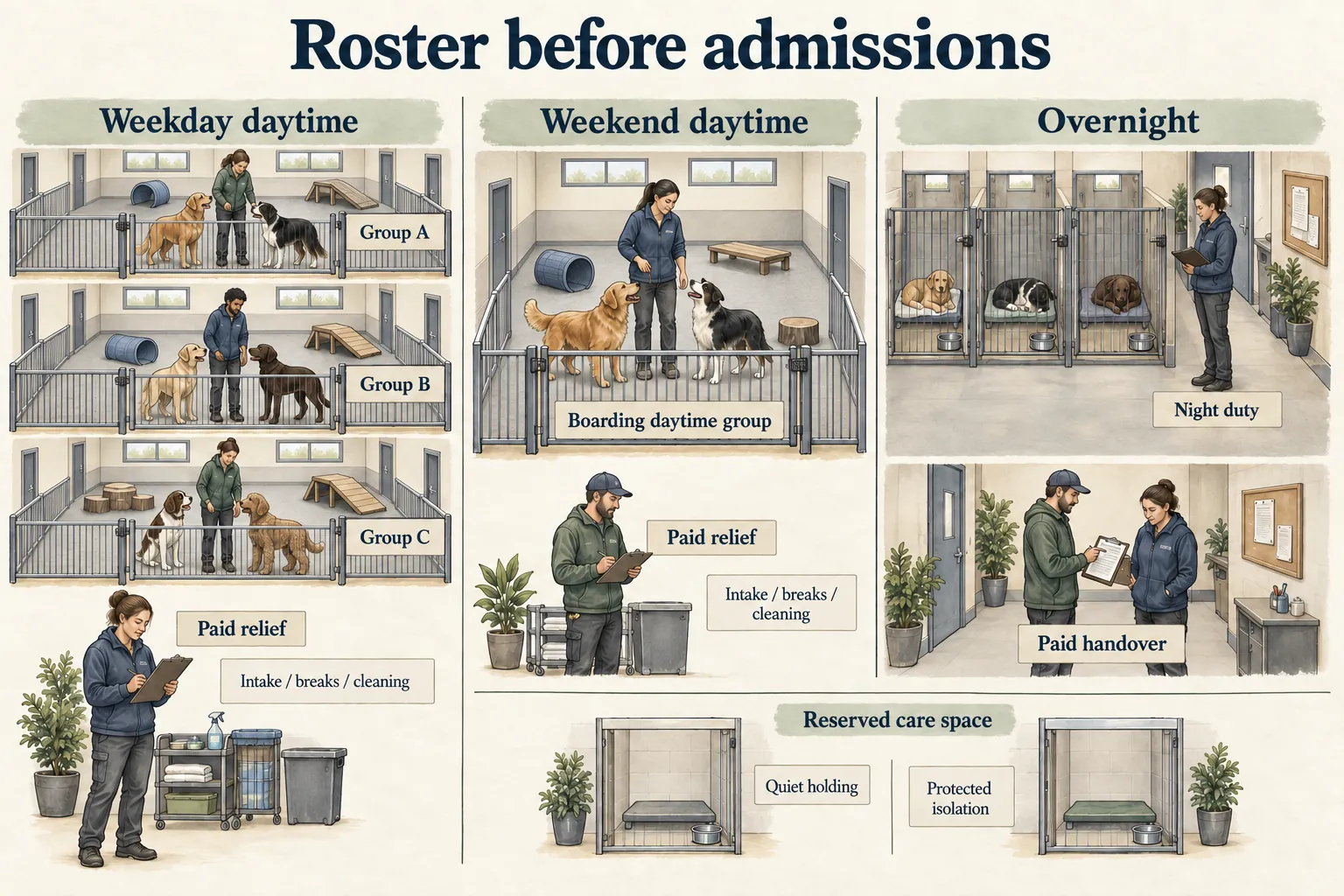
Write the accepted care promise and customer record
Give every accepted dog a stable identifier tied to the customer, emergency contacts and consent, care instructions, screening/record requirements, compatibility decision, allowed group/overnight space, included care period, feeding/rest arrangement, pickup authority, price and refund terms. Specify exclusions and the action when an accepted dog’s needs change.
The reference serves screened compatible adult dogs and excludes grooming, training, transport and veterinary revenue. Those activities require separate accepted scope, competence, equipment, permissions, insurance and costs. A customer request or a higher price does not supply the capability or paid time to deliver it.
Census 2022 NAICS 812910: Pet Care except Veterinary Services · 2022 industry definition · Checked 2026-10-07
IRS: business recordkeeping · Keeping supporting business records.
Separate public intake, groups, rest and isolation
Trace the public handover through a secure intake boundary into the assigned group or individual space, then rest, care and controlled pickup. Keep public circulation, escape protection, doors/barriers, staff access, food/cleaning storage, sanitation, protected isolation, overnight places and emergency movement in the measured layout. A conceptual drawing does not establish approved usable area.
The teaching groups contain 15 compatible dogs each, but that is not a national legal ratio or a blanket animal-safety maximum. Dogs with incompatible behavior, different rest/care requirements or illness can require separation and another paid plan. Quiet holding and isolation are operational space rather than extra sale places. Active isolation may reduce group admissions and consume relief.
Dog Daycare and Boarding: exact teaching inputs and calculation definitions · Authored 30-day planning scenario, October 7, 2026
California SB 945: Pet Boarding Facilities, chaptered September 14, 2016 · Enactment September 14, 2016 · Checked 2026-10-07
Use actual simultaneous presence instead of an average
Build a time-by-time calendar showing daycare-only dogs, boarders remaining from last night, new boarders, departures, groups, quiet rest, isolated dogs and usable individual places. Check each arrival before offering the booking. Never sell the same overnight place to overlapping dogs or assume that a late boarder departure leaves the next daytime group unaffected.
Average earned overnight dogs measure revenue; peak boarders measure care and space. The default assumes eight for both as an even-occupancy example. At 35 peak daycare dogs and eight peak boarders, the weekday group count is 43. If actual arrivals make the boarding peak 12, the dog calendar and paid workload must change even when the average earned nights remain eight.
Dog Daycare and Boarding: exact teaching inputs and calculation definitions · Authored 30-day planning scenario, October 7, 2026
Allocate all supervised periods and relief to paid people
The reference’s weekday care pool is four positions across a 12-hour care window: three group-supervision clocks plus one relief/ancillary clock. Boarding-only daytime care has one group clock plus one relief/ancillary clock. Overnight has a 12-hour attended window and one additional paid relief/handover hour. Pooled hours must be scheduled across actual employees; management and reception cannot do two simultaneous jobs.
Federal 29 CFR 785.21 counts required duty shorter than 24 hours as worktime even when sleeping is permitted. Section 785.19 distinguishes genuine duty-free meals from meals while responsible for care. Schedule real relief, lawful shifts, overtime, rest and absence coverage under the applicable rules. Do not remove night wages merely because a dog or worker may sleep; advertised remote monitoring is a different care promise.
29 CFR 785.21: Required duty shorter than 24 hours · Current eCFR text checked October 7, 2026 · Checked 2026-10-07
29 CFR 785.19: Bona fide meal periods · Current eCFR text checked October 7, 2026 · Checked 2026-10-07
Fit routine duties and growing incident recovery into the same clocks
Record group supervision separately from feeding, rest/transfer, cleaning, laundry, intake/customer handover, care records, break relief, shift handover and emergency response. A task performed away from the group needs someone else to cover that supervision. Timed duties and actual accepted dogs should replace the teaching rates before raising admissions.
The weekday model reserves 36 group-supervision person-hours and six standing ancillary hours. Daycare ancillary work adds 0.07 hour per peak dog plus a 2% exception allowance × 0.75 recovery hour; peak boarders add 0.30 hour plus 2% × one recovery hour. At 35 daycare dogs and eight peak boarders, total weekday work is 47.535 of 48 hours. At 37, it is 47.705. The rates are assumed workloads; they are not an incident forecast or evidence of sufficient competence.
Dog Daycare and Boarding: exact teaching inputs and calculation definitions · Authored 30-day planning scenario, October 7, 2026
BLS May 2025 national occupational wage workbook · May 2025 occupation medians · Checked 2026-10-07
Check the weekend and overnight plan separately
Boarding dogs still need the included daytime care when daycare sales are closed. The default’s eight boarding-only daytime days use an assumed single group and 24 paid person-hours each. At eight peak boarders, standing supervision/duties and growing recovery use 18.56 hours. The overnight pool is 13 paid hours each night, with a separate coverage/relief requirement of all 13 and routine/response work of 9.16 hours at the eight-dog peak.
Check individual overnight places, competent response, the boarder group, food/care duties, relief and staff presence together. A 12-place night inventory does not grant 12 additional dogs beside full daycare. With 12 peak boarders, weekday shared space leaves 33 daycare places, but routine and recovery work reduces the unchanged paid weekday ceiling to 25. One more paid weekday person-hour raises that specific workload limit enough for the 33-space case and must be costed.
Dog Daycare and Boarding: exact teaching inputs and calculation definitions · Authored 30-day planning scenario, October 7, 2026
Dogtown Austin: boarding offering and night manager · Advertised offering checked October 7, 2026 · Checked 2026-10-07
All Paws Retreat, Columbus: boarding and overnight presence · Advertised offering checked October 7, 2026 · Checked 2026-10-07
Connect a care exception to the original dog and response
Record the dog, time, group, observation, immediate safe response, responsible competent person, owner contact, required outside/veterinary support, paid hours, cost, credit/refund, place taken out of service and closure. An injury, escape, illness, incompatibility or late handover can consume care without earning another admission. Escalate under the verified written care and emergency arrangements.
California’s September 14, 2016 enacted pet-boarding chapter is a useful scoped example: it addresses separate sick-pet isolation, written care/emergency procedures, care for sick/injured animals and disclosure of personnel presence. It also allows local additional requirements. Treat that dated enactment as its stated scope and confirm current codified and address-specific requirements; it is not a complete legal determination for another state.
California SB 945: Pet Boarding Facilities, chaptered September 14, 2016 · Enactment September 14, 2016 · Checked 2026-10-07
IRS: business recordkeeping · Keeping supporting business records.
Close the earning, package and cash record before accepting more dogs
Tie each completed day and earned night to its included care, realized price, discount/credit, invoice, package redemption, customer advance balance, tax, receivable, collection and potential refund. A package sale is cash before care; unused care remains an obligation. Boarding daytime care does not create a second day sale.
Review actual peaks, paid clocks, exceptions, completed recurring attendance, realized yield and dated unrestricted cash together. Reduce admissions or revise the care/price/site plan when any boundary fails. A larger reserve cannot supply an uncovered employee or make incompatible groups safe. Recalculate the same full financial model after a care promise or paid hour changes.
Dog Daycare and Boarding: exact teaching inputs and calculation definitions · Authored 30-day planning scenario, October 7, 2026
IRS: business recordkeeping · Keeping supporting business records.
A wider boarding peak changes the weekday decision
This is a transparent workload comparison using the same assumed rates, physical places and paid pools. It is not a legal ratio, animal-safety certification or observed incident rate.
| Plan | Physical weekday room ceiling | Full conditional weekday daycare ceiling | Action |
|---|---|---|---|
| 8 peak boarders; 48 weekday care person-hours | 45 − 8 = 37 daycare dogs | 37 whole daycare dogs | At 35, shared headcount 43 and care 47.535 hours; keep the actual peak calendar. |
| 12 peak boarders; 48 weekday care person-hours | 45 − 12 = 33 daycare dogs | 25 whole daycare dogs | Peak boarding routine/recovery leaves 2.16 care hours for daycare ancillary work. |
| 12 peak boarders; 49 weekday care person-hours | 45 − 12 = 33 daycare dogs | 33 whole daycare dogs | One additional paid hour changes payroll, reserve and earning feasibility; space now binds. |
| Isolation or incompatible dogs active | Use the actual reduced usable group plan | Recalculate from competent care and relief needs | Do not sell protected isolation or assume the normal group size still applies. |
What this changes: Reserve boarder peak space first, then solve every paid clock at the proposed maximum. The room count alone overstates the wider-boarder plan.
Whole simultaneous dogs are physical counts. Monthly earning averages may be fractional. Workload calculations retain the full 0.07 / 0.30 / 2% / 0.75 / 1-hour assumptions; displayed figures are independently rounded.
Complete your decision record
A dog-to-group record, peak arrival/departure calendar, paid day/night/relief rota, incident and response log, and earned-care/customer-liability record. Enter the finding or number, the source and the next action for each row. “Supported” records your assessment of that item; it does not approve the business or certify completed research.
| Item and what to record | Your finding and evidence | Status and next action |
|---|---|---|
| Accepted dog and care scopeStable dog/customer record, screening/compatibility, included periods, care instructions, emergency consent, pickup and exclusions | ||
| Measured care flowPermitted groups, public/secure boundary, quiet holding, isolation, overnight places, sanitation and emergency movement | ||
| Actual time-by-time peakDaycare-only dogs, remaining/new/departing boarders, unusable places, group assignment and overlap | ||
| Paid individual rotaEvery group and day/night period, ancillary work, breaks, relief, handover, competence, overtime, absence and response | ||
| Care exception and liability ledgerOriginal dog/group, time, response, owner contact, paid recovery, place outage, credit/refund, earned care, package balance and unrestricted cash |
5 items have no evidence recorded yet.
Entries are temporary and are not sent to us or saved automatically. Download your completed work before leaving or refreshing this page.
Choose your next action
| If your finding is… | Your next action |
|---|---|
| Actual peak exceeds usable compatible space | Decline or reschedule the affected admission and revise the actual group/overnight calendar. |
| Room space fits but a paid care or relief clock fails | Reduce accepted activity or fund a competent complete rota; then reprice and recalculate. |
| A dog needs isolation or another care scope | Apply the verified care/response arrangement, protect other dogs and revise remaining admissions and staffing. |
| A provider offer has another night-presence promise | Compare its actual included care separately; do not use its price to remove promised paid coverage. |
| Unused packages create future work or refunds | Carry the obligation in the customer ledger and test unrestricted funds before spending. |
Errors that can change the result
- Counting quiet holding or isolation as sold overnight capacity.
- Adding daycare sales for boarders already priced with daytime care.
- Assuming average nights sold equal the arrival/departure peak.
- Treating a group size as legal or safe nationwide.
- Subtracting duty sleep or duty meals from paid night coverage.
- Using management or reception hours twice during overlapping tasks.
- Testing recovery only at today’s volume when advertising a larger maximum.
- Calling a booking, repeat inquiry or prepaid package completed demand.
Apply this to your business
These operating formats match the decisions in this guide.
Dog Daycare and Boarding
Fixed-site adult-dog daycare with three supervised compatible groups and limited individual overnight boarding
Open the operating guide and state profiles →Enter the actual average and peak dogs, paid coverage and realized rates into the one two-service financial calculator. Values entered here are not automatically transferred to another calculator.
Continue with the next part of your plan
- Can dog daycare and boarding cover the complete paid care roster?
One two-service earned-care calculation, actual peak and paid-workload checks, explicit activity and rate boundaries, and opening funding with a coherent 60-month cash schedule.
- How to find the permits and approvals your business actually needs
An approval register with official responses and the next unresolved question.
- What to check before committing to business premises
A comparable premises cost summary and a list of conditions to resolve before the next commitment.
- How to compare equipment quotes and build the opening budget
A comparable two-quote cost calculation and a supplier commitment record.
- How to build a staffing roster before estimating payroll
A roster with complete task coverage and an annualized monthly staffing budget.
Sources and limits
The sources below provide the stated background. The worked examples, calculator defaults and decision exercises are authored teaching material. They do not establish market prices, local demand, legal applicability or completed state research.
- Dog Daycare and Boarding: exact teaching inputs and calculation definitions
One fixed-site adult-dog day/night care scenario: two earning units, peak rooms, paid coverage, growing recovery, opening cash and 60-month schedule. All commercial values are assumptions.
- Census 2022 NAICS 812910: Pet Care except Veterinary Services
Pet care industry scope, including boarding and daycare except veterinary services. It does not establish address permission, dog capacity, price, demand or margin.
- BLS May 2025 national occupational wage workbook
Animal Caretakers 39-2021, Personal Service Supervisors 39-1022 and Customer Service Representatives 43-4051 national medians. Cross-industry proxies, not legal wage floors, hiring quotes or credential verification.
- 29 CFR 785.21: Required duty shorter than 24 hours
Required duty under 24 hours remains worktime even when sleep is permitted. Actual coverage, federal/state applicability, overtime and employee conditions need matched checks.
- 29 CFR 785.19: Bona fide meal periods
A bona fide unpaid meal requires complete relief from duties. Actual state and employee arrangements require applicable checks.
- California SB 945: Pet Boarding Facilities, chaptered September 14, 2016
Dated enacted chapter 122381(i), 122383(f)–(i) and 122384 addresses isolation, care/emergency procedures, sick/injured care and staff-presence disclosure. Local additions remain possible; confirm current codified and applicable requirements.
- Dogtown Austin: boarding offering and night manager
The Austin provider states boarding includes daycare and an on-site night manager. Private/crate terms and pricing differ. No local demand, staff cost or margin claim.
- All Paws Retreat, Columbus: boarding and overnight presence
The Columbus boarding offer includes daycare and explicitly states no staff are on-site overnight. It does not price the reference attended-night coverage or prove achieved yield, demand or margin.
- IRS: business recordkeeping
Keeping supporting business records.
Source background and its scope are stated above. The guide update date does not change a source observation period. Research and review standards · Report an issue
When you need a longer financial plan
Use a financial model to organize a broader forecast after defining your own operating assumptions. The site’s research, your worksheet entries and any purchased workbook are separate; entries are not transferred automatically.
Continue with the published financial scenario