Can self-storage rent and occupancy cover the lease and opening cash?
Test self-storage unit mix, realized net rent, occupancy, paid coverage, operating break-even and one 60-month opening cash schedule.
Work through the guide →
Start with the rentable unit roster and the lease commitment, then test size-specific realized rent and a supported occupancy ramp before accepting the site. The stated national wage scenario uses 160 average occupied unit-months per month at $110.00 per occupied unit-month, producing $1,204 mature monthly EBIT and $128,314 modeled opening funding. Sales, capacity and nonwage costs remain planning assumptions.

Vacant units earn no rent while the headlease and paid operating coverage continue. The consequential test is collected size-specific yield and retained unit-months against that fixed commitment, rather than a headline occupancy or an advertised rent.
Occupied unit-months measure rent earned over the month. Whole physical units and rented floor area are different quantities; monthly averages can be fractional. The reference applies equal occupancy to its 40/100/60 size mix.
At the assumed activity, the mature month produces $1,954 EBITDA, $1,204 EBIT and $1,554 cash after maintenance. The first twelve modeled months use $9,866 of operating cash; they do not represent a full year at the mature run rate.
The EBIT threshold is approximately 148.72 average occupied unit-months per month; it uses the same price, variable-cost basis and complete paid roster. The listed ceiling is 200 average occupied unit-months per month, with the operating qualifications in the capacity explanation below. The physical ceiling is 200 rentable units. At that ceiling, the stated manager, leasing and maintenance workload clocks fit the paid coverage; launch onboarding is tested separately. Permission, usable unit condition, access and after-hours response still require an address-specific check.
| Test | Entered activity or cost | Monthly EBIT |
|---|---|---|
| Published reference | 160 average occupied unit-months per month | $1,204 |
| 20% less earned activity | 128 average occupied unit-months per month | -$2,211 |
| 10% higher wage benchmarks | 1.10 × the same occupational wage anchors | $542 |
| 20% higher occupancy cost | $7,200.00 monthly occupancy | $4 |
Of the three separate tests shown, 20% less earned activity makes the largest change to monthly EBIT: -$3,414. This is a result of the stated test sizes, not a probability or a universal risk ranking.
The model pays 20 weekly manager hours, 20 leasing/customer-service hours and 8 maintenance hours using cross-industry wage anchors. Its 18% employer addition, work rates, lease and all other commercial values are assumptions. This is replacement-cost coverage, not a round-the-clock on-site promise.
Opening payments of $78,018, the deepest cumulative operating cash deficit of $20,059 in month 5, and the retained buffer of $30,237 add to $128,314 modeled funding. Refundable deposits are included in opening cash uses; they are not operating expenses. Funding is a scenario total, not a quote or a financing recommendation.
The reference begins with no occupied rent roll and follows the disclosed 40/55/70/82/90/96/100% ramp of mature activity. A refundable premises deposit uses opening cash; customer deposits and future rent are outside earned rental revenue. Debt, taxes, restricted money and owner withdrawals remain separate.
EBITDA pays the full modeled roster and operating costs. EBIT also deducts depreciation. Mature cash deducts maintenance investment from EBITDA, after receivables stop growing. All three exclude financing, income taxes and additional owner distributions.
With the same 160 occupied unit-months and paid costs, a 10% fall in weighted net rent changes mature cash after maintenance to approximately negative $153. Rent realization and the matched property commitment can therefore reverse the positive default month. Before accepting a headlease, obtain the rentable-unit condition record and installed site quotes, verify operating and customer-contract authority, test earned net rent and retention by size, and reconcile all response work and dated payments to funded paid coverage.
The wage observation is the BLS May 2025 national occupational median for each stated role. Hours, employer allowance, sales, prices, capacity and all nonwage costs are authored assumptions. Read the calculation definitions.
Calculations retain the exact input values. USD totals are displayed to whole dollars and blended prices to cents; activity and threshold estimates are displayed to up to two decimals. Rounded thresholds are estimates, not prescriptions for a sufficient whole job, visit or member count.
The customer rents access to an identified storage unit for an agreed period and retains responsibility for their goods under the applicable agreement and rules. This format supplies storage space and the stated access service; it does not include transporting, packing, handling or managing a customer’s inventory. An occupied unit-month is one whole unit rented for a full month, or the equivalent earned portion of shorter periods.
Rent can recur while a tenant retains the unit, but billing and occupied doors alone do not establish collected contribution. Promotions, move-outs, transfers, vacant-unit downtime, credits and arrears change realized yield. A customer deposit or several months paid in advance creates an obligation; it is not additional rent earned for the current month.
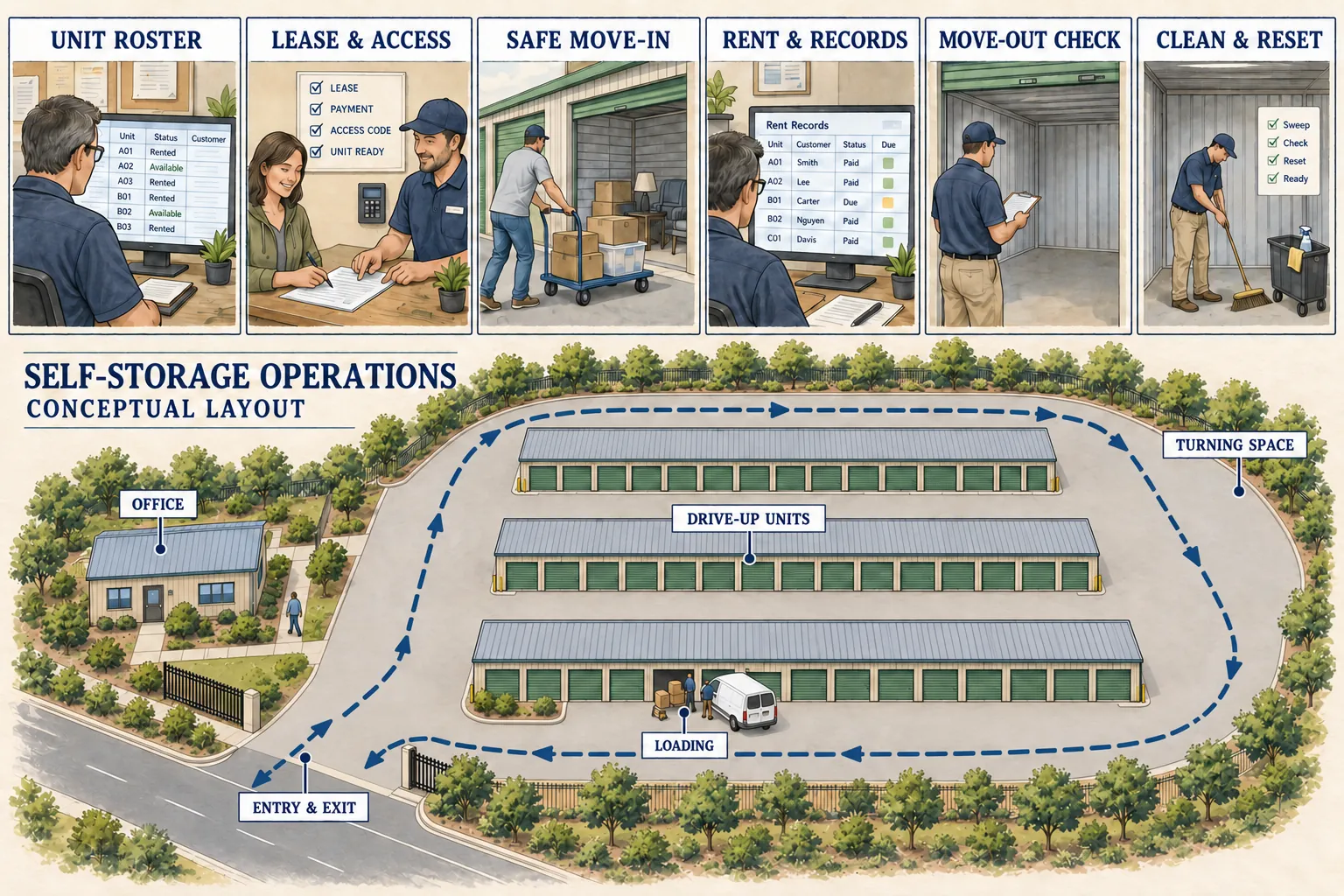
| Format | What changes | How to use it |
|---|---|---|
| Leased existing drive-up non-climate facility | Defined 200-unit inventory, all-in headlease, paid operating coverage and no acquired rent roll | The reference format. Confirm lawful operation, rentable condition, landlord rights, installed scope and supported leasing demand. |
| Purchase an operating facility | Property acquisition, inherited agreements/arrears, physical inspection, debt, tax, existing rent roll and transition duties | Build a separate acquisition and financing case; this opening allowance does not price the property or an existing business. |
| Ground-up development or major conversion | Land, entitlement, construction or conversion, professional/design scope, utility/site works, delivery timing and financing | Use a separate development budget and dated lease-up plan. Physical unit capacity does not establish permission or feasible construction cost. |
| Climate-controlled units or vehicle parking | Different space, utility, equipment, access, liability, customer terms and operating mix | Quote and model the actual format; neither is an unpriced extra within the non-climate reference. |
A founder prepared to control a fixed property commitment, size-specific rent and occupancy, unit condition, access reliability, customer accounts, lawful escalation, maintenance, security incidents and cash records. Fractional paid role coverage requires a defined response arrangement; it does not make the business passive.
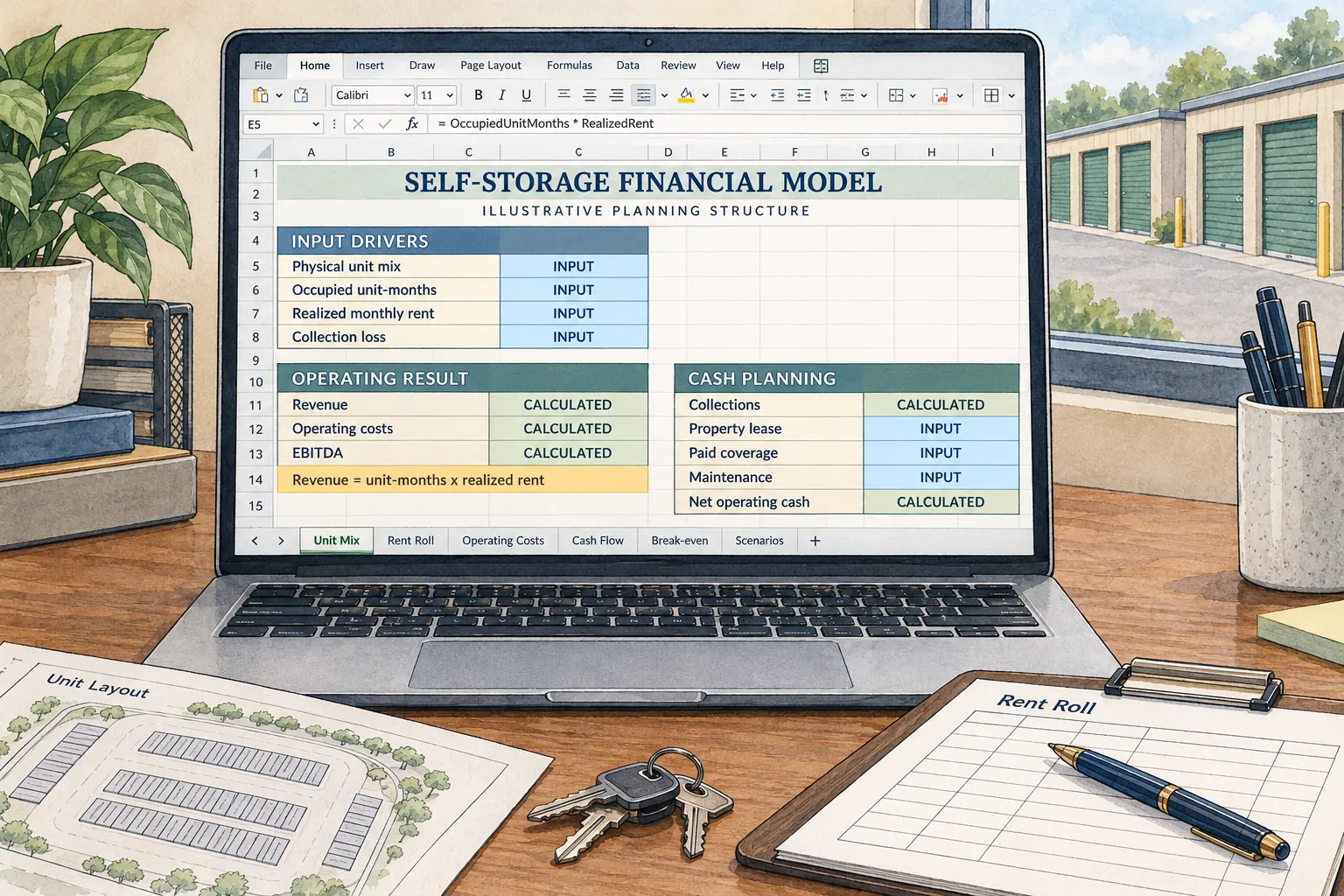
The figures below are a national wage reference scenario. The paid roster uses May 2025 BLS national occupational medians. Prices, customer volume, rent, equipment and other commercial inputs are authored assumptions. This is not a researched average startup cost, owner-income promise or a funding recommendation.
| Input or result | Reference | What to verify |
|---|---|---|
| Average occupied unit-months | 160 occupied unit-months / month | 160 average occupied unit-months per month; demand requires evidence. |
| Weighted realized net monthly rent | $110.00 | Validate earned net rent, concessions, expected losses and collections by size. |
| Revenue | $17,600 | Calculated volume × price, not observed sales. |
| Paid payroll | $6,618 / month | National wage medians × the stated hours × the 18% employer allowance. |
| Opening payments | $78,018 | Authored equipment and setup allowances, deposit and paid training. |
| Funding including reserve | $128,314 | Opening payments + deepest modeled operating deficit + retained buffer. |
| Mature operating profit (EBIT) | $1,204 / month | After the full paid roster and depreciation; before financing and income taxes. |
| Approximate EBIT threshold | Approximately 148.7 average occupied unit-months per month | A rounded estimate. Test the permitted occupancy increment against every paid clock and the unit supply. |
| Unit size | Available units | Average occupied unit-months | Net rent per occupied unit-month | Earned rent per month |
|---|---|---|---|---|
| 5 × 10 ft drive-up unit | 40 | 32 | $60.00 | $1,920 |
| 10 × 10 ft drive-up unit | 100 | 80 | $100.00 | $8,000 |
| 10 × 20 ft drive-up unit | 60 | 48 | $160.00 | $7,680 |
Available rent at full use is $22,000 a month across 24,000 rentable square feet. At the same 80% occupancy in each size, unit and area occupancy are both 80%. Different size occupancy breaks that equality and changes weighted yield. The advertised prices in the named locality examples do not replace these realized rent assumptions.
The assumed rentable inventory is 40 units of 5 × 10 ft, 100 of 10 × 10 ft and 60 of 10 × 20 ft: 200 units and 24,000 sq ft of unit floor area. Drive lanes, circulation, office, setbacks and other nonrentable space are additional. At 80% equal occupancy by size, the model rents 32, 80 and 48 average unit-months, totaling 160 and 19,200 occupied sq ft. Monthly averages may be fractional because occupancy and prorated earning can change during a month; physical unit counts remain whole. The paid manager, leasing and maintenance coverage is 86.67, 86.67 and 34.67 person-hours per month. At the 200-unit ceiling, assumed standing and occupancy-linked workloads are 60, 46.5 and 33 hours, including expected turnover and incidents. The default vacant-opening ramp adds paid leasing work for new rentals; its highest leasing load is 60.48 hours. These are disclosed workload assumptions, not observed productivity or 24-hour on-site staffing. Physical supply binds the reference, and the next 0.1 unit-month above 200 cannot fit that supply.
An assumed 3% of realized rental revenue covers payment costs. Realized net rent already reflects the stated concessions and expected collection losses, so those reductions are not charged a second time. Paid manager, leasing and maintenance work remains in payroll. The assumed $2,500 monthly standing allowance comprises $450 utilities, $400 liability/property insurance, $500 marketing, $300 software/access support, $450 routine outsourced repairs and unit-consumable replenishment and $400 professional/administrative support. The $6,000 all-in facility lease and $400 capital maintenance cash are separate. The allowance is not a quote for emergency staffing, building replacement, storm recovery or any specific insurance package.
May 2025 BLS occupation medians anchor paid property-manager, customer-service and general-maintenance coverage. These cross-industry occupations are replacement-cost proxies for the specified duties, not recruiting quotes, legal credentials or proof that one person can cover simultaneous tasks. Weekly hours are authored at 20, 20 and 8 and annualized by 52/12. The 18% employer addition is a teaching assumption; benefits, payroll taxes, workers compensation, overtime, relief and an actual after-hours response arrangement need separate checks.
The scenario models $78,018 of opening payments, a $20,059 deepest cumulative operating cash deficit in month 5, and a $30,237 retained standing-cost buffer, totaling approximately $128,314 funding. Opening payments include a refundable $12,000 premises deposit and $1,018 paid pre-opening training. A deposit uses cash without becoming a monthly expense. The model starts from a vacant opening and assumes no existing rent roll is purchased.
Recognize only rent earned for the stated occupied period, after the assumed concessions and expected collection losses. The default has no month-end rent receivable; that is a same-period collection assumption, not a claim that every tenant pays. Customer security deposits, rent for future periods and taxes collected for an authority are separate obligations. Keep restricted funds, refunds, arrears, lawful recovery costs, debt, tax and owner distributions in a dated ledger. The 60-month schedule measures month-end balances; the deepest daily cash need can be greater.
BLS May 2025 national wage workbook · Calculation definitions · How owner income differs from EBIT
| Workstream | What the brief needs | Decision before spending |
|---|---|---|
| Rentable inventory and site condition | Unit numbers, measured dimensions, rentable floor area, door/lock condition, drainage, safe access, lighting and nonrentable circulation | Identify which units can lawfully and reliably be offered. The 24,000 sq ft figure covers unit floors only. |
| Gate, security and response | Installed access controls, power/network dependencies, cameras, records, backup, privacy, service support, outage procedure and emergency response | Confirm who responds, the promised service period and all paid/contracted coverage. Cameras do not eliminate response work. |
| Agreements, payments and account control | Actual unit/tenant roster, compliant terms, discounts, billing, earned periods, collections, arrears, deposits, refunds, notice history and closure | Use one account record that explains the unit’s status, money owed, obligations still outstanding and the applicable next action. |
Compare installed scope, exclusions and payment dates. Do not treat an unquoted item as zero or count a bundled installation twice. How to compare equipment quotes and build the opening budget explains a reusable quote ledger.
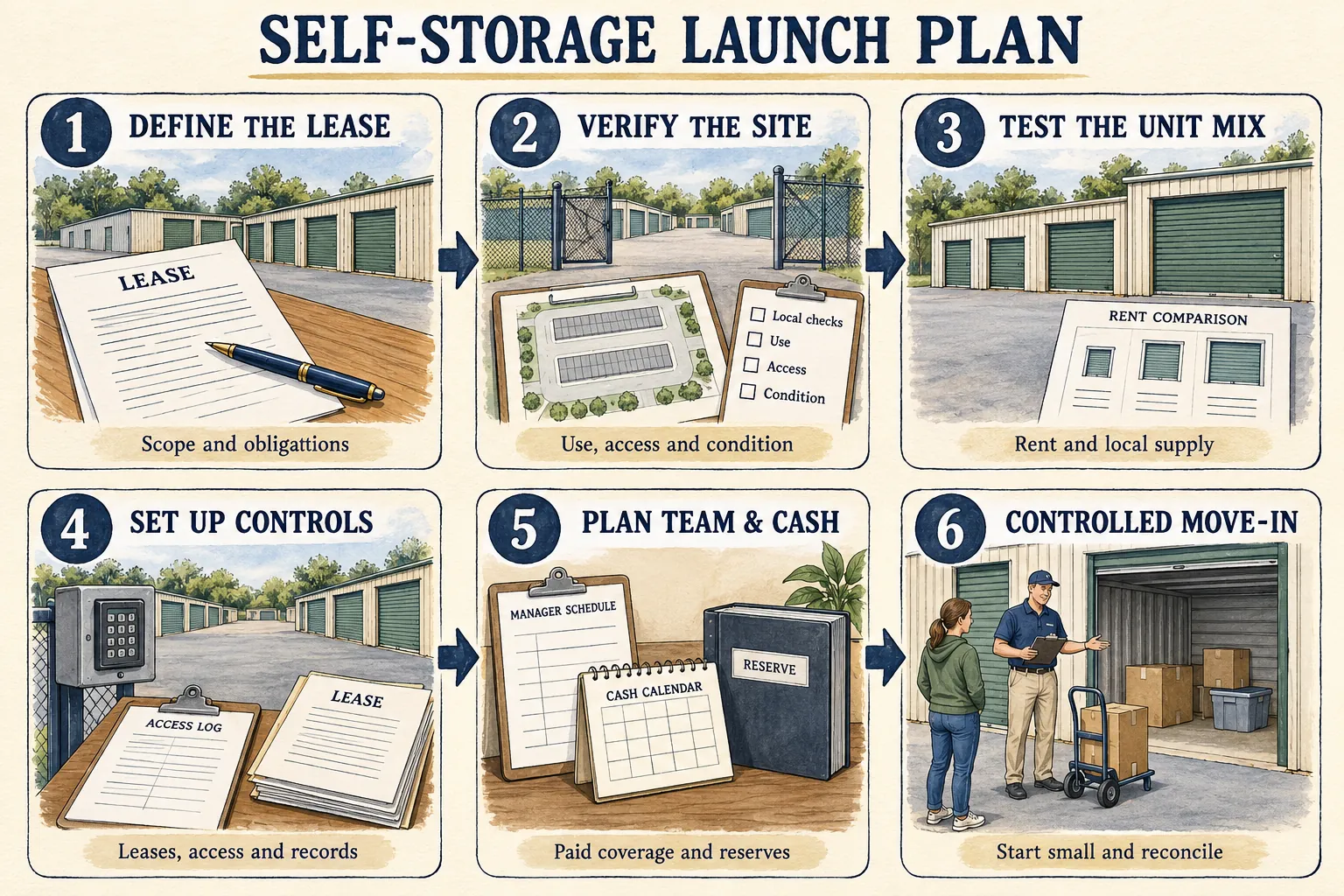
Measure and reconcile whole unit counts, sizes and condition. Check lawful storage use, address-specific site requirements, access, fire/building arrangements and landlord/subletting authority.
Obtain a matched lease and installed gate/door/security scope, insurance and support terms, paid roster, actual employer costs and opening payment dates. Preserve exclusions and deposits separately.
Compare exact offers without treating promotions as achieved rent. Track accepted unit rentals, earned net rent, retention, move-outs, credits and cash by size.
Start from the stated vacant-opening condition. Schedule readiness, new move-ins, customer support, maintenance and incident recovery against paid hours, then connect rent earning and settlement to the same cash forecast.
| Measure | Why it changes a decision |
|---|---|
| Physical and rentable unit inventory | Reconciles total units, unavailable units, size, condition, access and ready dates before a sale is promised. |
| Unit, area and rent occupancy | Separates occupied unit share, occupied floor area and earned rent against gross potential rent. A different occupied size mix changes yield. |
| Net rent and collections by size | Shows introductory discounts, concessions, credits, expected losses, rent earned, arrears and actual cash without counting a deposit twice. |
| Move-ins, move-outs and response workload | Connects leasing, turnover, access issues, unit readiness, maintenance and incidents to each paid role and launch growth. |
| Headlease and customer obligations | Tracks the property commitment, deposits, earned periods, advance rent, required notices, refunds, insurance, capital upkeep and dated unrestricted cash. |
Review actuals against the scope you priced. If an extra service, new trading hour or more distant client changes the work, update the roster and contribution calculation before expanding.
Bring the exact facility address, ownership and headlease/subletting arrangement, unit inventory, proposed self-storage use, customer access periods, gate/security scope, office, fire/building condition, drainage, signage, prohibited-item controls, customer agreement, account/deposit handling, arrears/termination route, staffing, employer setup, insurance and emergency response to the responsible planning/building/fire authorities, landlord, insurer and qualified advisers. Confirm current jurisdiction-specific requirements and legal applicability before relying on a template agreement or restricting customer access.
Each state profile links to official registration, tax and employer routes, together with the questions still requiring an address-specific answer. How to find the permits and approvals your business actually needs provides the record to keep.
Pause the site commitment when supported size-specific rent and occupancy cannot cover the lease and complete paid costs, the opening plan assumes an unquoted building/access remedy, landlord or operating authority is unresolved, the roster cannot deliver the promised response, or deposit/prepayment balances are being treated as current profit.
Write a response that changes the actual cause: narrower scope, a different site, revised paid staffing, a tested price or a delayed opening. A larger cash buffer only addresses a temporary timing gap.
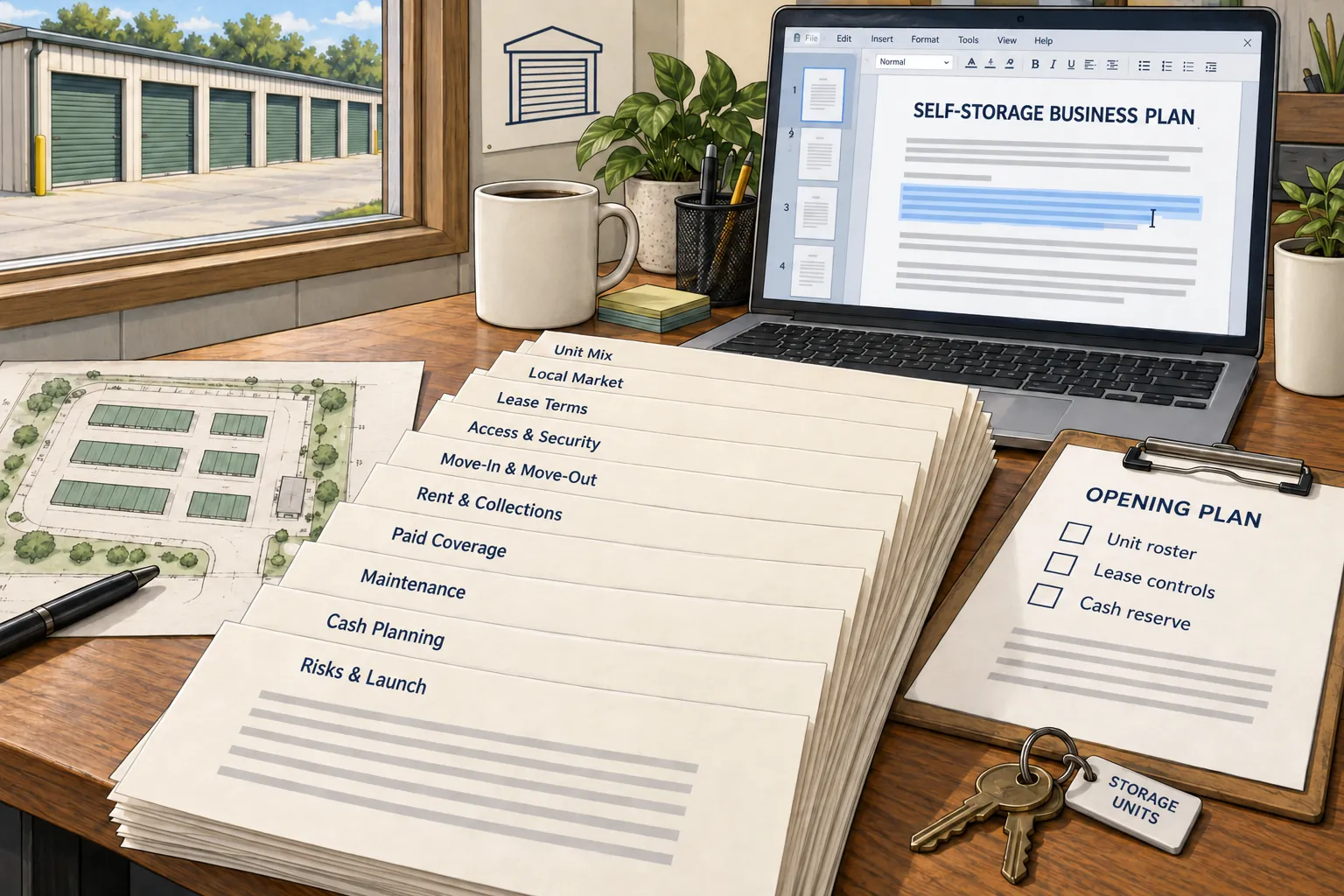
Test self-storage unit mix, realized net rent, occupancy, paid coverage, operating break-even and one 60-month opening cash schedule.
Work through the guide →Build a storage unit roster, rental/cash ledger, access and maintenance workflow, and jurisdiction-specific agreement record.
Work through the guide →Compare total occupancy cash, upfront commitments and site dependencies using a worked premises budget and a practical review record.
Work through the guide →Compare equipment at installed usable scope, account for excluded costs and connect supplier payment terms to the opening cash plan.
Work through the guide →Account for service, setup, cleaning, travel and owner work, then turn a complete paid week into a monthly staffing budget.
Work through the guide →Reconcile profit with customer payments, inventory, equipment and debt, then distinguish operating break-even from cash recovery.
Work through the guide →Restaurant earns from completed paid guest covers at a realized meal check and is constrained by paid preparation, kitchen stations, service peaks and guest handling. Self-Storage Facility earns net rent from a defined occupied unit-month and size mix while carrying the headlease, access, account and maintenance obligations. Compare the complete earning mechanism, paid capacity and dated cash using each format’s own unit.
Compare the operating choices →Coffee Shop earns from completed counter orders at a realized drink-and-food basket and is constrained by ordering, beverage preparation and pickup during concentrated buying windows. Self-Storage Facility earns net rent from a defined occupied unit-month and size mix while carrying the headlease, access, account and maintenance obligations. Compare the complete earning mechanism, paid capacity and dated cash using each format’s own unit.
Compare the operating choices →Cleaning Business earns from retained recurring commercial account-months with the promised visits and is constrained by account scope, visit frequency, paid travel, access and supervision. Self-Storage Facility earns net rent from a defined occupied unit-month and size mix while carrying the headlease, access, account and maintenance obligations. Compare the complete earning mechanism, paid capacity and dated cash using each format’s own unit.
Compare the operating choices →Hair Salon earns from completed paid appointments at a stated service mix and is constrained by paid stylist time, service duration, stations and the actual appointment diary. Self-Storage Facility earns net rent from a defined occupied unit-month and size mix while carrying the headlease, access, account and maintenance obligations. Compare the complete earning mechanism, paid capacity and dated cash using each format’s own unit.
Compare the operating choices →Auto Detailing Business earns from completed scoped vehicle packages and is constrained by technician person-hours, vehicle condition, bay occupation and handover. Self-Storage Facility earns net rent from a defined occupied unit-month and size mix while carrying the headlease, access, account and maintenance obligations. Compare the complete earning mechanism, paid capacity and dated cash using each format’s own unit.
Compare the operating choices →Laundromat earns from paid washer starts and attached drying revenue and is constrained by machine mix, dryers, utilities, uptime and peak customer circulation. Self-Storage Facility earns net rent from a defined occupied unit-month and size mix while carrying the headlease, access, account and maintenance obligations. Compare the complete earning mechanism, paid capacity and dated cash using each format’s own unit.
Compare the operating choices →Daycare Center earns from paid enrolled child-weeks by age group and is constrained by licensed rooms, applicable group and ratio rules, qualified coverage and relief. Self-Storage Facility earns net rent from a defined occupied unit-month and size mix while carrying the headlease, access, account and maintenance obligations. Compare the complete earning mechanism, paid capacity and dated cash using each format’s own unit.
Compare the operating choices →Pet Grooming Salon earns from completed grooming visits at a weighted size-and-service mix and is constrained by groomer and bather time, tubs, drying, tables and safe handover. Self-Storage Facility earns net rent from a defined occupied unit-month and size mix while carrying the headlease, access, account and maintenance obligations. Compare the complete earning mechanism, paid capacity and dated cash using each format’s own unit.
Compare the operating choices →Landscaping Company earns from completed recurring maintenance visits and is constrained by crew person-hours, route density, access, seasonality and weather-adjusted completions. Self-Storage Facility earns net rent from a defined occupied unit-month and size mix while carrying the headlease, access, account and maintenance obligations. Compare the complete earning mechanism, paid capacity and dated cash using each format’s own unit.
Compare the operating choices →Food Truck earns from completed paid food orders at a realized net ticket and is constrained by preparation, commissary, travel, viable service windows and truck throughput. Self-Storage Facility earns net rent from a defined occupied unit-month and size mix while carrying the headlease, access, account and maintenance obligations. Compare the complete earning mechanism, paid capacity and dated cash using each format’s own unit.
Compare the operating choices →Bakery earns from paid retail baskets at a realized product mix and is constrained by whole batches, paid production, counter flow, sell-through and waste. Self-Storage Facility earns net rent from a defined occupied unit-month and size mix while carrying the headlease, access, account and maintenance obligations. Compare the complete earning mechanism, paid capacity and dated cash using each format’s own unit.
Compare the operating choices →Fitness Studio earns from retained billable member-months at realized net yield and is constrained by class timetable, instructor hours, usable spots, promised access, churn and collections. Self-Storage Facility earns net rent from a defined occupied unit-month and size mix while carrying the headlease, access, account and maintenance obligations. Compare the complete earning mechanism, paid capacity and dated cash using each format’s own unit.
Compare the operating choices →HVAC Company earns from completed service calls and replacement jobs in a stated mix and is constrained by qualified technicians, travel, diagnosis, equipment, installation work and callbacks. Self-Storage Facility earns net rent from a defined occupied unit-month and size mix while carrying the headlease, access, account and maintenance obligations. Compare the complete earning mechanism, paid capacity and dated cash using each format’s own unit.
Compare the operating choices →Moving Company earns from completed local household moves and is constrained by whole crew-and-truck blocks across origin, route, destination and reset. Self-Storage Facility earns net rent from a defined occupied unit-month and size mix while carrying the headlease, access, account and maintenance obligations. Compare the complete earning mechanism, paid capacity and dated cash using each format’s own unit.
Compare the operating choices →Auto Repair Shop earns from completed repair orders with realized labor and parts revenue and is constrained by paid technician time, bay dwell, lifts, parts readiness, authorization and rework. Self-Storage Facility earns net rent from a defined occupied unit-month and size mix while carrying the headlease, access, account and maintenance obligations. Compare the complete earning mechanism, paid capacity and dated cash using each format’s own unit.
Compare the operating choices →Plumbing Company earns from completed and collected residential plumbing jobs and is constrained by qualified plumber time, vehicles, travel, diagnosis, materials, permits and callbacks. Self-Storage Facility earns net rent from a defined occupied unit-month and size mix while carrying the headlease, access, account and maintenance obligations. Compare the complete earning mechanism, paid capacity and dated cash using each format’s own unit.
Compare the operating choices →Electrical Contractor earns from completed and collected electrical service and small-alteration jobs and is constrained by qualified electrician time, sold-hour realization, vehicles, materials, inspections and rework. Self-Storage Facility earns net rent from a defined occupied unit-month and size mix while carrying the headlease, access, account and maintenance obligations. Compare the complete earning mechanism, paid capacity and dated cash using each format’s own unit.
Compare the operating choices →Pest Control Company earns from retained paid residential service-plan months and is constrained by qualified technicians, initial visits, routine obligations, travel, records and callbacks. Self-Storage Facility earns net rent from a defined occupied unit-month and size mix while carrying the headlease, access, account and maintenance obligations. Compare the complete earning mechanism, paid capacity and dated cash using each format’s own unit.
Compare the operating choices →Residential Remodeling Company earns from accepted delivered interior scope expressed as earned-project equivalents and is constrained by paid carpenter hours, management, customer selections, authorized trades, inspection dependencies and rework. Self-Storage Facility earns net rent from a defined occupied unit-month and size mix while carrying the headlease, access, account and maintenance obligations. Compare the complete earning mechanism, paid capacity and dated cash using each format’s own unit.
Compare the operating choices →No. It is an authored opening and operating scenario for leasing an existing non-climate drive-up facility. Property or business acquisition, land, development, construction, major conversion and their financing require separate evidence and models.
One unit rented for a full month, or the equivalent earned portion of shorter periods. Physical units are whole; average unit-months can be fractional because move-in, move-out and prorated earning occur during a month.
No. This reference applies 80% equally to each size, preserving the stated rental mix. Different size occupancy, promotions, credits and collection losses change earned rent even if the total occupied-unit share stays the same.
No. The $60, $100 and $160 size-specific net rents are authored teaching assumptions. Their inventory-weighted average is $110. Named operator offers elsewhere are scope-labeled asking prices and do not establish this realized yield.
Customer security deposits and future-period rent are separate obligations. Only the amount earned for the stated period enters current rent, under the applicable agreement and accounting treatment.
No. Mature cash after capital maintenance excludes financing, taxes, owner distributions and changing receivables. The reference does not recover its opening cash uses within the 60-month schedule.
No states match these filters.
Sorting compares one defined format. It does not rank states for attractiveness or prove demand. Funding includes opening payments, the deepest cumulative operating cash deficit in the 60-month model and the retained cash buffer.
| State | Funding scenario | Loaded payroll / month | Approximate EBIT threshold average occupied unit-months per month |
|---|---|---|---|
| Alabama | $121,950 | $5,609 | 139.3 |
| Alaska | $132,346 | $7,182 | 154 |
| Arizona | $126,306 | $6,317 | 145.9 |
| Arkansas | $118,620 | $5,062 | 134.1 |
| California | $133,521 | $7,346 | 155.5 |
| Colorado | $146,031 | $8,267 | 164.2 |
| Connecticut | $131,996 | $7,133 | 153.5 |
| Delaware | $128,751 | $6,679 | 149.3 |
| Florida | $126,665 | $6,375 | 146.4 |
| Georgia | $128,132 | $6,593 | 148.5 |
| Hawaii | $129,863 | $6,835 | 150.7 |
| Idaho | $121,881 | $5,598 | 139.2 |
| Illinois | $131,549 | $7,071 | 153 |
| Indiana | $124,856 | $6,081 | 143.7 |
| Iowa | $125,237 | $6,143 | 144.3 |
| Kansas | $123,052 | $5,788 | 140.9 |
| Kentucky | $120,781 | $5,419 | 137.5 |
| Louisiana | $119,171 | $5,158 | 135 |
| Maine | $126,114 | $6,286 | 145.6 |
| Maryland | $132,087 | $7,146 | 153.7 |
| Massachusetts | $169,587 | $8,646 | 167.7 |
| Michigan | $124,750 | $6,064 | 143.5 |
| Minnesota | $129,285 | $6,754 | 150 |
| Mississippi | $120,030 | $5,297 | 136.3 |
| Missouri | $125,302 | $6,154 | 144.4 |
| Montana | $124,372 | $6,003 | 142.9 |
| Nebraska | $125,508 | $6,187 | 144.7 |
| Nevada | $122,888 | $5,761 | 140.7 |
| New Hampshire | $131,594 | $7,077 | 153 |
| New Jersey | $134,617 | $7,498 | 157 |
| New Mexico | $123,613 | $5,879 | 141.8 |
| New York | $153,315 | $8,384 | 165.3 |
| North Carolina | $123,998 | $5,942 | 142.4 |
| North Dakota | $124,679 | $6,053 | 143.4 |
| Ohio | $125,565 | $6,197 | 144.8 |
| Oklahoma | $123,858 | $5,919 | 142.2 |
| Oregon | $132,759 | $7,240 | 154.5 |
| Pennsylvania | $126,778 | $6,394 | 146.6 |
| Rhode Island | $133,085 | $7,285 | 155 |
| South Carolina | $123,995 | $5,941 | 142.4 |
| South Dakota | $120,530 | $5,378 | 137.1 |
| Tennessee | $125,736 | $6,224 | 145 |
| Texas | $123,868 | $5,921 | 142.2 |
| Utah | $126,044 | $6,274 | 145.5 |
| Vermont | $127,582 | $6,516 | 147.8 |
| Virginia | $131,028 | $6,998 | 152.3 |
| Washington | $222,980 | $9,505 | 175.8 |
| West Virginia | $120,371 | $5,353 | 136.9 |
| Wisconsin | $132,678 | $7,228 | 154.4 |
| Wyoming | $124,212 | $5,977 | 142.7 |
Published research and calculations support business planning and education. They are not personalized financial, investment, tax or legal advice, and they do not guarantee costs, revenue, profit or financing. Estimates depend on the stated format, location, source periods and assumptions. Check the requirements and commitments that apply to your circumstances.