
How to control self-storage unit mix, access and tenant accounts
Operate self-storage from one unit roster tied to rentable condition, size-specific earned rent, access records, customer accounts and paid response work. The 200-unit reference has 24,000 sq ft of unit floors and assumes 160 occupied unit-months; an occupied door alone does not prove collected rent, lawful account action or a unit ready for the next tenant.
What you will produce: A unit-to-account record covering readiness, agreement scope, promotions, earned periods, deposits, access incidents, turnover, maintenance, lawful escalation and cash.
Updated October 4, 2026 · Worked examples and editable worksheets
What to have ready
Bring the unit plan, condition inspection, headlease/operating-right evidence, installed access scope, response roster, actual agreements, rent/discount terms, account ledger and current official requirements.
Work through the calculation and decision
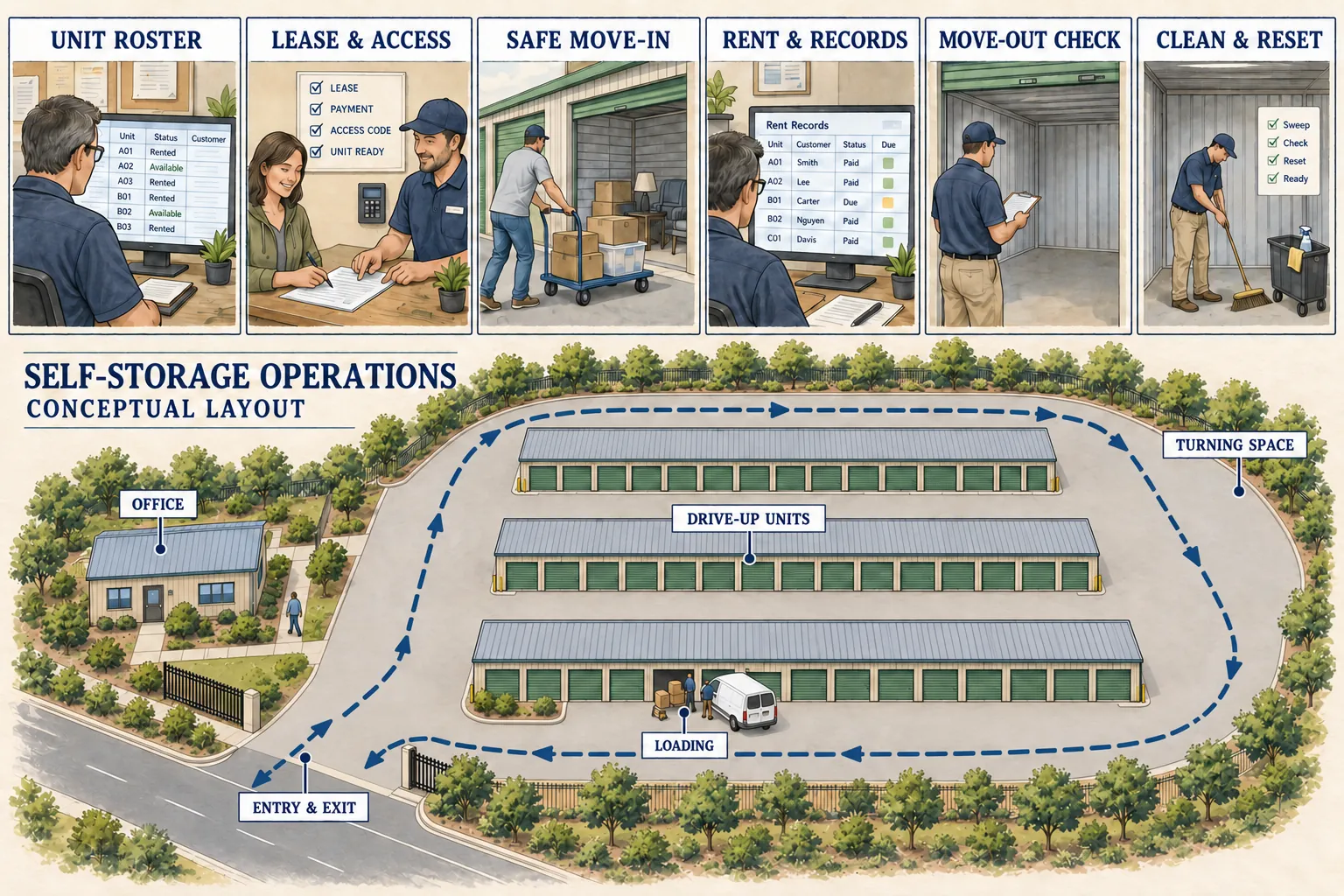
Reconcile every unit before offering space
Give each unit a stable identifier, measured size, rentable floor area, climate/access condition, door/lock condition, allowable use and ready status. Record why a unit is unavailable and what must happen before it returns to supply. Office, customer movement, emergency access, setbacks and service areas need their own condition and permission checks.
The reference’s 40 / 100 / 60 size mix totals 200 whole units and 24,000 sq ft of unit floors. Keep that ceiling distinct from average occupied unit-months. A monthly average can express prorated earning across whole units; it cannot manufacture another physical unit or permission to use an unapproved space.
Census: 2022 NAICS 531130 · 2022 NAICS definition · Checked 2026-10-04
Self-Storage Facility reference economics · Authored leased existing-site non-climate 200-unit scenario and paid roster; not observed performance, an acquisition price or a construction budget.
Resolve the headlease and installed scope
Confirm property control, permitted storage use, authority to rent units to customers, access periods, property charges, deposit/repair responsibilities, insurance, installation rights, termination and handback duties. An existing leased site still needs address-specific building/fire, drainage, safety, signage and accessibility checks.
Quote installed gates, doors, locks, cameras, lighting, power/network support and office systems with exclusions, service and payment terms. An equipment listing is not a ready-to-operate quote. Define outage, emergency and incident response; a camera or subscription does not supply free staff or prove complete response coverage.
Self-Storage Facility reference economics · Authored leased existing-site non-climate 200-unit scenario and paid roster; not observed performance, an acquisition price or a construction budget.
Connect the agreement to the earning and cash ledger
Link each customer to an identified unit, accepted rental period, permitted use, current price, promotion, change/termination conditions, contact, payment/refund terms, deposit and access arrangement. The customer’s goods remain distinct from assets the business owns. This reference supplies space without moving or handling goods.
Separate current rent earned, future-period prepayments, customer security deposits, discounts, credits, receivables, actual receipts, refunds and taxes. Prepaying another period does not create a second current sale. The actual agreement, earning policy and jurisdiction determine handling; deposits are not assumed free working capital.
IRS: business recordkeeping · Keeping supporting business records.
Self-Storage Facility reference economics · Authored leased existing-site non-climate 200-unit scenario and paid roster; not observed performance, an acquisition price or a construction budget.
Use the actual jurisdiction and agreement date
California’s current self-storage chapter specifies disclosures for covered agreements initially entered on or after January 1, 2026, including promotions, changeable rent and a first-year maximum. Texas Chapter 59 specifies contractual and procedural conditions for the lien-sale remedy and authorization for elected email notices. Ohio Section 5322.05 conditions late fees on payment timing and the agreement. These official examples apply only in their own jurisdiction and stated scope.
Preserve agreement date, notice choice, contact history, balances, restrictions and required notices. Federal servicemember protection can constrain lien enforcement; the DOJ guide explains the court-order protection for covered military-service periods. Obtain qualified applicability advice before restricting access, terminating a rental, charging disputed fees or pursuing recovery. A remedy or permitted fee is not guaranteed collection or ordinary rent.
California Business and Professions Code: self-storage chapter · Current law checked October 4, 2026; Section 21715.2 covers agreements initially entered on or after January 1, 2026 · Checked 2026-10-04
Texas Property Code Chapter 59 · Current text checked October 4, 2026 · Checked 2026-10-04
Ohio Revised Code Section 5322.05 · Effective May 4, 2004; current text checked October 4, 2026 · Checked 2026-10-04
DOJ: Servicemembers Civil Relief Act guide · Current guidance checked October 4, 2026 · Checked 2026-10-04
Distinguish unit, area and economic occupancy
Unit occupancy compares rented and rentable units for a defined period. Area occupancy compares rented floor area with rentable unit floors. Economic occupancy compares earned rent with matched gross potential rent under a documented definition. Size-specific vacancies, unavailable units, promotions and collection losses can make these measures diverge.
The uniform reference rents 32 / 80 / 48 unit-months and 19,200 sq ft at 80%. Actual equal occupancy is unproven. Track inquiries, applications, accepted rentals, move-ins, earned rent, transfers, retention and move-outs by size. Population, establishment counts and provider prices do not establish paid lease-up.
Self-Storage Facility reference economics · Authored leased existing-site non-climate 200-unit scenario and paid roster; not observed performance, an acquisition price or a construction budget.
Fit turnover and recovery into paid coverage
Assign inspections, cleanup, doors/locks, access support, inquiries, agreements, billing, account issues and incident response to paid roles or scoped providers. Record person-hours, concurrent duties and relief. Fractional weekly coverage is not unlimited availability; shared hours cannot be used twice.
The teaching roster supplies 86.67 / 86.67 / 34.67 monthly manager, leasing and maintenance hours. At 200 occupied units, assumed work uses 60 / 46.5 / 33 hours including routine work, 5% turnover, 5% account issues and 2% maintenance incidents in their respective clocks. Net added rentals consume another 0.5 leasing hour each. These rates need timed records and supported recovery/relief before expansion or broader service promises.
BLS May 2025 national occupation wage workbook · May 2025 · Checked 2026-10-04
Self-Storage Facility reference economics · Authored leased existing-site non-climate 200-unit scenario and paid roster; not observed performance, an acquisition price or a construction budget.
Tie a move-out or incident to the original account
Record the unit/customer, trigger, lawful possession/access status, condition, belongings, required work, responsible role/provider, paid hours, support/material cost, notices, charge or credit and closure. A unit returns to rentable supply only when condition and lawful possession are resolved. An access restriction is not an ordinary completed move-out.
Keep billed charges, collectible amounts and actual receipts separate. Recovery can consume paid work and repairs without earning another rental. Retain original cause and account so repeated problems change the work plan rather than appearing as new demand.
IRS: business recordkeeping · Keeping supporting business records.
Choose the next commitment from the complete record
Review inventory, retained earning by size, arrears/deposits, paid work and dated property/maintenance payments together. If rents, availability or support work differ, update the single financial calculator and cash schedule. More units or headline occupancy cannot repair weak net rent or an overbooked response roster.
Before accepting or expanding the lease, obtain operating authority and installed scope, paid rental/retention evidence, compliant customer terms, matched insurance/response arrangements, complete paid coverage and funded dates. Compare acquisition or development only after each has separate full evidence and financing scope.
Self-Storage Facility reference economics · Authored leased existing-site non-climate 200-unit scenario and paid roster; not observed performance, an acquisition price or a construction budget.
One unit changes status in four connected records
This qualitative example invents no local price, demand, approval or recovery timeline.
| Record | What to establish | Next decision |
|---|---|---|
| Physical unit | Identifier, size, condition, lawful possession, access and ready date | Only a lawfully ready unit returns to supply |
| Agreement/account | Actual terms, date, promotion, notice choice, contact and action | Use the applicable lawful process |
| Earning/obligations | Current rent, credits, receivable, cash, deposit, future rent and refund | Occupancy, income and available cash stay distinct |
| Paid work/costs | Inspection, cleanup, repair, account work, incident recovery and provider scope | Recalculate workload and dated cash |
What this changes: The roster, agreement, rent/cash ledger and paid work must describe the same event. A locked door or closed billing line alone is not a ready unit.
Illustrative amounts are rounded for display. Use the full inputs and stated units when recalculating; an approximate threshold is not itself a sufficient activity prescription.
Reference inventory and paid-work boundary
| Item | Authored reference | Selected-site check |
|---|---|---|
| Inventory | 40 × 5 × 10 ft; 100 × 10 × 10 ft; 60 × 10 × 20 ft | Measured condition and lawful rentable use |
| Unit floor area | 24,000 sq ft | Other access, circulation, office and site space is additional |
| Mature activity | 160 unit-months; uniform 80% occupancy | Actual retained periods and net rent by size |
| Paid roster | 20 / 20 / 8 weekly role hours | Duties, wages, employer cost, relief and response |
| Work at 200 | 60 / 46.5 / 33 monthly workload hours | Timed turnover, issues, incidents and promised coverage |
This case supplies neither a property purchase price, observed local occupancy, installed quote nor completed local cost-and-revenue study.
Complete your decision record
A unit-to-account record covering readiness, agreement scope, promotions, earned periods, deposits, access incidents, turnover, maintenance, lawful escalation and cash. Enter the finding or number, the source and the next action for each row. “Supported” records your assessment of that item; it does not approve the business or certify completed research.
| Item and what to record | Your finding and evidence | Status and next action |
|---|---|---|
| InventoryUnit ID, size/area, condition, unavailable cause and lawful ready date | ||
| Site rightsHeadlease, authority, permitted use, installed scope, insurance and handback | ||
| AgreementDate, terms, promotion, notice, official rules and qualified applicability advice | ||
| Rent/customer moneyEarned periods, future rent, concessions, arrears, deposits, refunds and receipts | ||
| Response/recoveryOriginal unit/account, promised coverage, provider, paid hours, costs, notices and closure | ||
| CashProperty, payroll, maintenance, restricted funds and available funding dates |
6 items have no evidence recorded yet.
Entries are temporary and are not sent to us or saved automatically. Download your completed work before leaving or refreshing this page.
Choose your next action
| If your finding is… | Your next action |
|---|---|
| Condition or operating right unresolved | Resolve the address and unit scope before promising access or installing equipment. |
| Occupancy masks lower net rent | Reconcile earning, concessions and collection by size before enlarging the sales plan. |
| Account action lacks applicable authority | Obtain the current route and preserve evidence before acting. |
| Turnover or incidents exceed coverage | Revise funded response, service promise, recovery scope or inventory. |
| Customer funds appear as profit | Reconcile deposit/prepayment obligations with earning and cash. |
Errors that can change the result
- Adding goods handling or moving without separate scope.
- Calling unit floor area the entire site requirement.
- Treating an introductory ask as achieved rent.
- Copying another state’s notice or recovery rules.
- Equating an access restriction with lawful account closure.
- Assuming cameras remove paid response and maintenance.
Apply this to your business
These operating formats match the decisions in this guide.
Self-Storage Facility
Leased existing 200-unit non-climate drive-up self-storage facility with a defined unit mix and paid operating coverage
Open the operating guide and state profiles →Use the same inventory, customer terms, paid work, realized rent and cash dates to assess the property commitment. Values entered here are not automatically transferred to another calculator.
Continue with the next part of your plan
- Can self-storage rent and occupancy cover the lease and opening cash?
One size-specific rent and occupancy case, three operating thresholds, a paid-workload check, and opening funding and a 60-month cash schedule from the same inputs.
- What to check before committing to business premises
A comparable premises cost summary and a list of conditions to resolve before the next commitment.
- How to find the permits and approvals your business actually needs
An approval register with official responses and the next unresolved question.
- How to compare equipment quotes and build the opening budget
A comparable two-quote cost calculation and a supplier commitment record.
- How to build a staffing roster before estimating payroll
A roster with complete task coverage and an annualized monthly staffing budget.
Sources and limits
The sources below provide the stated background. The worked examples, calculator defaults and decision exercises are authored teaching material. They do not establish market prices, local demand, legal applicability or completed state research.
- Self-Storage Facility reference economics
Authored leased existing-site non-climate 200-unit scenario and paid roster; not observed performance, an acquisition price or a construction budget.
- Census: 2022 NAICS 531130
Lessors of miniwarehouses and self-storage units, printed page 442. It does not establish this exact format, price, occupancy, cost or demand.
- BLS May 2025 national occupation wage workbook
Cross-industry medians for SOC 11-9141, 43-4051 and 49-9071; not hiring quotes, eligibility, full employer costs or 24-hour coverage.
- California Business and Professions Code: self-storage chapter
California agreement disclosures for the stated effective scope, not other jurisdictions or a complete individual-account determination.
- Texas Property Code Chapter 59
Sections 59.041(b) and 59.043(d), contractual/procedural lien and elected email-notice conditions; not guaranteed collection or permission to skip procedure.
- Ohio Revised Code Section 5322.05
Ohio agreement and payment-timing conditions for late fees; not ordinary rent, another state’s terms or complete recovery advice.
- DOJ: Servicemembers Civil Relief Act guide
Court-order protection for covered lien enforcement during and within 90 days after military service; actual person, service period and legal applicability require checks.
- IRS: business recordkeeping
Keeping supporting business records.
Source background and its scope are stated above. The guide update date does not change a source observation period. Research and review standards · Report an issue
When you need a longer financial plan
Use a financial model to organize a broader forecast after defining your own operating assumptions. The site’s research, your worksheet entries and any purchased workbook are separate; entries are not transferred automatically.
Continue with the published financial scenario