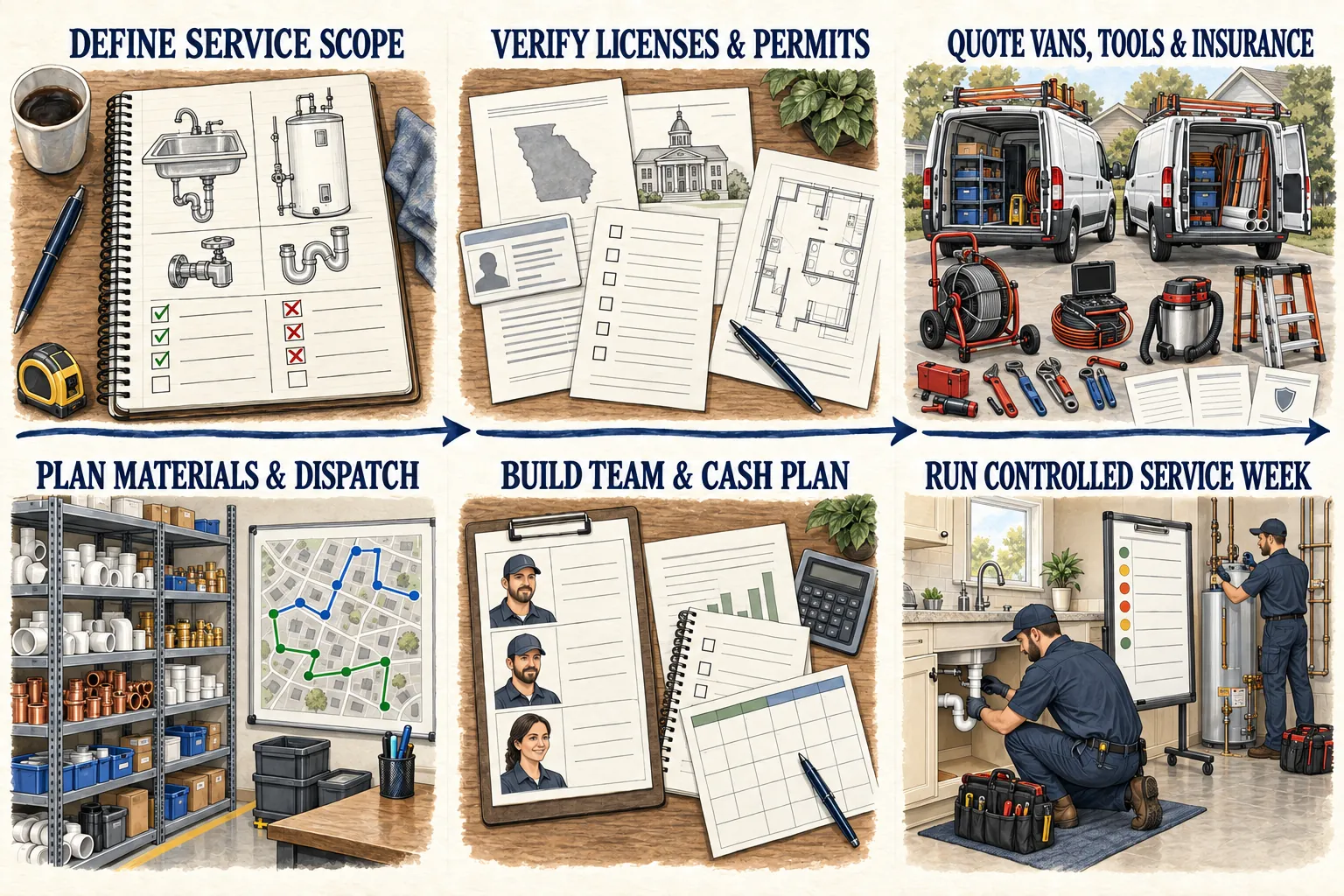
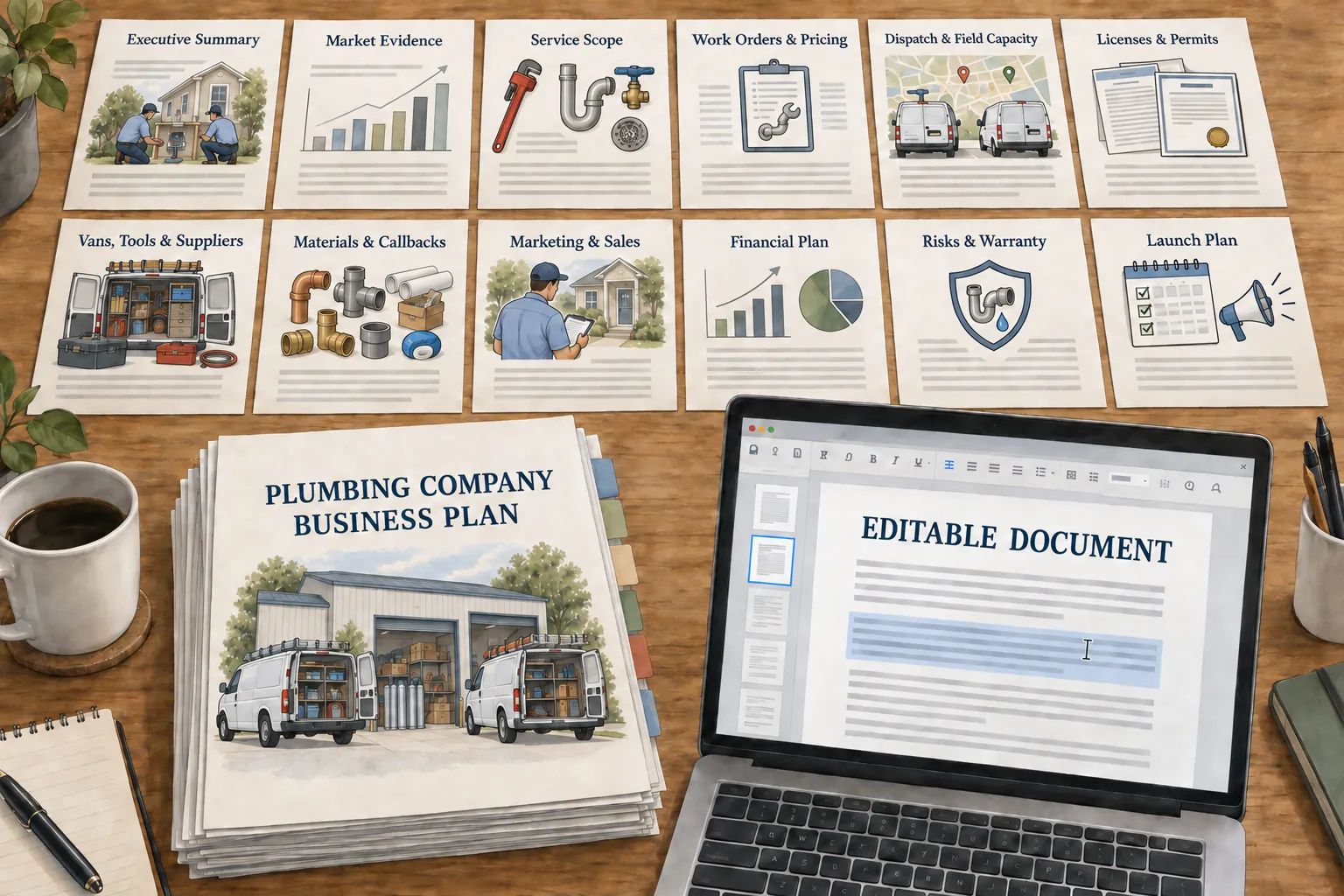
Start a Plumbing Company by defining one licensed residential service scope, one completed-and-collected job policy, and a paid two-plumber dispatch schedule. The reference case assumes 120 monthly jobs at $650 each, calculates $18,538 of cash after maintenance, and reaches cash break-even at 80.89 jobs against a 142-job field-hour ceiling. Replace the assumed job value, materials, travel, callbacks, occupancy, vehicles, insurance, permits, and demand with evidence for the selected market before committing $326,049 of modeled funding.
What the customer buys and what makes the business repeatable.
One operating record starts with an inquiry and ends with a completed, documented, invoiced, and collected service job. Link the address, problem, triage, assigned plumber and vehicle, travel, diagnosis, estimate, authorization, materials, permit or inspection dependency, paid field hours, completion evidence, invoice, collection, warranty, and callback outcome. An inquiry, booked window, dispatched truck, estimate, deposit, material order, open invoice, callback, refund, or chargeback is not another completed revenue unit.
Repeat work helps only when the company solves the original problem without hiding callbacks or unpaid recovery time. Track customer source, booked-to-completed conversion, realized service and material revenue, materials cost, paid field hours, travel, permits, collection, callback cause, warranty recovery, and customer outcome by the original work order.
The format on this site: Local residential plumbing service contractor with two full-time paid field plumbers, two service vehicles, paid dispatch coverage, and paid owner-manager and qualifying-contractor replacement-cost coverage. HVAC and refrigeration, new-construction production plumbing, commercial and industrial contracting, sewer excavation, septic work, fire-suppression systems, large remodeling, multiple branches, a third vehicle, and unpaid labor are outside the reference format.
Choose the format before choosing a budget.
Different formats need different operating plans
Format
What changes
How to use it
Two-plumber residential service company
Two paid field plumbers in two service vehicles complete diagnosis, repair, and small replacement jobs within a defined territory
The reference format; work-order time, materials, permits, dispatch, collections, and callbacks constrain it.
New-construction or large remodeling contractor
Project schedules, crews, bids, retainage, change orders, inspections, and working capital replace short residential service-job flow
Use a separate project, labor, materials, billing, and financing model.
Commercial, industrial, sewer, septic, or fire-suppression specialist
Credentials, equipment, site risk, vehicles, crews, contracts, and job duration differ materially
Do not extend the residential service assumptions into these scopes.
A founder prepared to manage licensed technical work, a paid field roster, dispatch promises, customer authorization, materials cash, two vehicles, permit dependencies, documentation, collection, and callback accountability. The format rewards complete work-order records because a full calendar cannot repair weak contribution, excessive travel, missing authority, or repeated return visits.
Understand the reference operating plan.
The figures below are a national wage reference scenario. The paid roster uses May 2025 BLS national occupational medians. Prices, customer volume, rent, equipment and other commercial inputs are authored assumptions. This is not a researched average startup cost, owner-income promise or a funding recommendation.
One defined format · monthly amounts before financing and income taxes
Input or result
Reference
What to verify
Completed sales units
120 completed and collected residential service jobs / month
120 completed and collected jobs per month; demand requires evidence.
Net selling price
$650.00
Build and test a relevant local menu, package or contract scope.
Revenue
$78,000
Calculated volume × price, not observed sales.
Paid payroll
$21,742 / month
National wage medians × the stated hours × the 18% employer allowance.
Opening payments
$209,184
Authored equipment and setup allowances, deposit and paid training.
After the full paid roster and depreciation; before financing and income taxes.
EBIT break-even
81.3 completed and collected jobs per month
A sales threshold to compare with capacity and tested demand.
Two paid field plumbers supply 346.67 monthly hours. At 120 completed jobs, the authored ledger uses 258.00 full work-order hours, 9.00 callback hours, and 30.00 hours for training, stocking, and meetings. The entered 142-job ceiling uses 345.95 hours. Travel, diagnosis, authorization, supplier stops, permit dependencies, documentation, vehicle downtime, and callback history remain unverified; capacity is not demand.
Separate materials acquisition, job-specific permit, disposal, and specialty cost, payment leakage, and callback parts from paid payroll. Keep callback field hours in the capacity ledger so the same recovery work is not counted twice. Keep vehicle and fuel cost, commercial auto and liability insurance, utilities, dispatch software, phones, recurring marketing, professional support, uniforms, storage, training and administration visible. Model vehicle, tool and premises maintenance separately. Every amount remains an authored scenario input until a matched quote or operating record supports it.
The occupation rows are broad May 2025 cross-industry wage anchors for the disclosed paid roster. They do not establish local recruiting terms, licensing authority, overtime, on-call pay, benefits, employer obligations, owner distributions or unpaid owner capacity.
A positive reference EBIT depends on the assumed paid sales volume and costs. It does not establish local demand or cash available for owner withdrawals.
Make completed-job break-even fit the full two-plumber service clock
Interpretation of the national reference format
For this two-plumber residential service format, the decision turns on completed and collected jobs that fit the same paid field-hour, vehicle, material, permit, dispatch, documentation and callback ledger. The reference case reaches cash break-even at 80.89 jobs and models $18,538 of monthly cash after maintenance at 120 jobs, but the 142-job ceiling is useful only after travel, authorization, supplier stops, permits, collections and return work are measured rather than assumed.
The reference requires 81.3 completed and collected jobs per month for EBIT break-even. At 96 completed and collected jobs per month (20% below the volume assumption), monthly EBIT is $6,962. This one-input test retains a positive result, but does not establish local demand or cover every change to costs and cash timing. These are scenario calculations with the other inputs held fixed, not a demand forecast or a recommended safety margin.
The authored reference models 120 completed and collected jobs and $18,537.60 of monthly cash after maintenance. It needs 81 whole jobs for cash break-even from 80.89 calculated jobs, compared with a 142-job field-hour ceiling. Service and material revenue, direct costs, work-order time, premises, vehicles, permits, insurance, callbacks, collections and demand remain authored assumptions rather than observed national or local performance.
Keep one work-order ledger from inquiry through collection and callback closure. Reconsider price, materials policy, territory, accepted scope, staffing, vehicles or opening commitment when the cash threshold no longer fits qualified paid capacity or supported demand.
Vehicle purchase, upfit, registration, commercial coverage, secure tool and material storage, replenishment rules, fuel, parking, maintenance, tires, downtime, and replacement
Prove that both vehicles can be parked, insured, stocked, and kept available inside the selected service territory.
Diagnosis, repair, drain, inspection, press, and safety tools
Hand and power tools, drain machines, camera, press tools, ladders, leak testing, lockout controls, PPE, dust containment where applicable, calibration, inspection, service, and replacement
Tie each item to an included service and competent licensed worker rather than buying an undifferentiated tool package.
Dispatch, authorization, permit, invoice, and callback records
Name the jurisdiction, license holder or qualifying person, worker credentials, residential services, excluded services, permit triggers, inspection steps, customer documents, warranties, and any federal RRP exposure.
Build the full work-order clock
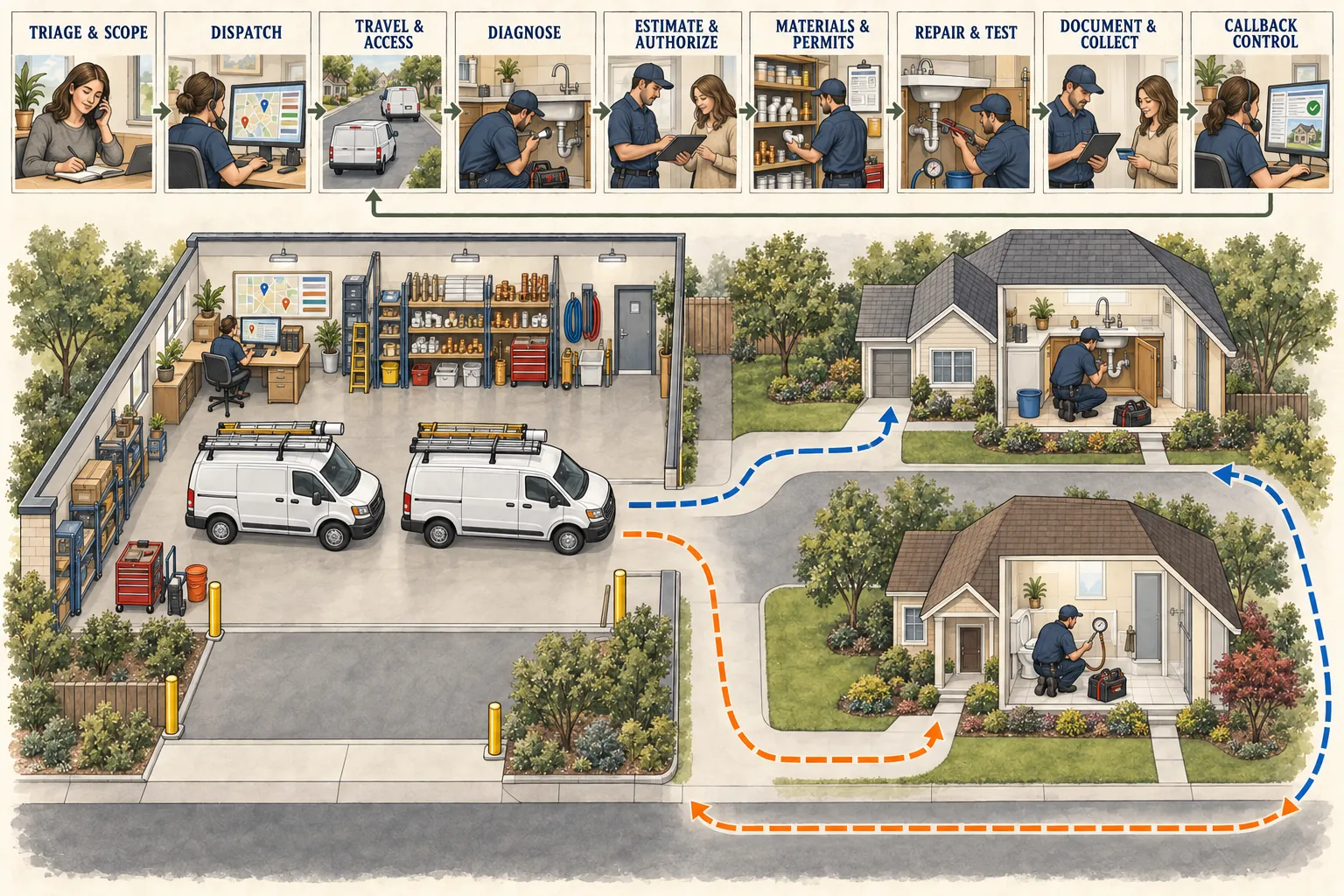
Time intake, dispatch, travel, diagnosis, authorization, supplier stops, permit dependencies, productive work, documentation, cleanup, collection, quality control, and callbacks. Do not schedule one plumber or vehicle into simultaneous jobs.
Quote vehicles, tools, insurance, premises, and materials
Replace every opening allowance with a delivered quote, applicable fee, policy, lease term, supplier arrangement, and payment date before financing the launch.
Run a lawful paid demand test
Track inquiries, accepted scope, booked windows, dispatched jobs, completed and collected jobs, realized service and material dollars, all paid hours, direct cost, travel, callbacks, and work refused because scope or capacity was unavailable.
Your first evidence task: For four representative weeks, use one work-order ledger and one plumber-and-vehicle schedule. Record inquiry source, triage, address, promised window, dispatched worker and vehicle, travel, diagnosis, estimate, authorization, materials, permits, productive work, documentation, invoice, collection, callback, warranty recovery, vehicle downtime, and work declined because scope or capacity was unavailable.
What to measure in the first operating weeks.
A small operating dashboard
Measure
Why it changes a decision
Completed and collected jobs by service scope
Separates delivered revenue from inquiries, appointments, estimates, deposits, material orders, open invoices, callbacks, refunds, and chargebacks.
Realized service and material revenue
Shows whether the entered $650 job value exists after discounts, tax treatment, refunds, collection loss, and the actual job mix.
Materials cost, permits, disposal, and supplier credits
Connects the job mix to contribution and working cash instead of relying on a markup rule.
Paid field hours by work-order stage
Makes travel, diagnosis, authorization, supplier stops, permit waiting, productive work, documentation, cleanup, stocking, training, and callbacks visible.
Callbacks tied to the original job
Connects recovery travel, diagnosis, labor, parts, refunds, supplier credits, customer result, and closure to the sale that caused them.
Review actuals against the scope you priced. If an extra service, new trading hour or more distant client changes the work, update the roster and contribution calculation before expanding.
Prepare the right approval brief.
Take the exact entity, ownership, qualifying license holder, worker credentials, service territory, storage and dispatch address, two vehicles, included plumbing scope, water-heating work, drains, gas work, excavation, paint disturbance, materials and wastes, employees, customer documents, warranties, insurance, advertising, and permit triggers to the responsible state board, municipality, building department, insurer, fire authority, environmental office, and advisers. Ask which licenses, registrations, permits, inspections, bonds, insurance, tax, safety, lead, consumer, and record rules apply.
Stop when cash break-even requires more completed and collected jobs than the two-plumber time ledger can deliver, when the qualifying license or local permit path is unresolved, when quoted revenue depends on unlicensed scope, when material and callback records do not reconcile, or when vehicles, insurance, parking, premises use, safety, and lead-safe obligations remain unpriced.
Write a response that changes the actual cause: narrower scope, a different site, revised paid staffing, a tested price or a delayed opening. A larger cash buffer only addresses a temporary timing gap.
Reconcile collected jobs, realized service and material dollars, direct job cost, paid coverage, callbacks, fixed cost, maintenance, and the two-plumber field-hour ceiling.
Turn each work order into one sequence for triage, travel, diagnosis, authorization, materials, permits, productive work, documentation, collection, quality control, and callback recovery.
A Restaurant earns from completed guest orders through kitchen, service, and seating throughput. A Plumbing Company earns from completed and collected residential service jobs through licensed plumbers, two vehicles, dispatch, materials, permits, and callback control. Both must fit paid capacity to realized contribution, while plumbing adds address-to-address travel, trade authority, water and gas system risk, material acquisition, and return-service exposure.
A Coffee Shop earns from completed beverage and food orders through bar, queue, seating, and peak-hour throughput. A Plumbing Company earns from completed and collected residential service jobs through licensed plumbers, two vehicles, dispatch, materials, permits, and callback control. Both must fit paid capacity to realized contribution, while plumbing adds address-to-address travel, trade authority, water and gas system risk, material acquisition, and return-service exposure.
A Cleaning Business earns from completed account visits through crew hours, route density, access, and repeat contracts. A Plumbing Company earns from completed and collected residential service jobs through licensed plumbers, two vehicles, dispatch, materials, permits, and callback control. Both must fit paid capacity to realized contribution, while plumbing adds address-to-address travel, trade authority, water and gas system risk, material acquisition, and return-service exposure.
A Hair Salon earns from completed appointments through licensed stylist hours and usable chairs. A Plumbing Company earns from completed and collected residential service jobs through licensed plumbers, two vehicles, dispatch, materials, permits, and callback control. Both must fit paid capacity to realized contribution, while plumbing adds address-to-address travel, trade authority, water and gas system risk, material acquisition, and return-service exposure.
An Auto Detailing Business earns from completed detailing packages through technician hours, bays, water, tools, and vehicle handoff. A Plumbing Company earns from completed and collected residential service jobs through licensed plumbers, two vehicles, dispatch, materials, permits, and callback control. Both must fit paid capacity to realized contribution, while plumbing adds address-to-address travel, trade authority, water and gas system risk, material acquisition, and return-service exposure.
A Laundromat earns from paid washer turns and dryer use through machine count, cycle time, utilities, uptime, and customer turns. A Plumbing Company earns from completed and collected residential service jobs through licensed plumbers, two vehicles, dispatch, materials, permits, and callback control. Both must fit paid capacity to realized contribution, while plumbing adds address-to-address travel, trade authority, water and gas system risk, material acquisition, and return-service exposure.
A Daycare Center earns from paid enrolled child-weeks through licensed rooms, age-group ratios, staff coverage, and safe occupancy. A Plumbing Company earns from completed and collected residential service jobs through licensed plumbers, two vehicles, dispatch, materials, permits, and callback control. Both must fit paid capacity to realized contribution, while plumbing adds address-to-address travel, trade authority, water and gas system risk, material acquisition, and return-service exposure.
A Pet Grooming Salon earns from completed grooming appointments through groomer, bathing, drying, table, and animal-handoff capacity. A Plumbing Company earns from completed and collected residential service jobs through licensed plumbers, two vehicles, dispatch, materials, permits, and callback control. Both must fit paid capacity to realized contribution, while plumbing adds address-to-address travel, trade authority, water and gas system risk, material acquisition, and return-service exposure.
A Landscaping Company earns from completed recurring property visits through crew hours, route density, weather, equipment, and seasonal scope. A Plumbing Company earns from completed and collected residential service jobs through licensed plumbers, two vehicles, dispatch, materials, permits, and callback control. Both must fit paid capacity to realized contribution, while plumbing adds address-to-address travel, trade authority, water and gas system risk, material acquisition, and return-service exposure.
A Food Truck earns from completed food orders through preparation, travel, commissary, service windows, and truck throughput. A Plumbing Company earns from completed and collected residential service jobs through licensed plumbers, two vehicles, dispatch, materials, permits, and callback control. Both must fit paid capacity to realized contribution, while plumbing adds address-to-address travel, trade authority, water and gas system risk, material acquisition, and return-service exposure.
A Bakery earns from completed retail baskets through batch production, sell-through, staffing, counter, and freshness. A Plumbing Company earns from completed and collected residential service jobs through licensed plumbers, two vehicles, dispatch, materials, permits, and callback control. Both must fit paid capacity to realized contribution, while plumbing adds address-to-address travel, trade authority, water and gas system risk, material acquisition, and return-service exposure.
A Fitness Studio earns from paid active member-months through class timetable, instructor hours, spots, access, retention, and collections. A Plumbing Company earns from completed and collected residential service jobs through licensed plumbers, two vehicles, dispatch, materials, permits, and callback control. Both must fit paid capacity to realized contribution, while plumbing adds address-to-address travel, trade authority, water and gas system risk, material acquisition, and return-service exposure.
An HVAC Company earns from completed and collected service calls or replacement jobs through technician hours, vehicles, travel, parts, equipment, installation mix, and callbacks. A Plumbing Company earns from completed and collected residential service jobs through licensed plumbers, two vehicles, dispatch, materials, permits, and callback control. Both must fit paid capacity to realized contribution, while plumbing adds address-to-address travel, trade authority, water and gas system risk, material acquisition, and return-service exposure.
A Moving Company earns from completed local household moves through whole crew-and-truck blocks across yard, origin, route, destination, and reset. A Plumbing Company earns from completed and collected residential service jobs through licensed plumbers, two vehicles, dispatch, materials, permits, and callback control. Both must fit paid capacity to realized contribution, while plumbing adds address-to-address travel, trade authority, water and gas system risk, material acquisition, and return-service exposure.
An Auto Repair Shop earns from completed repair orders through technician hours, bay hours, lifts, tools, parts readiness, authorization, and rework. A Plumbing Company earns from completed and collected residential service jobs through licensed plumbers, two vehicles, dispatch, materials, permits, and callback control. Both must fit paid capacity to realized contribution, while plumbing adds address-to-address travel, trade authority, water and gas system risk, material acquisition, and return-service exposure.
No. A booked or dispatched call is work in process. Count one job only under the stated completion and collection policy, then track warranty, refunds, chargebacks, and callbacks against that original job.
Are billable hours the same as paid plumber hours?
No. Paid field time also includes travel, diagnosis, authorization, supplier stops, permit coordination, documentation, cleanup, stocking, training, meetings, idle time, and callbacks. Reconcile the full work-order clock before adding jobs.
How should materials enter the model?
Keep realized material sales, acquisition cost, freight, returns, credits, warranty parts, job-specific permits, disposal, and supplier terms attached to each completed job. A markup rule is not achieved material contribution.
How should callbacks enter the plan?
Tie each callback to the original job, cause, travel, diagnosis, paid field hours, replacement parts, supplier recovery, refund, customer outcome, and closure. Do not count the return visit as a new sale.
Can two plumbers complete 142 jobs every month?
Only under the disclosed 2.15-hour full work-order allowance, 5 percent callback rate, 1.5 callback hours, 30 planned non-job hours, available vehicles, materials, permits, and demand. Measure the actual ledger before using the ceiling.
Sorting compares one defined format. It does not rank states for attractiveness or prove demand. Funding includes a 60-month cash reserve under each scenario.
Plumbing Company · same commercial assumptions, state occupational wage medians
State
Funding scenario
Loaded payroll / month
EBIT break-even completed and collected jobs per month
Published research and calculations support business planning and education. They are not personalized financial, investment, tax or legal advice, and they do not guarantee costs, revenue, profit or financing. Estimates depend on the stated format, location, source periods and assumptions. Check the requirements and commitments that apply to your circumstances.