
How to test a laundromat site and utility scope before signing
A laundromat site works only when the proposed machine schedule can be installed, supplied, drained, exhausted, serviced and approved under a clear allocation of responsibility. Complete a measured utility survey and reconcile every required upgrade with the lease, quote and opening timeline before committing.
What you will produce: A site utility matrix, an installed-scope gap list and a lease condition tied to the unresolved technical work.
Updated September 6, 2026 · Worked examples and editable worksheets
What to have ready
Bring a measured floor plan, machine schedule and manufacturer installation data. Obtain the landlord records, serving-utility contacts, contractor survey, proposed operating hours, accessibility route and the local authority responsible for the address.
Work through the calculation and decision
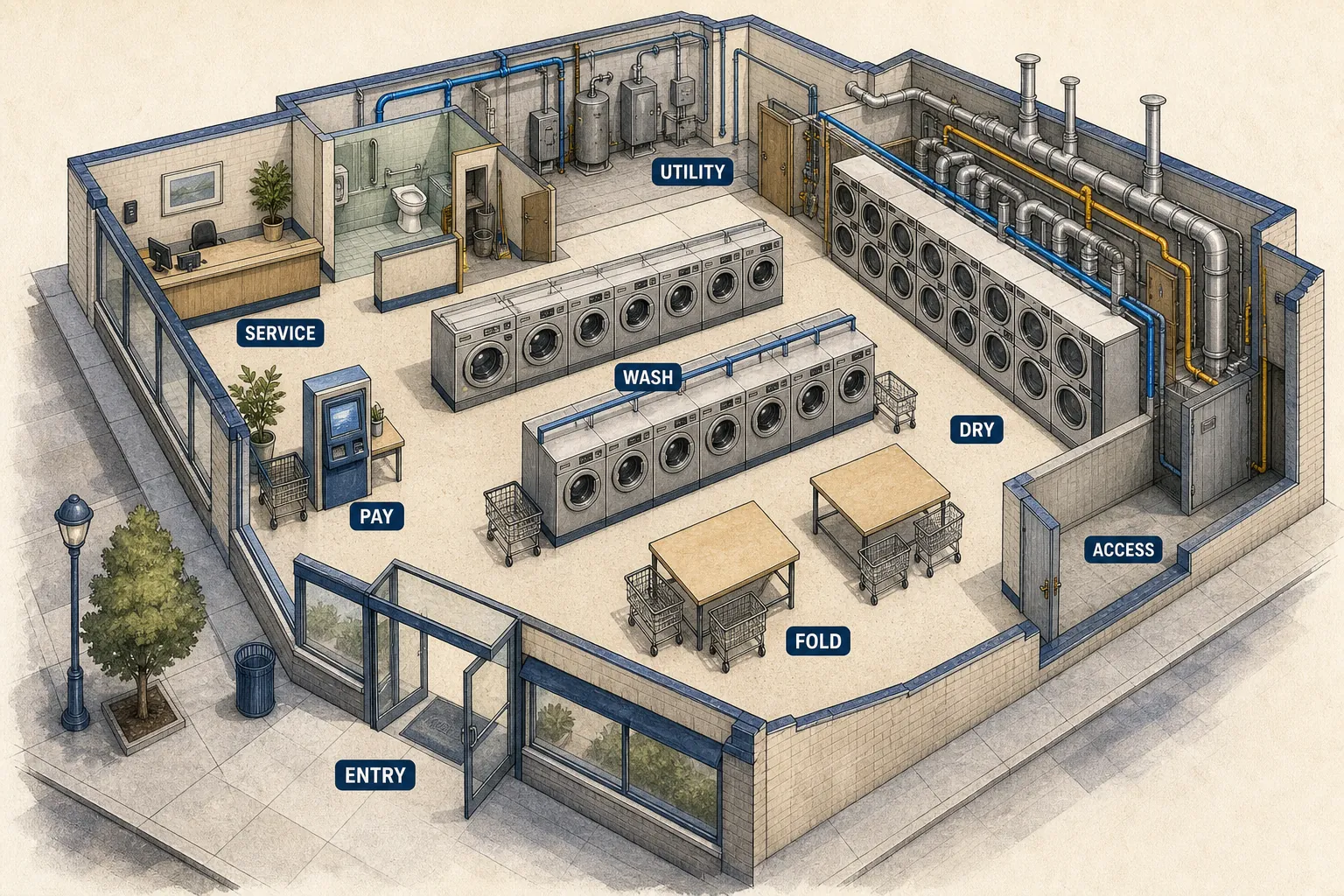
What should the machine schedule specify?
List each washer and dryer by model, capacity, count and location. For each item record water connections, drain demand, gas or electric load, exhaust, make-up air, clearances, anchoring and service access. Use the exact manufacturer manual for the proposed model rather than a generic machine count.
Map customer entry, accessible movement, carts, folding, payment, restroom, attendant work and emergency access. A floor plan can fit machine rectangles while leaving no credible service aisle, dryer exhaust route or customer turning space.
How do you reconcile the site with the utility envelope?
Trace incoming water pressure and pipe sizes, hot-water production, drain and sewer capacity, gas meter and pressure, electrical service and panels, dryer exhaust and make-up air, ventilation and structural support. Record the evidence, measured value, required value, assessor and unresolved difference.
Ask the serving utility and responsible authority about the actual address and proposed loads. A state average energy price provides context but does not identify the tariff, demand charge, sewer basis, impact fee or upgrade cost for one premise.
What must the lease and quote settle?
Assign every upgrade to the landlord or tenant and identify ownership, access and removal rights for installed infrastructure. Tie commencement, rent, deposit and equipment orders to the approvals and capacity confirmations that could still make the site unusable.
Compare equipment bids on delivered and commissioned scope: machines, freight, foundations, utility trunks, permits, taxes, payment integration, testing, training and warranty response. An attractive equipment price can leave the largest site work unpriced.
One utility matrix exposes the commitment that still cannot be priced
This authored example illustrates the record. The values are not a design and must be replaced with the selected machines and site survey.
| System | Proposed evidence | Decision status |
|---|---|---|
| Water supply | Exact washer schedule, manufacturer pressure and connection requirements | Utility and plumber must confirm available service |
| Drain and sewer | Combined discharge route, receptor and local capacity review | Unresolved; do not treat fit-out allowance as a quote |
| Gas and exhaust | Dryer input, meter pressure, exhaust length and make-up air | Mechanical design and utility answer required |
| Electrical | Machine, payment, lighting and support loads by panel | Electrician to reconcile service and panels |
| Structure and access | Anchoring, slab, service aisles and accessible customer route | Measured plan required before order |
| Lease allocation | Owner of upgrades, work access, commencement and restoration | Make the next payment conditional on written terms |
What this changes: The site remains provisional while the drain and sewer route is unresolved. A lower rent or a complete equipment quote does not remove that dependency.
Illustrative amounts are rounded for display. Use the full inputs and stated units when recalculating; an approximate threshold is not itself a sufficient activity prescription.
Complete your decision record
A site utility matrix, an installed-scope gap list and a lease condition tied to the unresolved technical work. Enter the finding or number, the source and the next action for each row. “Supported” records your assessment of that item; it does not approve the business or certify completed research.
| Item and what to record | Your finding and evidence | Status and next action |
|---|---|---|
| Machine scheduleModel, capacity, count, location and current manual | ||
| Water and hot waterAvailable and required pressure, flow, pipe, heater and shutoff | ||
| Drain and sewerDischarge, receptor, pipe, capacity, charges and authority answer | ||
| Gas, exhaust and make-up airLoads, meter, pressure, route, clearances and design responsibility | ||
| Electrical, structure and accessService, panels, slab, anchoring, maintenance and accessibility | ||
| Lease and installed quoteResponsibility, timing, exclusions, conditions and next commitment |
6 items have no evidence recorded yet.
Entries are temporary and are not sent to us or saved automatically. Download your completed work before leaving or refreshing this page.
Choose your next action
| If your finding is… | Your next action |
|---|---|
| A required service or discharge route is unconfirmed | Keep the site provisional and make dependent payments conditional on a written answer. |
| The quote omits utility trunks or commissioning | Add comparable installed scope before choosing the supplier. |
| The layout blocks maintenance or accessible circulation | Revise the machine mix or premises before treating nominal capacity as usable. |
Errors that can change the result
- Assuming a former laundromat can support a new machine schedule.
- Using a state energy average as the address tariff.
- Signing the lease before assigning major utility upgrades and opening-delay risk.
Apply this to your business
These operating formats match the decisions in this guide.
Laundromat
Attended 2,400-square-foot self-service laundromat with 36 washers and paired gas-dryer capacity
Open the operating guide and state profiles →Carry the confirmed installed scope, timing and utility costs into the opening cash plan. Values entered here are not automatically transferred to another calculator.
Continue with the next part of your plan
- How many washer turns per day does a laundromat need?
A washer-turn break-even calculation, a machine-size observation log and a downside decision.
- What to check before committing to business premises
A comparable premises cost summary and a list of conditions to resolve before the next commitment.
- How to compare equipment quotes and build the opening budget
A comparable two-quote cost calculation and a supplier commitment record.
Sources and limits
The sources below provide the stated background. The worked examples, calculator defaults and decision exercises are authored teaching material. They do not establish market prices, local demand, legal applicability or completed state research.
- Alliance Laundry Systems: washer-extractor installation manual
Manufacturer installation requirements and example water, drain, electrical, clearance and foundation specifications.
- Alliance Laundry Systems: stacked tumble-dryer installation manual
Manufacturer installation requirements and example gas, exhaust, clearance and make-up-air specifications.
- U.S. Energy Information Administration: commercial electricity prices
Current state and national commercial electricity context; the rate for an address must come from the serving utility and tariff.
- IRS: state government websites
Starting links to state offices.
Source background and its scope are stated above. The guide update date does not change a source observation period. Research and review standards · Report an issue
When you need a longer financial plan
Use a financial model to organize a broader forecast after defining your own operating assumptions. The site’s research, your worksheet entries and any purchased workbook are separate; entries are not transferred automatically.