
How to plan service bays, parts delays, warranty work, and rework
Start with two paid technicians and three usable bays, then schedule complete blocks for intake, inspection and diagnosis, customer authorization, parts confirmation, repair, quality control, documentation, vehicle handoff, cleanup, equipment maintenance, ordinary downtime, and warranty or rework recovery. A vehicle is ready for a productive bay only when its scope, authorization, parts, technician, bay, lift, tools, safety controls, and handling requirements are resolved.
What you will produce: A weekly technician-and-bay board, repair-order readiness check, sold-hour and clock-hour reconciliation, parts and core record, vehicle-flow plan, quality-control record, warranty and rework ledger, and conditional decision about price, accepted scope, staffing, equipment, parts policy, or premises commitment.
Updated September 28, 2026 · Worked examples and editable worksheets
What to have ready
Bring technician schedules and pay terms, bay and lift availability, vehicle and service scope, completed repair orders, sold and clock hours, bay dwell, diagnosis and authorization times, parts orders and returns, supplier lead times, cores, sublet work, quality-control results, warranty and rework by original order, equipment maintenance, vehicle storage, and ordinary downtime.
Work through the calculation and decision
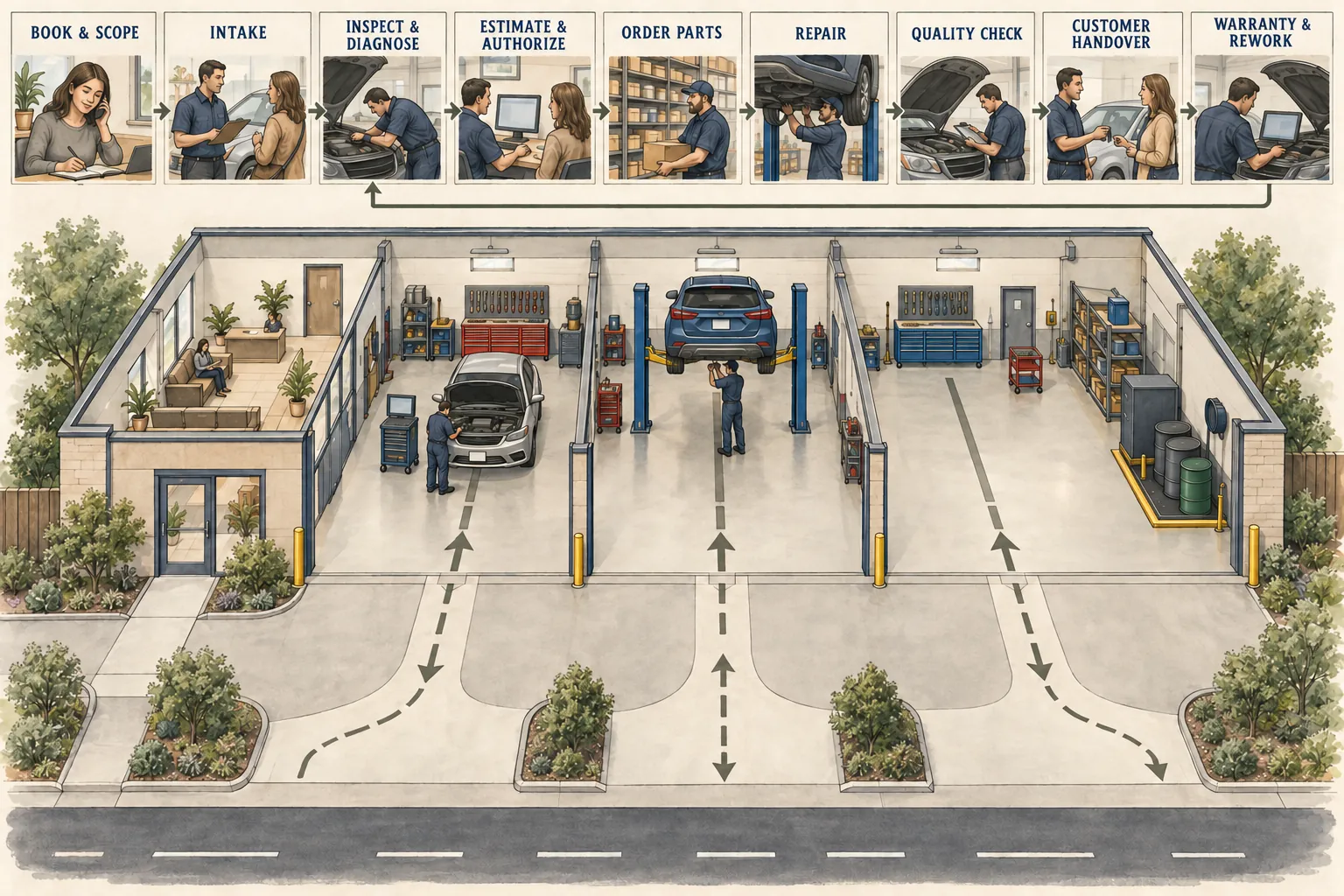
How should two technicians and three bays be scheduled?
Build a continuous status path for each repair order: intake, inspection, diagnosis, estimate, authorization, parts ready, repair, quality control, documentation, handoff, cleanup, and release. Show the technician, bay, lift, tools, and vehicle status for each block.
Do not assign a technician, bay, lift, scan tool, or other required resource to simultaneous work. Protect diagnosis, overrun, equipment downtime, and rework rather than filling every visible minute. A vehicle parked in a bay while waiting for parts is occupied space, not automatically productive capacity.
How should parts and customer authorization enter readiness?
Record the approved operations, estimate limit, customer decision, ordered parts, promised and received dates, fit verification, freight, cores, returns, supplier credits, and any sublet dependency. Move the vehicle only through the documented process that protects it and the customer’s authorization.
A scheduled appointment without approved scope, available parts, a qualified technician, a suitable bay or lift, tools, safe handling, and required facility conditions is not deliverable repair capacity. Record every delay cause so quoting, ordering, staging, and scheduling change the actual constraint.
How should warranty work, comebacks, and quality control be managed?
Link each return to the original repair order, complaint, diagnosis, cause, prior operation, technician, parts, supplier or manufacturer recovery, paid time, bay-hours, refund or credit, customer outcome, and closure. Keep the event out of new-sales counts and include its time in the technician and bay reconciliation.
Review supported causes such as diagnosis, authorization, parts defect or fit, installation, torque or adjustment, contamination, documentation, quality control, customer communication, or another recorded category. Change the intake, diagnosis, parts, repair, verification, training, or handoff step that can prevent recurrence.
The reference schedule uses 311.60 of 346.67 paid technician-hours at 110 completed orders
The authored schedule holds two full-time paid technicians, three nominal bays, 110 completed repair orders, nonbillable technician time, and no-charge rework. It is a capacity scenario, not an observed shop benchmark; parts-delay bay-hours and equipment downtime remain direct records for the selected shop.
| Schedule measure | Calculation | Reference |
|---|---|---|
| Paid technician-hours | Two full-time paid technicians | 346.67 hours |
| Direct technician-hours | 110 orders × 2.50 hours | 275.00 hours |
| Nonbillable technician-hours | Training, meetings, documentation, cleanup, maintenance, and idle time | 30.00 hours |
| No-charge rework technician-hours | 4.40 entered events × 1.50 hours | 6.60 hours |
| Technician hours used | 275.00 + 30.00 + 6.60 | 311.60 hours |
| Technician-hour headroom | 346.67 − 311.60 | 35.07 hours |
| Nominal available bay-hours | Three-bay monthly planning schedule | 528.00 hours |
| Occupied bay-hours at the base volume | 110 orders × 3.20 hours | 352.00 hours |
| Unallocated nominal bay-hours | 528.00 − 352.00 before direct parts-delay and downtime records | 176.00 hours |
| Entered management ceiling | Research-bound conservative ceiling | 122 orders |
| Technician use at the ceiling | 305.00 direct + 30.00 nonbillable + 7.32 rework | 342.32 hours |
| Bay use at the ceiling | 122 × 3.20 entered bay-hours | 390.40 hours |
What this changes: The entered base plan leaves 35.07 technician-hours, while nominal bay-hours leave more room. The 122-order ceiling remains an authored management boundary; actual parts waiting, blocked bays, equipment downtime, authorization delay, technician efficiency, and rework can reduce it.
Complete your decision record
A weekly technician-and-bay board, repair-order readiness check, sold-hour and clock-hour reconciliation, parts and core record, vehicle-flow plan, quality-control record, warranty and rework ledger, and conditional decision about price, accepted scope, staffing, equipment, parts policy, or premises commitment. Enter the finding or number, the source and the next action for each row. “Supported” records your assessment of that item; it does not approve the business or certify completed research.
| Item and what to record | Your finding and evidence | Status and next action |
|---|---|---|
| Scope and authorizationCustomer, vehicle, complaint, inspection, diagnosis, estimate, approved operations, limit, declined work, warranty terms, and customer decision | ||
| Parts readinessPart, supplier, order and promised date, received and fit confirmation, cost, freight, core, return, credit, sublet dependency, and vehicle status | ||
| Technician and bay blockDate, technician, bay or lift, operation, planned and actual clock time, sold time, delay cause, quality-control step, equipment downtime, and released capacity | ||
| Warranty or reworkOriginal repair order, complaint, diagnosis, cause, technician-hours, bay-hours, replacement parts, supplier recovery, refund or credit, customer outcome, and closure | ||
| DecisionKeep, move, decline, rescope, or reprice work; revise parts policy, authorization, bay flow, equipment, quality control, or staffing plan |
5 items have no evidence recorded yet.
Entries are temporary and are not sent to us or saved automatically. Download your completed work before leaving or refreshing this page.
Choose your next action
| If your finding is… | Your next action |
|---|---|
| The board overlaps a technician, bay, lift, or required tool | Move or decline work, change the scope or schedule, or add supported capacity before promising the slot. |
| Authorization, parts, vehicle storage, or handling conditions are unresolved | Keep the order in the correct readiness status and use the applicable authorization or change process instead of consuming a productive repair block. |
| Warranty and rework exceed the protected recovery window | Reduce new-work promises and correct the supported recurring cause before expanding accepted scope or volume. |
Errors that can change the result
- Treating every paid technician-hour or open bay-hour as sellable repair capacity.
- Using a labor guide time without reconciling actual clock time, diagnosis, parts readiness, bay dwell, and quality control.
- Counting a warranty return, comeback, refund, supplier recovery, or repeat repair as another completed order.
Apply this to your business
These operating formats match the decisions in this guide.
Auto Repair Shop
Independent three-bay general automotive repair shop with two full-time paid automotive service technicians plus one full-time paid owner-manager/service-advisor replacement-cost role, ordinary diagnostic and mechanical-repair equipment, and a defined passenger-car and light-truck scope
Open the operating guide and state profiles →Carry the readiness record, technician-and-bay schedule, parts controls, warranty and rework findings, and released capacity into the price and opening-cash decision. Values entered here are not automatically transferred to another calculator.
Continue with the next part of your plan
- How many sold technician hours does an auto repair shop need to break even?
Labor revenue, parts revenue, contribution per repair order, three labeled monthly results, break-even repair orders and sold hours for each boundary, technician-hour gap, bay-hour gap, lower physical capacity, and the signed gap between physical capacity and EBIT break-even.
- How to compare equipment quotes and build the opening budget
A comparable two-quote cost calculation and a supplier commitment record.
- How to build a staffing roster before estimating payroll
A roster with complete task coverage and an annualized monthly staffing budget.
- How to build a 13-week cash plan for your first 90 days
A weekly cash schedule, the lowest balance and the extra funding needed to retain your chosen minimum.
- How to turn a state business profile into a local opening plan
A local evidence register showing which decisions are supported and what must be resolved next.
Sources and limits
The sources below provide the stated background. The worked examples, calculator defaults and decision exercises are authored teaching material. They do not establish market prices, local demand, legal applicability or completed state research.
- U.S. Census Bureau: 2022 NAICS 811111 General Automotive Repair
Official industry definition. It includes employer shops of many sizes and service mixes and does not establish local demand, a repair-order ticket, startup cost or three-bay profitability.
- BLS May 2025 Occupational Employment and Wage Estimates
Cross-industry wage anchors for automotive technicians and first-line repair supervisors. They are not recruiting quotes, flat-rate plans, owner draws or complete employer costs.
- EPA: managing used oil for businesses
Federal used-oil handling background. State and local rules, the selected waste stream, customer authorization, specialty work and vendor pricing still require exact checks.
- Auto Repair Shop reference economics and definitions
The site-authored three-bay scenario and its disclosed assumptions; it is not observed national or local performance.
Source pages checked September 28, 2026. Research and review standards · Report an issue
When you need a longer financial plan
Use a financial model to organize a broader forecast after defining your own operating assumptions. The site’s research, your worksheet entries and any purchased workbook are separate; entries are not transferred automatically.