Define the academic service, confirm the leased address and fund competent paid instruction plus every nonteaching duty. The national scenario assumes 80 billable student-month equivalents × eight completed one-hour student sessions at $36 net tuition. Those 640 sessions earn $23,040, leaving approximately $946 mature EBIT and $1,380 cash after capital maintenance. Modeled opening funding is approximately $156,311. The complete ramp permits 82 whole equivalents under the assumed resource clocks; 77 is sufficient for EBIT. Student-month equivalents are service units, not a count of children, and all commercial and workload values remain assumptions to validate.
Can completed instruction cover the complete paid timetable?
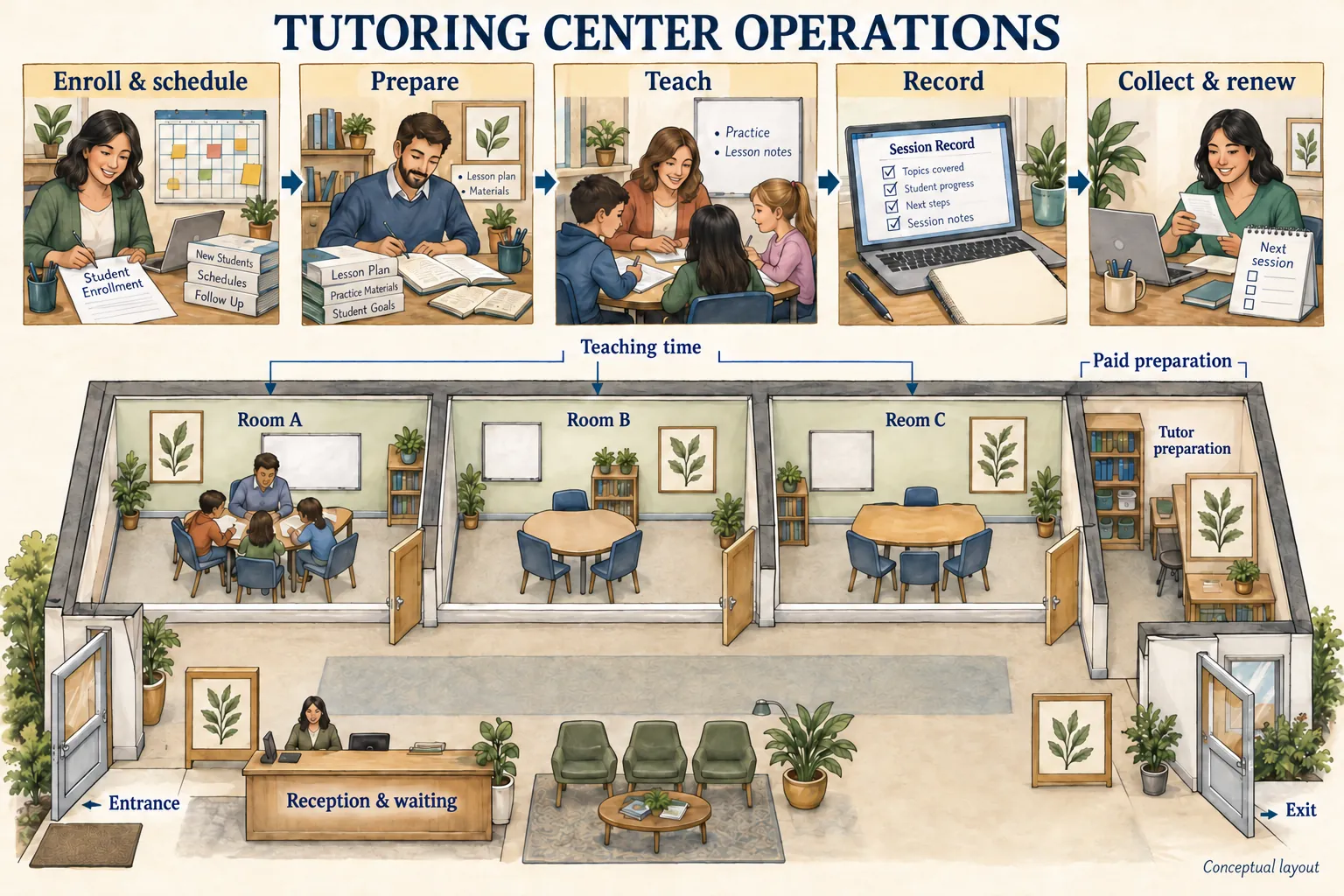
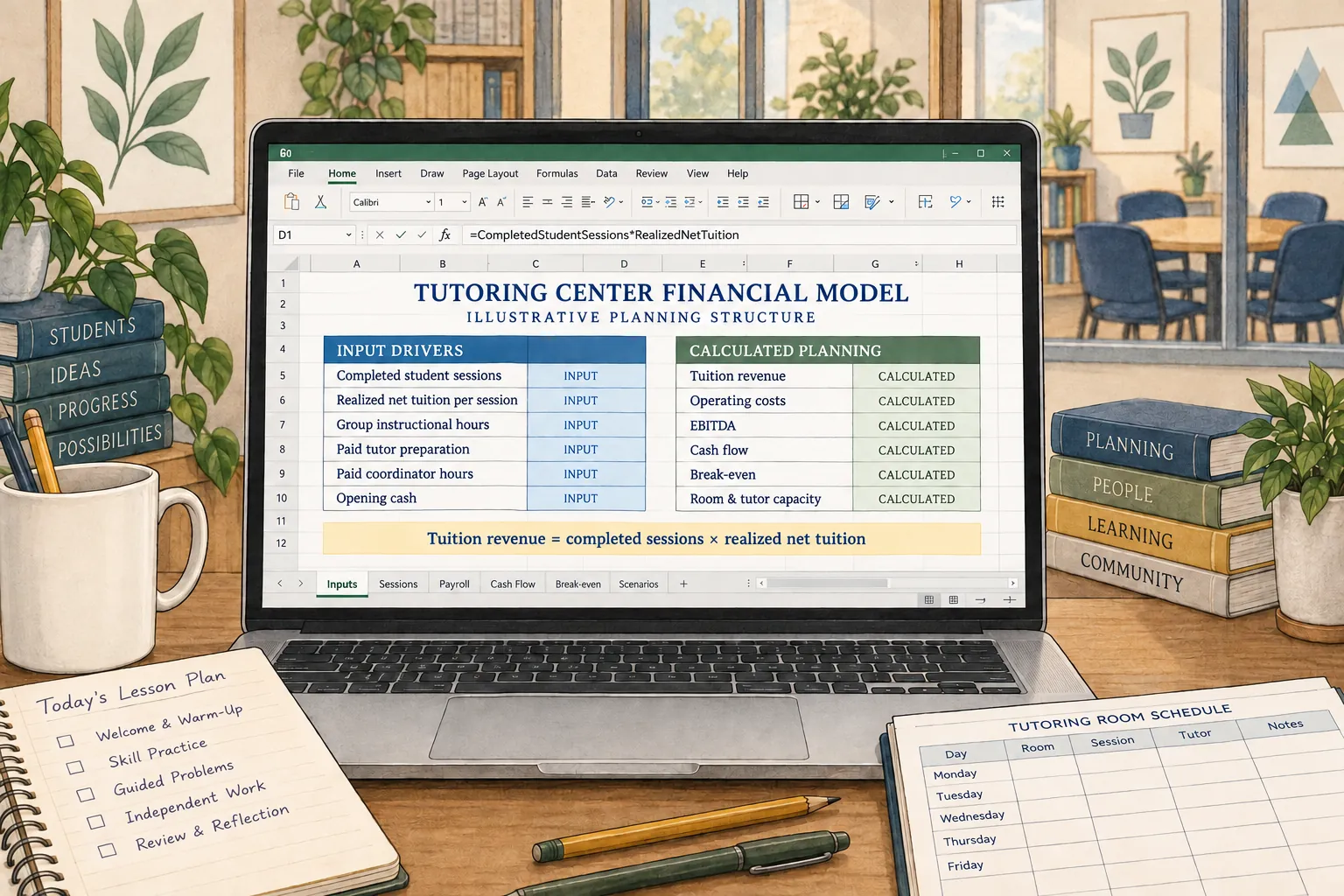
Start from what a learner actually receives. Tuition is earned from completed student sessions. Group blocks use the room and tutor once, then add paid preparation, unearned teaching, enrollment, family coordination and expected recovery. A booking, package payment or retained enrollment is a different record.
At 640 completed student sessions, the reference produces $23,040 earned tuition, $1,780 EBITDA, $946 depreciation-inclusive EBIT and $1,380 mature cash after maintenance. The first twelve planning months use $18,841 operating cash. These distinct boundaries exclude financing, income taxes and additional owner distributions.
Separate held-constant tests of the academic-tutoring reference
Test
Defined change
Mature EBIT
Mature cash after maintenance
Reference
80 equivalents × 8 completed sessions at $36
$946
$1,380
20% fewer earned student sessions
64 equivalents; 512 completed sessions; same paid roster
-$3,293
-$2,860
10% higher wage benchmarks
1.10 × the three wage anchors; employer share held at 18%
-$345
$88
20% higher premises cost
$4,800 monthly premises allowance
$146
$580
10% lower realized tuition
$32.40 per completed session; same activity and paid costs
-$1,173
-$740
Higher employer-cost condition
30% above the same base wages, replacing the assumed 18%
-$367
$66
Of the three proportional activity/wage/premises tests, 20% fewer earned student sessions has the largest EBIT effect (-$4,239). That comparison follows the declared test sizes, not measured probabilities. A 10% reduction in realized tuition changes mature cash to -$740; an actual employer-cost quote can also change the narrow margin.
At the same realized tuition and complete paid costs, the continuous EBIT threshold is approximately 76.428 student-month equivalents. At whole-equivalent resolution, 77 × eight = 616 completed student sessions produces nonnegative EBIT and fits the disclosed resource plan; 76 does not cover EBIT. The cash-after-maintenance threshold is approximately 74.7925 equivalents; 75 is sufficient and the prior whole increment fails. These are service-volume conditions, requiring an actual feasible timetable and paid attendance.
Holding 640 completed sessions and the paid roster fixed, the continuous net session rate required for EBIT is approximately $34.39. A $34.40 rate produces nonnegative EBIT at cent resolution; the prior cent does not. A provider asking price is neither this achieved yield nor evidence of completed demand.
One full-ramp capacity test at the 82-equivalent conditional ceiling
Limiting resource
Available per month
Largest workload at the ceiling
Binding planning month
Usable instructional room-hours, including unearned teaching blocks
264 room-hours / month
240.9 room-hours / month
7
Paid tutor person-hours, including preparation, onboarding and activity-linked recovery
330 person-hours / month
328.1776 person-hours / month
7
Paid family coordination and collection person-hours
86.6667 person-hours / month
76.5472 person-hours / month
7
Paid management person-hours
43.3333 person-hours / month
37.3184 person-hours / month
7
The default needs 214 whole earned group blocks, 21.4 expected unearned teaching hours, 58.85 paid preparation hours and 5.35 expected tutor recovery hours. Add 6.4 replacement student equivalents and 12 standing tutor hours to obtain 318 mature tutor hours. Month 7 adds growth as well as replacements, raising tutor work to 320.944 hours. At the 82-equivalent full-ramp ceiling, tutor work reaches 328.1776 of 330 hours; the next whole target equivalent reaches 332.4944 and fails. Checking only the mature month would wrongly permit 83.
Lower group fill can break delivery without changing tuition arithmetic. At two target students per group, the same 640 sessions require 320 earned blocks and 352 room-hours, exceeding 264. The unchanged paid plan permits only 55 whole target equivalents across the ramp. Do not prescribe more enrollment to repair a shortfall that cannot fit the room-and-tutor calendar.
Opening payments of $89,825, the deepest cumulative operating deficit of $27,652 in month 5, and the retained two-month standing-cost buffer of $38,834 add to approximately $156,311 funding. The refundable deposit uses cash without becoming a monthly expense. The reference does not sustainably recover its opening payments within 60 planning months.
The target group fill, unearned hours, churn, onboarding and recovery rates are authored assumptions. Every pupil, whole block, group match, room, tutor, parent handover and actual missed block needs a dated timetable. Subject/grade compatibility, tutor competence, breaks, safeguarding response and peak family availability can reduce the conditional ceiling. Advance tuition, unused sessions, credits and refunds remain obligations; the default receives no advance-funded opening cash.
Calculations and downloads retain full precision; displayed whole-dollar totals are independently rounded. Approximate thresholds are estimates. Explicit sufficient activity and price conditions are checked before currency rounding and against the prior permitted increment. Month-end balances do not establish the largest daily cash need.
Observed offers and planning choices
What do actual tutoring offers support?
The case assumes $36 realized net per completed 60-minute student session, with eight earned sessions per billable student-month equivalent. That is $288 earned tuition per equivalent, after concessions, refunds and expected collection losses, before the separate 8% variable-cost allowance. The observed offers below use different products and billing units. None establishes the center’s achieved net price, retained enrollment or paid demand.
Named advertised offers retrieved October 8, 2026; units and products differ
1.5 class hours weekly; four to six students per group. Provider lists 5805 Coit Road, Suite 403, Plano.
Specialist abacus, different group size and hours; page title says online while physical addresses appear. Confirm delivery. No general academic price or achieved net yield.
$80/student/hour one-hour K–12 general academic small-group session
Weekly hour-long groups of two to four same-grade, similar-level students. Attended sessions charged weekly to card; 24-hour notice avoids the stated full cancellation charge.
Advertised terms, not achieved collections, retained enrollment or a new center price. Individual general academic support at $135/hour is a distinct service.
Smith Street Workshop provides the closest unit comparison: $80 per student per hour for general academic K–12 groups of two to four same-grade, similar-level students. Its attended-session weekly billing and 24-hour cancellation terms describe its contract. The planning case counts only completed instruction as earned tuition and funds expected unearned teaching time separately. A cancellation charge or prepaid membership does not become an extra completed session. Smith Street Workshop: All Subjects tutoring and pricing.
The Laguna Niguel offer is a monthly math membership with two sessions each week; the captured enrollment page supplies no session duration. The Plano offer is a specialist abacus program with larger groups and a different weekly time allowance, and delivery requires confirmation. Dividing either monthly price by eight or treating them as hourly academic prices would change the sourced product. No advertised offer replaces the $36 input.
Which opening and recurring components are actually priced?
The $80,000 opening allowance and $4,000 monthly premises allowance are authored amounts for the stated three-room plan. Obtain an accepted use, landlord terms and installed quotations for acoustic separation, accessible circulation, fire/egress, furniture, equipment and records systems. The direct Brother printer offer displays $229.99 for one monochrome print-only printer with its listed in-box toner and drum; the Lakeshore rectangular table line displays $299–$379, with chairs sold separately. Neither includes a complete room fit-out, tax, freight or installation, and the table page does not support a selected-size price.
For one recurring component, TutorBird advertises $16.95/month plus $4.95 for each additional tutor or staff account. The owner counts as an account. This is a software component, not evidence for the complete $2,500 other-cost allowance or payment-processing rate.
What does paid teaching cost include?
The wage anchors are May 2025 cross-industry hourly medians: $20.84 for Tutors (25-3041), $21.53 for Customer Service Representatives (43-4051) and $50.85 for General and Operations Managers (11-1021). Family coordination and management use broad duty proxies; staffing hours and the 18% employer addition remain assumptions. U.S. Bureau of Labor Statistics: May 2025 Occupational Employment and Wage Statistics tables. Job-related required work must be budgeted across instruction, preparation, onboarding, records, recovery and training. The federal training exclusion has four conditions and is not an automatic exemption for tutors. U.S. Department of Labor: FLSA Hours Worked Advisor: training.
IRS employer Social Security and Medicare rates supply only part of employer cost; the full addition also depends on unemployment, insurance, leave, benefits and the actual worker plan. Internal Revenue Service: Publication 15 (2026), Employer's Tax Guide. For broad context, June 2026 BLS service-provider establishments with 1–49 workers report $9.42 benefits for $27.39 wages per hour. Dividing benefits by wages gives approximately 34.39%; the table’s 25.6% uses total compensation as its denominator. Holding every other national input fixed, applying that broad ratio calculates mature cash after maintenance of -$414.61. It is a sensitivity, not a tutoring-center benefit quote. U.S. Bureau of Labor Statistics: Employer Costs for Employee Compensation, Table 6.
Which planning assumption reverses the result?
At the default 640 completed student sessions, earned tuition is $23,040/month, mature EBIT is $946.44, and cash after capital maintenance is $1,379.77, before financing, income tax and distributions. Reducing assumed realized net yield to $30 with all costs and completed sessions fixed calculates -$2,153.03 monthly cash. The whole-equivalent EBIT condition rises to 92, above the assumed 82-equivalent all-ramp capacity. A larger enrollment target cannot fix that result within this paid-resource plan.
One Fayetteville operator describes 60-minute math sessions and 3:1 or 4:1 groups. That observation supports a real format example, not a legal or safe staffing limit or the planning case’s achieved fill of three. Match grades, needs, competencies and the dated timetable before treating a monthly average as deliverable.
Offers were checked October 8, 2026. The supplied sources do not quote a complete independent center opening or establish student demand. Use the calculator to replace the disclosed assumptions with a matched lease, paid roster, collection terms and tested enrollment plan.
What the customer buys and what makes the business repeatable.
The customer purchases defined academic instruction for a named learner. The earning unit is one completed student session of the stated length. A group block can deliver a session to several compatible learners while using one tutor and one room; student sessions and group blocks are not the same unit. An inquiry, assessment, booked place, monthly enrollment or advance package payment is a separate record.
Regular attendance can support recurring tuition, but retention alone does not prove sessions delivered or collected contribution. Grade/subject changes, school holidays, family schedules, withdrawals, absence credits, makeups and collection losses change the earned mix. Measure distinct learners and completed sessions separately, with the stated renewal and refund terms.
The format on this site: Leased neighborhood small-group academic tutoring center for school-age students, with paid tutors, family coordination and management. Childcare or custodial after-school supervision, preschool, camps, meals, transport, special-education or clinical services, outcome guarantees, test-preparation packages, online or in-home tutoring, franchise royalties, school contracts, multiple branches, property purchase, major structural conversion and unpaid owner work are outside this academic small-group reference. A different service scope needs its own authority, staffing, room schedule and financial case.
Choose the format before choosing a budget.
Different formats need different operating plans
Format
What changes
How to use it
Leased small-group academic tutoring
School-age learners, defined academic scope, competent paid tutors, group instruction and paid family coordination
One learner per instructional block and a different realized rate, skill scope and paid timetable
Rebuild group-fill, preparation and price assumptions; a premium individual offer does not validate small-group yield.
Online or in-home tutoring
Digital access or travel, different premises, scheduling, supervision and privacy scope
Do not reuse the three-room lease or fixed-site capacity case.
Childcare, camps or specialized educational/clinical services
Different custody, authority, qualifications, facilities, hours and accepted responsibilities
Establish the actual service boundary and model it separately; the tutoring label does not settle legal applicability.
A founder prepared to manage consistent academic scope, competent tutors, compatible learner groups, paid planning time, parent trust, attendance and tuition records, staff coverage and refund obligations.
Understand the reference operating plan.
The figures below are a national wage reference scenario. The paid roster uses May 2025 BLS national occupational medians. Prices, customer volume, rent, equipment and other commercial inputs are authored assumptions. This is not a researched average startup cost, owner-income promise or a funding recommendation.
One defined format · monthly amounts before financing and income taxes
Input or result
Reference
What to verify
Completed sales units
80 billable student-month equivalents / month
80 billable student-month equivalents per month; demand requires evidence.
Realized net tuition per student-month equivalent (eight completed sessions)
$288.00
Build and test a relevant local menu, package or contract scope.
Revenue
$23,040
Calculated volume × price, not observed sales.
Paid payroll
$12,917 / month
National wage medians × the stated hours × the 18% employer allowance.
Opening payments
$89,825
Authored equipment and setup allowances, deposit and paid training.
One tutor and room per block; actual group compatibility and attendance still need a timetable
Scheduled but unearned teaching
10% × 214 earned group hours = 21.4 expected hours
Consumes room time, paid instruction and preparation without adding tuition
The $36 realized session rate, eight completed sessions, target fill of three and expected unearned hours are assumptions. Advertised monthly or group offers retain their own duration, calendar, age/subject, group, enrollment-fee and cancellation terms. They do not establish this center’s achieved net tuition or attendance. Whole actual sessions, missed blocks and peak tutor/room assignments must fit a dated timetable.
The teaching scenario has three usable instructional rooms, 22 teaching days and four bookable hours per room per day, providing 264 room-hours per month. Reception, waiting, circulation and private records space are outside sale capacity. Eight completed one-hour sessions per billable student-month equivalent and a target fill of three students require 214 whole earned group blocks at the 80-equivalent default. An additional 10% of earned group hours remains scheduled without earned tuition; those hours still consume rooms, tutor time and preparation. Tutor work also includes 12 fixed hours, preparation at 0.25 hour per scheduled teaching hour, expected recovery on 5% of earned blocks at 0.5 hour per exception, and one hour per new or replacement student equivalent. Mature tutor work is 318 of 330 paid person-hours. Growth plus replacements raises it to 320.944 in month 7. The full-ramp conditional ceiling is 82 whole equivalents: month-7 tutor work is 328.1776 hours; the next equivalent needs 332.4944 hours and fails. Room, family coordination and management clocks are also checked for every month. Student-month equivalents and expected missed-block/recovery hours are modeling units; actual pupils, whole sessions, age/skill groups, peak room assignments, staff competence and a dated timetable can impose a lower limit. Three is an authored target fill, not a legal or educational-quality ratio.
The assumed 8% of earned tuition consists of 5% instructional materials and use-driven supplies plus 3% payment costs. Realized tuition already reflects concessions, refunds and expected collection losses; those are not deducted again. Tutors and all preparation, enrollment and recovery hours remain in paid payroll rather than another labor percentage. The $2,500 monthly standing allowance comprises $450 utilities, $400 insurance, $650 recurring marketing, $350 scheduling/records/communications, $300 cleaning and standing supplies, and $350 professional/administrative support. The $4,000 premises allowance and $400 capital-maintenance cash are separate. Obtain matched address, insurance, software/privacy, curriculum and installed-scope quotes; prevent overlap between standing supplies and the use-driven materials share.
May 2025 BLS Tutors, Customer Service Representatives and General and Operations Managers medians anchor the stated paid duties. The tutor pool pays 330 monthly person-hours; family coordination pays 20 weekly hours × 52/12 = 86.6667 monthly hours; management pays ten weekly hours × 52/12 = 43.3333 monthly hours. Coordination and management do not add simultaneous teaching capacity. The management occupation is a broad replacement-cost proxy, not proof of a tutoring director hiring rate or qualification. The 18% employer addition and the work rates are assumptions. Paid pools must become lawful individual shifts with preparation, training, breaks and applicable overtime; occupation medians are neither hiring quotes nor legal wage floors.
The national wage scenario models approximately $89,825 opening payments: $80,000 authored setup allowances, an $8,000 refundable premises deposit and approximately $1,825 paid training. The deepest cumulative operating cash deficit is approximately $27,652 in month 5, and the two-month standing-cost buffer is approximately $38,834. Those components total approximately $156,311 modeled funding. These are scenario values rather than a lease, construction quote or funding recommendation.
Recognize tuition only for instruction earned under the customer terms and accounting policy. An assessment booking, inquiry, retained enrollment, advance tuition payment, unused session package or refundable deposit is not another completed student session. Keep future instruction, rescheduling, credits, withdrawals, refunds, card settlement, receivables and tax collected in separate dated records. The default assumes same-period collection and no customer-advance funding. Month-end cash can miss a larger daily payroll or premises gap; debt, income taxes and owner distributions need their own schedules.
A positive reference EBIT depends on the assumed paid sales volume and costs. It does not establish local demand or cash available for owner withdrawals.
Make completed instruction fit the complete paid timetable
Interpretation of the national reference format
The lease decision should follow completed paid tutoring that can be delivered by competent staff in compatible whole groups. A pupil count or a package payment can conceal missed instruction, unmatched peak availability, unpaid preparation and future refund exposure.
The National wage scenario produces approximately $946 mature monthly EBIT from 640 assumed completed student sessions at $36 net tuition. The continuous EBIT threshold is approximately 76.43 student-month equivalents, with eight completed sessions per equivalent. At whole-equivalent resolution, 77 is sufficient for EBIT and fits the disclosed all-ramp resource test; the prior whole increment does not cover EBIT. At 20% fewer earned sessions, the same paid roster and realized tuition produce -$3,293 EBIT. Student-month equivalents are service units rather than actual child counts; wages are observations while demand, group fill and all commercial and workload values remain assumptions.
The authored national scenario has positive mature EBIT but a narrow tuition and capacity margin. Seventy-seven whole student-month equivalents are sufficient for EBIT at the stated completed-session yield; the all-ramp resource ceiling is 82. The first twelve months use cash, and opening payments are not recovered within 60 planning months. All commercial and workload values remain assumptions.
Rehearse a complete school-week timetable with actual learners, subjects/levels, rooms, tutors, preparation, enrollment, parent handovers and recovery. Compare realized net tuition and every paid role with the sufficient financial threshold before expanding the site or cohort.
Write subjects/grades, accepted learner needs, group matching, session duration, tutor competence, assessment/materials, communication, arrival/pickup responsibility, absence/makeup, withdrawal/refund and privacy terms.
Resolve the complete address and service scope
Verify permitted use, access/egress, occupancy, accessible layout, landlord/insurer acceptance and any childcare or other activity boundary against the exact operation. Quote the full installed scope and deposits.
Rehearse whole groups with paid staff
Place actual learners, competent tutors, rooms, arrival/pickup, breaks, preparation, enrollment assessments, parent communication and recovery in a dated timetable. Test partial group fill and whole missed blocks.
Test completed earning and cash
Track repeated paid attendance, realized net tuition, credits/refunds, advances, earned revenue and actual collections. Fund setup, the ramp deficit and the retained buffer from dated commitments.
Your first evidence task: Reconcile one paid learner cohort to a complete school-week timetable: each completed student session, whole group blocks, room and tutor assignments, group fill, paid preparation/enrollment/coordination, missed and makeup instruction, parent responsibilities, refunds, advances and actual collections. A 10% fall in realized tuition makes the national mature cash result approximately negative $740 at the same service volume and paid costs.
What to measure in the first operating weeks.
A small operating dashboard
Measure
Why it changes a decision
Distinct learners and completed student sessions
Separates retained enrollment, scheduled instruction, actual attendance, packages, credits and earned tuition.
Whole group blocks, compatible fill and peak rooms
Reconciles learner needs and availability to real tutors, rooms, missed/makeup blocks and non-sale waiting/circulation.
Realized net tuition and collection
Shows concessions, refunds, credits, expected losses, earned receivables and the remaining future-session obligation.
Every paid instruction and nonteaching hour
Includes preparation, enrollment, parent communication, breaks, records, safeguarding response and expected recovery.
Withdrawals, incident action and dated unrestricted cash
Connects a changing cohort to future work, refunds, wages, deposits and the funds available before the next tuition collection.
Review actuals against the scope you priced. If an extra service, new trading hour or more distant client changes the work, update the roster and contribution calculation before expanding.
Prepare the right approval brief.
Bring the exact entity/address, academic subjects/grades, learner age and accepted needs, session length, maximum simultaneous people, custody and pickup responsibilities, room and waiting layout, access/egress/occupancy, tutor/staff duties and competence, safeguarding and escalation records, privacy/data practices, customer terms, deposits/refunds, individual shifts, insurance and landlord permission to the responsible planning/building/fire, education or childcare where applicable, labor, tax and employer offices and qualified advisers. Requirements follow the actual activity and jurisdiction; a broad industry code, provider price or state directory does not approve the center.
Pause the lease or additional enrollment when the actual permitted service and address are unresolved, learner groups or staff competence do not match the promise, a peak room or paid-role clock fails, completed tuition cannot cover the full roster, or advance tuition is being treated as unrestricted earned profit.
Write a response that changes the actual cause: narrower scope, a different site, revised paid staffing, a tested price or a delayed opening. A larger cash buffer only addresses a temporary timing gap.
Build a learner-to-group timetable, competent paid coverage, parent handover and incident records, and earned-tuition/refund ledger for a leased academic tutoring center.
Restaurant earns from completed paid guest covers at a realized meal check and is constrained by paid preparation, kitchen stations, service peaks and guest handling. Tutoring Center earns completed student sessions while whole group blocks, preparation, enrollment, family coordination and recovery use finite rooms and paid clocks. Compare fulfilled earning, complete paid work, customer obligations and dated cash in each format’s own unit.
Coffee Shop earns from completed counter orders at a realized drink-and-food basket and is constrained by ordering, beverage preparation and pickup during concentrated buying windows. Tutoring Center earns completed student sessions while whole group blocks, preparation, enrollment, family coordination and recovery use finite rooms and paid clocks. Compare fulfilled earning, complete paid work, customer obligations and dated cash in each format’s own unit.
Cleaning Business earns from fulfilled recurring cleaning-account months and is constrained by paid cleaner hours, travel, access, visit scope and recovery. Tutoring Center earns completed student sessions while whole group blocks, preparation, enrollment, family coordination and recovery use finite rooms and paid clocks. Compare fulfilled earning, complete paid work, customer obligations and dated cash in each format’s own unit.
Hair Salon earns from completed paid appointments at the realized service mix and is constrained by competent stylist time, preparation, chairs, service duration and cancellations. Tutoring Center earns completed student sessions while whole group blocks, preparation, enrollment, family coordination and recovery use finite rooms and paid clocks. Compare fulfilled earning, complete paid work, customer obligations and dated cash in each format’s own unit.
Auto Detailing Business earns from completed paid detailing packages for accepted vehicle conditions and is constrained by technician time, bays, water handling, drying, setup and rework. Tutoring Center earns completed student sessions while whole group blocks, preparation, enrollment, family coordination and recovery use finite rooms and paid clocks. Compare fulfilled earning, complete paid work, customer obligations and dated cash in each format’s own unit.
Laundromat earns from paid washer turns by machine size at realized cycle revenue and is constrained by usable machine cycles, utility/installed scope, attended coverage and maintenance. Tutoring Center earns completed student sessions while whole group blocks, preparation, enrollment, family coordination and recovery use finite rooms and paid clocks. Compare fulfilled earning, complete paid work, customer obligations and dated cash in each format’s own unit.
Daycare Center earns from paid child-weeks by the accepted age-room mix and is constrained by applicable room/age rules, qualified continuous coverage, director work and enrollment. Tutoring Center earns completed student sessions while whole group blocks, preparation, enrollment, family coordination and recovery use finite rooms and paid clocks. Compare fulfilled earning, complete paid work, customer obligations and dated cash in each format’s own unit.
Pet Grooming Salon earns from completed paid grooming appointments at the accepted service mix and is constrained by competent groomer/support time, baths, drying, tables, animal handoff and recovery. Tutoring Center earns completed student sessions while whole group blocks, preparation, enrollment, family coordination and recovery use finite rooms and paid clocks. Compare fulfilled earning, complete paid work, customer obligations and dated cash in each format’s own unit.
Landscaping Company earns from completed property-maintenance visits on a repeat route and is constrained by two paid crews, travel, weather, access, equipment and rework. Tutoring Center earns completed student sessions while whole group blocks, preparation, enrollment, family coordination and recovery use finite rooms and paid clocks. Compare fulfilled earning, complete paid work, customer obligations and dated cash in each format’s own unit.
Food Truck earns from completed paid orders within feasible service windows and is constrained by paid preparation, travel, commissary, service, stock and truck availability. Tutoring Center earns completed student sessions while whole group blocks, preparation, enrollment, family coordination and recovery use finite rooms and paid clocks. Compare fulfilled earning, complete paid work, customer obligations and dated cash in each format’s own unit.
Bakery earns from completed paid retail baskets from a feasible production and sell-through mix and is constrained by whole batches, paid production/counter work, freshness, waste and selling windows. Tutoring Center earns completed student sessions while whole group blocks, preparation, enrollment, family coordination and recovery use finite rooms and paid clocks. Compare fulfilled earning, complete paid work, customer obligations and dated cash in each format’s own unit.
Fitness Studio earns from retained billable member-months at realized net yield and is constrained by class access, competent paid instructors, rooms/equipment, churn and collections. Tutoring Center earns completed student sessions while whole group blocks, preparation, enrollment, family coordination and recovery use finite rooms and paid clocks. Compare fulfilled earning, complete paid work, customer obligations and dated cash in each format’s own unit.
HVAC Company earns from completed and collected residential HVAC service jobs and is constrained by qualified technicians, vehicles, diagnosis, parts, travel, authorization and callbacks. Tutoring Center earns completed student sessions while whole group blocks, preparation, enrollment, family coordination and recovery use finite rooms and paid clocks. Compare fulfilled earning, complete paid work, customer obligations and dated cash in each format’s own unit.
Moving Company earns from completed and collected household moving jobs and is constrained by paid crew/truck hours, travel, access, job scope and incident recovery. Tutoring Center earns completed student sessions while whole group blocks, preparation, enrollment, family coordination and recovery use finite rooms and paid clocks. Compare fulfilled earning, complete paid work, customer obligations and dated cash in each format’s own unit.
Auto Repair Shop earns from completed and collected repair orders at the realized work mix and is constrained by qualified technician clock-hours, sold hours, bays, parts, authorization and warranty recovery. Tutoring Center earns completed student sessions while whole group blocks, preparation, enrollment, family coordination and recovery use finite rooms and paid clocks. Compare fulfilled earning, complete paid work, customer obligations and dated cash in each format’s own unit.
Plumbing Company earns from completed and collected residential plumbing service jobs and is constrained by qualified plumbers, vehicles, materials, diagnosis, authorization, travel and rework. Tutoring Center earns completed student sessions while whole group blocks, preparation, enrollment, family coordination and recovery use finite rooms and paid clocks. Compare fulfilled earning, complete paid work, customer obligations and dated cash in each format’s own unit.
Electrical Contractor earns from completed and collected electrical service and small-alteration jobs and is constrained by qualified electricians, vehicles, sold-hour realization, materials, permits and rework. Tutoring Center earns completed student sessions while whole group blocks, preparation, enrollment, family coordination and recovery use finite rooms and paid clocks. Compare fulfilled earning, complete paid work, customer obligations and dated cash in each format’s own unit.
Pest Control Company earns from retained paid residential service-plan months and is constrained by qualified technicians, initial visits, scheduled obligations, travel, records and callbacks. Tutoring Center earns completed student sessions while whole group blocks, preparation, enrollment, family coordination and recovery use finite rooms and paid clocks. Compare fulfilled earning, complete paid work, customer obligations and dated cash in each format’s own unit.
Residential Remodeling Company earns from accepted delivered interior scope expressed as earned-project equivalents and is constrained by carpenter person-hours, management, customer decisions, authorized trades and rework. Tutoring Center earns completed student sessions while whole group blocks, preparation, enrollment, family coordination and recovery use finite rooms and paid clocks. Compare fulfilled earning, complete paid work, customer obligations and dated cash in each format’s own unit.
Self-Storage Facility earns from occupied unit-months by size at realized net rent and is constrained by whole rentable units, paid management/leasing/maintenance, access and response. Tutoring Center earns completed student sessions while whole group blocks, preparation, enrollment, family coordination and recovery use finite rooms and paid clocks. Compare fulfilled earning, complete paid work, customer obligations and dated cash in each format’s own unit.
Dog Daycare and Boarding earns from completed daycare dog-days and earned overnight dog-nights, with boarding including daytime care and is constrained by compatible peak dog groups, individual overnight places, complete day/night care, relief and recovery. Tutoring Center earns completed student sessions while whole group blocks, preparation, enrollment, family coordination and recovery use finite rooms and paid clocks. Compare fulfilled earning, complete paid work, customer obligations and dated cash in each format’s own unit.
Is one student session the same as one tutor hour?
No. A completed group block can serve several compatible learners. The model converts completed student sessions into whole earned blocks, then adds unearned teaching, paid preparation, enrollment and recovery.
Are 80 student-month equivalents 80 actual children?
No. An equivalent represents eight completed sessions in this case. Actual distinct learners and their dated attendance are separate records; partial service, irregular attendance and cohort timing can change the relationship.
Is three learners per group a legal or quality standard?
No. Three is an authored target fill. Learner needs, tutor competence, accepted service, local requirements, actual room layout and the timetable determine suitable groups.
Can I use a monthly provider offer as the session rate?
Only after checking duration, actual calendar, group size, location, included assessment/materials, absence/makeup and refund terms. An advertised rate is not achieved net tuition or proof of this center's demand.
Does advance tuition count as another month of earned revenue?
Future instruction and unused sessions remain separate obligations until earned under the applicable contract and accounting policy. Track withdrawals, credits, makeups and refunds alongside cash received.
Does the mature surplus recover the opening money?
The reference has positive mature cash after maintenance but uses cash during its ramp and does not sustainably recover opening payments within 60 planning months. Financing, tax, distributions and daily timing can change cash further.
Sorting compares one defined format. It does not rank states for attractiveness or prove demand. Funding includes opening payments, the deepest cumulative operating cash deficit in the 60-month model and the retained cash buffer.
Tutoring Center · same commercial assumptions, state occupational wage medians
State
Funding scenario
Loaded payroll / month
Approximate EBIT threshold billable student-month equivalents per month
Published research and calculations support business planning and education. They are not personalized financial, investment, tax or legal advice, and they do not guarantee costs, revenue, profit or financing. Estimates depend on the stated format, location, source periods and assumptions. Check the requirements and commitments that apply to your circumstances.