
How to control electrical dispatch, permits, inspections, and rework
Start with 346.67 paid monthly field hours for two electricians. Reserve 28 hours for training, stocking, calibration, and meetings, then schedule the complete work-order cycle and rework. The reference ledger uses 300.16 hours at 112 jobs and 346.33 hours at the entered 131-job ceiling. A booked window is not feasible merely because a calendar slot is open.
What you will produce: A dispatch-readiness record, complete field-hour schedule, vehicle and material plan, permit and authorization checkpoints, rework ledger, released-capacity decision and the next territory, scope, staffing, vehicle or promise-window test.
Updated September 30, 2026 · Worked examples and editable worksheets
What to have ready
Bring inquiry, estimate, authorization, dispatch, travel, access, diagnosis, material and permit readiness, field-work, testing, documentation, invoice, collection and rework records; include both electricians, vehicles, tools, supplier stops and protected recovery time.
Work through the calculation and decision
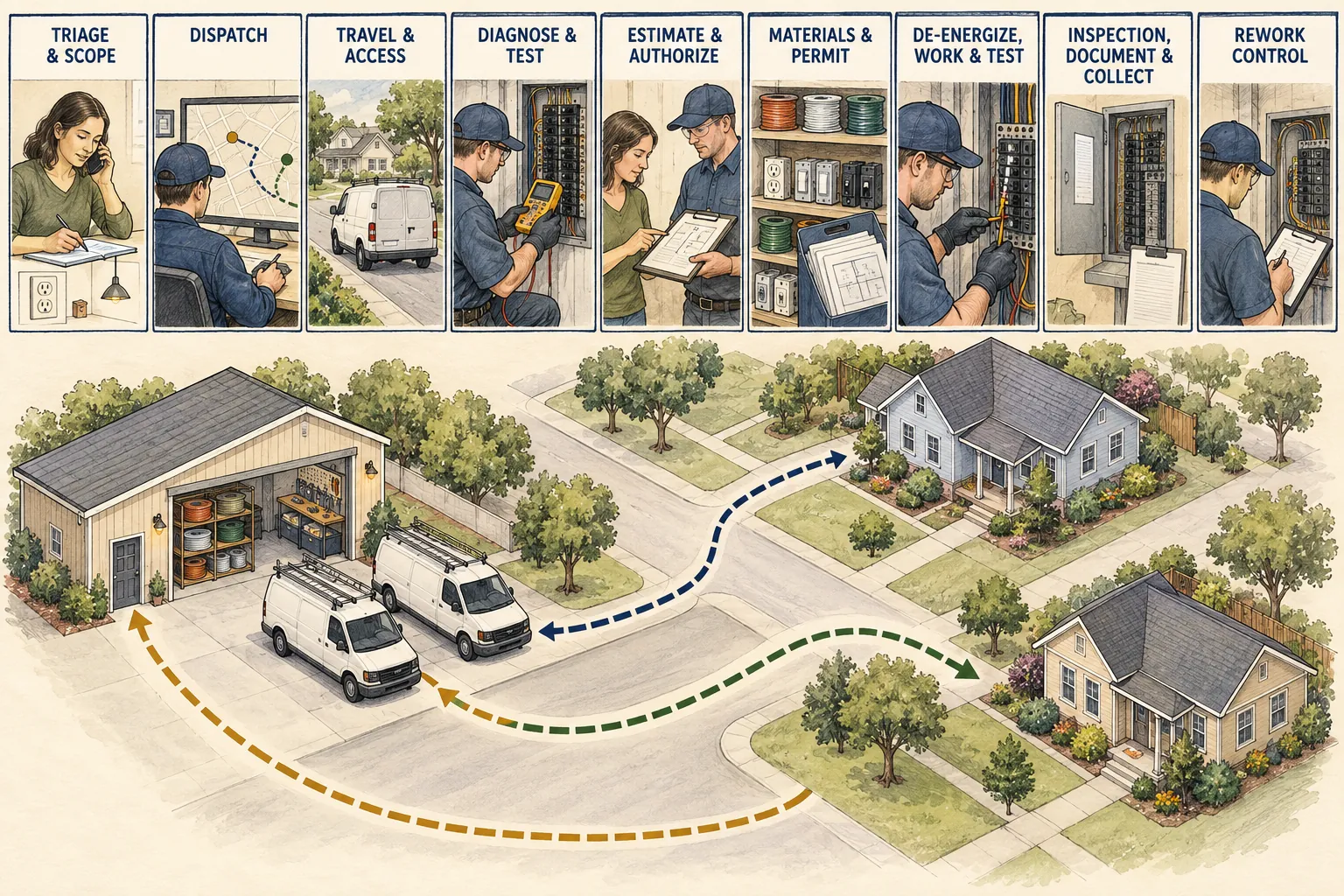
Qualify scope before dispatch
Record the address, property type, symptom, urgency, service boundary, likely code, permit or inspection trigger, energized-work condition, paint-disturbance risk, required credential, promised window, and information the customer must provide.
Protect travel and diagnosis time
Assign one electrician and one vehicle, route the stop, record arrival, diagnosis, photos or measurements, and the time required to define an authorized scope. Do not convert uncertain diagnosis into promised productive hours.
Release work only after authorization and readiness
Confirm price basis, customer authorization, conductor, device and breaker compatibility, tool and test equipment, permit, inspection, de-energization or access dependency, and safe work conditions before committing the completion window.
Close the job with evidence
Record installed or repaired scope, materials, paid and sold hours, permit and inspection status, required test and quality checks, panel or circuit documentation, customer handoff, invoice, collection, warranty terms, and follow-up.
Return rework to the original ledger
Reserve travel, diagnosis, field work, parts, supplier recovery, refund, documentation, and customer recovery against the original job. A rework reduces future sellable capacity and is not new demand.
The reference schedule uses 300.16 field hours at 112 completed jobs
The authored schedule keeps two full-time paid electricians, two vehicles, 112 completed jobs, planned non-job time and no-charge rework. It is a capacity scenario; travel, supplier, permit, access and documentation time remain direct records for the selected service territory.
| Input or result | Basis | Reference |
|---|---|---|
| Paid field-electrician hours | Assumed scheduling input | 346.67 per month |
| Full work-order field hours | Assumed scheduling input | 2.35 per completed job |
| Planned training, stocking, calibration, and meetings | Assumed scheduling input | 28.00 hours per month |
| No-charge rework rate | Assumed scheduling input | 4.0% of completed jobs |
| Field hours per rework | Assumed scheduling input | 2.00 hours |
| 112-job base | Calculated from the disclosed reference inputs | 263.20 work-order hours + 8.96 rework hours + 28.00 planned hours = 300.16 hours |
| 131-job ceiling | Calculated from the disclosed reference inputs | 307.85 work-order hours + 10.48 rework hours + 28.00 planned hours = 346.33 hours |
| Base schedule headroom | Calculated from the disclosed reference inputs | 46.51 paid field hours before unmodeled delay |
What this changes: The entered base plan fits inside 346.67 paid field hours, but its headroom is conditional on the full work-order and rework allowances. Actual route, access, material and permit records can reduce the 131-job management ceiling.
Complete your decision record
A dispatch-readiness record, complete field-hour schedule, vehicle and material plan, permit and authorization checkpoints, rework ledger, released-capacity decision and the next territory, scope, staffing, vehicle or promise-window test. Enter the finding or number, the source and the next action for each row. “Supported” records your assessment of that item; it does not approve the business or certify completed research.
| Item and what to record | Your finding and evidence | Status and next action |
|---|---|---|
| Intake and triageAddress, property, symptom, urgency, scope boundary, permit or inspection flag, access, promise window | ||
| Dispatch and travelAssigned electrician and vehicle, route, departure, arrival, travel, parking, customer access | ||
| Diagnosis and authorizationFinding, evidence, estimate, exclusions, authorization, change authorization | ||
| Readiness and workMaterials, supplier stop, compatible equipment, tool and tester, permit, inspection, de-energization, productive field time, test, labeling, cleanup | ||
| Closure and recoveryDocumentation, invoice, collection, warranty, rework, parts credit, refund, customer outcome |
5 items have no evidence recorded yet.
Entries are temporary and are not sent to us or saved automatically. Download your completed work before leaving or refreshing this page.
Choose your next action
| If your finding is… | Your next action |
|---|---|
| A promise window lacks a required input | Keep the work in the correct readiness state until authority, access, authorization, electrician, vehicle, material, permit and tools align. |
| The board overlaps an electrician, vehicle or required tool | Move, decline or rescope work before promising the slot; do not count the overlap as deliverable capacity. |
| Rework exceeds the protected recovery window | Reduce new-work promises and correct the supported intake, diagnosis, material, installation, testing, documentation or handoff cause. |
Errors that can change the result
- Treating every booked window as a deliverable job before scope, authority, materials, and access are known.
- Planning only productive tool time and omitting travel, diagnosis, authorization, supplier stops, permits, documentation, and cleanup.
- Assigning one electrician, vehicle, tool, or required credential to overlapping jobs.
- Letting rework enter a separate calendar without consuming the original job's margin and future capacity.
- Using the 131-job ceiling as demand evidence or a universal productivity benchmark.
Apply this to your business
These operating formats match the decisions in this guide.
Electrical Contractor
Small residential electrical service and alteration contractor with two full-time paid field electricians, two service vehicles, paid dispatch coverage, and paid owner-manager and qualifying-electrician replacement-cost coverage
Open the operating guide and state profiles →Carry the work-order clock, scope checks, permit dependencies, rework reserve, and released capacity into the price and funding decision. Values entered here are not automatically transferred to another calculator.
Continue with the next part of your plan
- How many electrical service jobs and sold hours are needed to break even?
Realized revenue and variable cost per completed job, monthly contribution, loaded payroll, three labeled operating results, exact and whole-job break-even thresholds, field-hour capacity, and the signed gap between capacity and each financial boundary.
- How to find the permits and approvals your business actually needs
An approval register with official responses and the next unresolved question.
- How to compare equipment quotes and build the opening budget
A comparable two-quote cost calculation and a supplier commitment record.
- How to build a 13-week cash plan for your first 90 days
A weekly cash schedule, the lowest balance and the extra funding needed to retain your chosen minimum.
Sources and limits
The sources below provide the stated background. The worked examples, calculator defaults and decision exercises are authored teaching material. They do not establish market prices, local demand, legal applicability or completed state research.
- Electrical Contractor reference economics and definitions
The site-authored two-electrician residential service scenario and its disclosed assumptions; it is not observed national or local performance.
- BLS May 2025 Occupational Employment and Wage Estimates
Cross-industry wage anchors for electricians, customer service representatives and first-line construction supervisors. They are not recruiting quotes, owner distributions or complete employer costs.
- SBA: planning a business
Background on costs, demand and break-even.
Source pages checked September 30, 2026. Research and review standards · Report an issue
When you need a longer financial plan
Use a financial model to organize a broader forecast after defining your own operating assumptions. The site’s research, your worksheet entries and any purchased workbook are separate; entries are not transferred automatically.
Continue with the published financial scenario